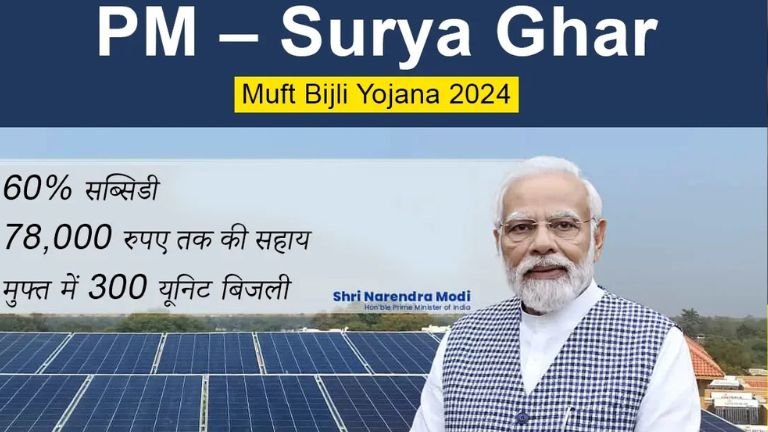
PM Surya Ghar Muft Bijli Yojana 2025: Complete Guide to India’s Rooftop Solar Scheme
India is rapidly moving towards clean and renewable energy, and rooftop solar power is one of the biggest pillars of this transition. To accelerate adoption at the household level, the Government of India launched the PM Surya Ghar: Muft Bijli Yojana, a landmark scheme that provides massive financial support for installing rooftop solar systems in residential homes.
This solar scheme aims to reduce electricity bills to near zero for millions of families while strengthening India’s commitment to sustainable energy. With subsidies of up to ₹78,000 for eligible households, the scheme has become one of the most searched government initiatives in 2025.
This detailed guide explains everything you need to know about the PM Surya Ghar Solar Scheme, including eligibility, subsidy structure, application process, benefits, document requirements, installation process, common mistakes, and future impact.
What is PM Surya Ghar Muft Bijli Yojana?
PM Surya Ghar Muft Bijli Yojana is a central government scheme designed to promote rooftop solar installations on residential homes. The objective is to help households generate their own electricity and reduce dependency on conventional grid power.
Under this scheme:
- Households can install solar panels on their rooftops
- The government provides direct financial subsidy
- Electricity bills can reduce to zero or near zero
- Excess electricity can be exported to the grid under net metering
The scheme is being implemented nationwide through authorized solar vendors and state electricity distribution companies.
Why the Government Launched This Solar Scheme
India is one of the fastest-growing energy consumers in the world. With rising electricity demand, fossil fuel dependence, and climate change concerns, rooftop solar adoption offers a powerful solution.
Key objectives of the scheme include:
- Reducing electricity costs for middle and lower-income families
- Promoting renewable energy at the grassroots level
- Reducing carbon emissions
- Lowering dependency on imported fossil fuels
- Strengthening energy self-sufficiency for households
Key Features of PM Surya Ghar Solar Yojana
- Direct subsidy up to ₹78,000
- Applicable for residential homes only
- Online application through a centralized portal
- Installation only through government-approved vendors
- Net metering facility to sell excess power
- Direct benefit transfer of subsidy to bank account
- Long system lifespan of 20–25 years
Rooftop Solar Subsidy Structure Explained
The subsidy depends on the capacity of the solar system installed:
| Solar Capacity | Subsidy Amount |
|---|---|
| Up to 1 kW | ₹30,000 |
| 2 kW | ₹60,000 |
| 3 kW and Above | ₹78,000 (Maximum) |
This subsidy significantly reduces the upfront investment, making solar power affordable for ordinary households.
Who is Eligible for the Solar Scheme?
To apply for PM Surya Ghar Yojana, the applicant must fulfill the following conditions:
- Must be an Indian citizen
- Should own a residential house
- Must have a valid electricity connection
- The electricity connection should be in the applicant’s name
- The rooftop must be suitable for solar installation
- Household should not have previously availed solar subsidy
Both urban and rural households are eligible to apply.
Documents Required for Solar Scheme Application
Applicants must keep the following documents ready:
- Aadhaar card
- Electricity bill
- Proof of house ownership
- Bank account details
- Passport-size photograph
- Mobile number linked with Aadhaar
These documents are used for identity verification, installation approval, and subsidy transfer.
Step-by-Step Process to Apply for Rooftop Solar Scheme
The application process is fully online and simple:
Step 1: Registration
Visit the official solar rooftop portal and register using:
- State
- Electricity distribution company
- Consumer number
- Mobile number
Step 2: Application Submission
Fill in personal details and choose the required solar capacity.
Step 3: Feasibility Approval
The DISCOM verifies rooftop feasibility and approves the application.
Step 4: Installation by Approved Vendor
After approval, select a government-registered vendor who installs the solar system.
Step 5: Net Meter Installation
The electricity department installs a net meter to record energy import and export.
Step 6: Subsidy Transfer
After system inspection and approval, the subsidy amount is directly transferred to the applicant’s bank account.
What is Net Metering and Why It Matters
Net metering allows households to export extra electricity generated by their solar panels into the power grid.
- If you generate more power than you consume, surplus units are sent to the grid
- These units are adjusted in your electricity bill
- This reduces your bill further and maximizes solar benefits
Net metering converts your rooftop into an income-generating energy source.
Cost of Rooftop Solar System After Subsidy
Approximate costs after subsidy:
| Capacity | Market Cost | Subsidy | Final Cost |
|---|---|---|---|
| 1 kW | ₹70,000 | ₹30,000 | ₹40,000 |
| 2 kW | ₹1.40 Lakh | ₹60,000 | ₹80,000 |
| 3 kW | ₹2.10 Lakh | ₹78,000 | ₹1.32 Lakh |
The investment is usually recovered within 4 to 5 years through electricity savings.
How Much Electricity Can You Generate?
On average, 1 kW solar system generates:
- Around 4 to 5 units per day
- About 120 to 150 units per month
A 3 kW system can generate up to 450 units per month, which is sufficient for most middle-class households.
Financial Benefits of the Solar Scheme
- Electricity bills reduced up to 90–100 percent
- Protection from future power tariff hikes
- High return on investment
- Increased property value
- Long-term financial security
Once the initial cost is recovered, electricity becomes virtually free for the next 15 to 20 years.
Environmental Benefits of Rooftop Solar
- Reduces carbon emissions
- Lowers dependence on coal-based power
- Improves air quality
- Supports India’s climate goals
- Promotes sustainable living
A single household solar system can reduce several tons of carbon emissions over its lifetime.
Installation Time and Process
- Approval process takes around 15–30 days
- Installation takes 2–5 working days
- Net meter installation may take 7–10 days
- Total time from application to live system is usually 30–45 days
Maintenance and Warranty
Solar systems are low maintenance:
- Only basic cleaning of panels is required every few months
- Inverter warranty usually 5–10 years
- Solar panel performance warranty is up to 25 years
Most vendors offer annual maintenance packages.
Common Mistakes to Avoid While Applying
- Applying through unregistered vendors
- Not checking rooftop shadow and structure strength
- Entering incorrect bank details
- Ignoring net metering procedure
- Installing oversized systems without proper load calculation
Following the official process ensures smooth subsidy approval.
Is the Solar Scheme Safe and Legit?
Yes. PM Surya Ghar Yojana is one of the verified and government-authorized renewable energy schemes. Subsidy is transferred directly to the applicant’s verified bank account only after physical inspection of the installed system.
Impact of PM Surya Ghar Yojana on India’s Energy Sector
The scheme is expected to:
- Install rooftop solar in over 1 crore homes
- Generate over 30 GW of clean energy
- Create thousands of green jobs
- Reduce national electricity burden
- Support India’s net-zero emissions target
This is one of the largest residential solar programs globally.
Future Expansion of the Solar Scheme
The government may expand the scheme in future with:
- Increased subsidy limits
- Battery storage support
- Special incentives for rural areas
- Solar loans with low interest
- Integration with smart grids
Frequently Asked Questions
Is the solar subsidy available for apartments?
Individual flat owners can apply if separate rooftop access and electricity connection exist.
Can I take a loan for solar installation?
Yes, many banks and NBFCs offer solar loans at low interest rates.
Will solar work during cloudy days?
Yes, solar systems generate power even in low sunlight but at reduced capacity.
Is subsidy available for battery backup?
Currently, subsidy is mainly for grid-connected systems without batteries.
PmSolar.apply.link
The PM Surya Ghar Muft Bijli Yojana is not just a subsidy scheme but a nationwide mission towards energy independence and environmental responsibility. With rising electricity costs and growing climate concerns, rooftop solar offers a smart, secure, and sustainable solution for Indian households.
With subsidies up to ₹78,000, simple online application, low maintenance, and long-term savings, this scheme is one of the most financially beneficial government initiatives available today.
If you are planning to reduce your electricity bills permanently and contribute to a greener India, rooftop solar under this scheme is a powerful step forward.