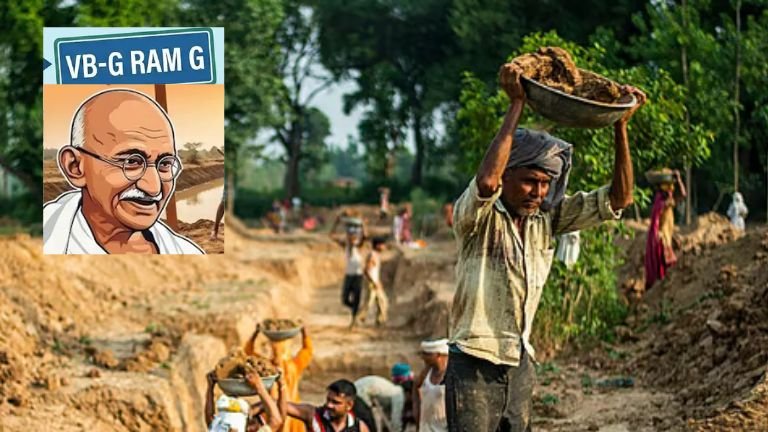
New ‘G RAM G’ bill introduced to replace MGNREGA: 125 days of work guaranteed for rural people?
The Mahatma Gandhi National Rural Employment Guarantee Act (MGNREGA), which has been a lifeline for the rural poor for the past 20 years, is about to change. The Union Government has introduced the ‘Vikasita Bharat Guarantee for Employment and Livelihood Mission (Gramin)’ or VB-G RAM G Bill-2025 in the Lok Sabha.
So what is in this new bill compared to the old plan? Will it benefit or harm the common man? Why are the opposition parties opposing it? Here is the complete information.
Let’s first understand: What is the Current MGNREGA? (Context: What is the Current MGNREGA?)
Before we get to know about the new bill, it is important to have clarity about the scheme that has been prevalent in our villages for so many years. The ‘Mahatma Gandhi National Rural Employment Guarantee Act’ (MGNREGA) is a revolutionary scheme that has been implemented with the aim of increasing the livelihood security of the people of rural India. It aims to provide at least 100 days of guaranteed wage employment to every rural family in the country in a financial year. Under this scheme, any adult member who is willing to do unskilled work that requires physical labor can apply for a job in their gram panchayat. Its main objectives are to eradicate poverty in villages, prevent migration and develop rural infrastructure.
What is the New Bill?
Now Union Rural Development Minister Shivraj Singh Chouhan has introduced a new bill in the Lok Sabha. Its main objective is to repeal the old MGNREGA Act of 2005 explained above and implement the ‘VB-G RAM G’ (Viksit Bharat Guarantee for Rozgar and Ajeevika Mission) Act with new rules.
Key Features & Changes
According to official government documents, the key elements of the new bill are as follows:
- 125 days employment guarantee: Currently, 100 days of work is being provided annually under MGNREGA. According to the new bill, this will be increased to 125 days .
- Nature of Work: Emphasis will be placed on asset creation, not just button removal. There will be 4 main categories:
- Water Security
- Rural Infrastructure
- Livelihood-related infrastructure
- Works to prevent extreme weather events
- No disruption to agricultural work: To ensure that farmers do not face a shortage of labor during harvest or sowing, state governments will have the power to suspend work under this scheme for a maximum of 60 days in a year.
MGNREGA vs New Bill: Key Differences (Comparison Table)
The difference between the old scheme and the new bill can be easily understood in the following table:
| Features | Old scheme (MGNREGA) | New Bill (VB-G RAM G) |
|---|---|---|
| Working days | 100 days | 125 days |
| Salary subsidy | 100% Central Government | 60% Centre : 40% State (Proposed) |
| Harvest Break | There is no specific rule. | Work stoppage allowed for 60 days |
| Nature of the project | Rights-based | Mission Mode |
Who will benefit the most from this project?
The government has stated that the new bill, if implemented, will directly benefit the following categories of rural people:
- Rural wage laborers: By getting an additional 25 days of work per year, the annual income of each family will increase.
- Farming Community: By temporarily stopping the work of this project during the harvest and sowing season, farmers will be able to easily get hired laborers for agricultural activities.
- Gram Panchayats: Instead of just doing earthworks, the infrastructure of villages will be developed by building ‘permanent assets’ like roads, lakes, and canals.
- Women: Like MGNREGA, women will continue to be given priority in this scheme, and they will be provided with employment close to home.
Why is there controversy and opposition? (Why is there Opposition?)
The opposition parties have expressed strong objections to this bill since it was introduced. The main reasons are as follows:
- Dropping of Mahatma Gandhi’s name: Many parties, including the Congress, are expressing opposition to the removal of the name ‘Mahatma Gandhi’ from the old plan.
- Funding Split: In the old MGNREGA scheme, the entire (100%) cost of salaries was borne by the central government. But under the new bill, it is reported that the cost will be shared between the central and state governments in the ratio of 60:40 (i.e. 60% central, 40% state). The opposition parties argue that this will put a financial burden on the states.
Government’s Stance
Statement by Minister Shivraj Singh Chouhan:
“We follow the principles of Mahatma Gandhi. This new bill aims to make rural India a ‘developed India’. The poor will get more days of work (125 days) and digital technology will be used to curb corruption.”
Final Takeaway
For now, it is just a ‘Bill’ and not yet an Act. It will come into effect only after it is approved by the Lok Sabha and Rajya Sabha. Till then, the old MGNREGA rules will continue.
Verified Sources:
– Lok Sabha Proceedings (Dec 17, 2025)
– Press Information Bureau (PIB) Releases
– Ministry of Rural Development Statements