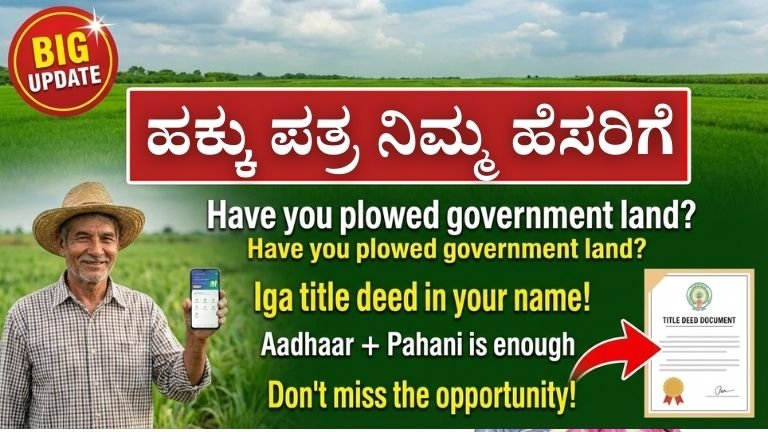
How to Apply for Land Rights (Hakku Patra) If You Are Cultivating Government Land in Karnataka L 6
If you or your family have been cultivating government land for many years in Karnataka, you may be eligible to obtain legal ownership through a Hakku Patra (Land Grant Certificate). Many farmers are unaware that long-term cultivation of certain categories of government land can be regularized under Karnataka land laws, subject to eligibility and verification.
This comprehensive guide explains:
- What is Hakku Patra
- Legal background in Karnataka
- Who is eligible
- Required documents (including Aadhaar and Pahani)
- Step-by-step application process
- Online and offline procedure
- Role of Revenue Department
- Common rejection reasons
- Legal risks and precautions
- FAQs
This article is written in detailed, SEO-optimized format for blog publishing.
What is Hakku Patra?
A Hakku Patra is a legal land ownership certificate issued by the Karnataka Revenue Department granting ownership rights over government land to eligible occupants who have been cultivating or residing on it for years.
Once issued, the land gets transferred in the beneficiary’s name in revenue records.
The process is handled under the Karnataka Revenue framework by the Revenue Department Karnataka.
Legal Background – Karnataka Land Grant Rules
Land regularization for long-term cultivation is governed under provisions of the Karnataka Land Revenue Act and Land Grant Rules. In certain cases, the government allows regularization of unauthorized cultivation of government land if:
- The land is not forest land
- The land is not reserved for public purpose
- The occupant is landless or small farmer
- Cultivation has been continuous for several years
Important: Forest land, gomala land (in many cases), and protected lands cannot be regularized.
Who Can Apply for Hakku Patra?
You may be eligible if:
- You are cultivating government land for many years
- You belong to economically weaker section
- You are landless or marginal farmer
- Your name appears in revenue records (RTC / Pahani)
- There is no legal dispute on the land
Continuous cultivation proof is important.
Important Documents Required
Before applying, keep these documents ready:
1. Aadhaar Card
Must match your current address.
2. Pahani / RTC Extract
Land record document showing cultivation details.
You can download RTC from Bhoomi Karnataka official portal.
3. Identity Proof
Voter ID / Ration Card.
4. Income Certificate
Issued by Tahsildar.
5. Caste Certificate (if applicable)
6. Cultivation Proof
- Electricity bill (if pump set used)
- Crop loan records
- Crop insurance details
- Witness statements from neighbors
How Many Years of Cultivation Required?
There is no fixed universal number mentioned publicly because eligibility depends on government notification and case review.
However, generally:
- Continuous cultivation for several years
- No eviction notice issued
- No encroachment after cutoff date
Always verify current cutoff year in local Tahsildar office.
Step-by-Step Application Process (Offline)
Land regularization is usually processed offline through Revenue authorities.
Step 1: Visit Village Accountant Office
Meet the Village Accountant (VA) and inform about:
- Land survey number
- Extent of land
- Years of cultivation
VA will verify field details.
Step 2: Submit Application to Tahsildar
Prepare written application including:
- Your name
- Survey number
- Extent of land
- Duration of cultivation
- Request for regularization
Attach all required documents.
Submit to the Tahsildar office under jurisdiction.
Step 3: Field Inspection
Revenue Inspector will conduct:
- Physical inspection
- Boundary verification
- Crop verification
- Check encroachment status
They will submit report to Tahsildar.
Step 4: Verification by Committee
In many cases, a Land Grant Committee reviews:
- Applicant eligibility
- Economic status
- Land category
- Objections (if any)
Public notice may be issued inviting objections.
Step 5: Approval and Hakku Patra Issuance
If approved:
- Order passed by competent authority
- Land mutated in your name
- RTC updated
- Hakku Patra certificate issued
Is Online Application Available?
Currently, full online application for land regularization is not completely automated.
However:
- RTC download is online
- Mutation status can be checked online
- Land records available digitally
For services, use:
Seva Sindhu portal for related certificates.
How to Check Land Record (RTC) Online
- Visit Bhoomi Karnataka portal
- Enter district
- Enter taluk
- Enter survey number
- Download RTC
Ensure your name appears under cultivator column if possible.
Important Legal Caution
Not all government land can be regularized.
You cannot apply if land is:
- Forest land
- Lake buffer zone
- Reserved government land
- Land acquired for public purpose
- Road or irrigation project land
False claim may lead to eviction and penalty.
Common Reasons for Rejection
- Cultivation after cutoff date
- Encroachment for commercial use
- Disputed ownership
- Fake documents
- Land reserved category
Always verify eligibility before applying.
What Happens After Approval?
After Hakku Patra issuance:
- You become legal owner
- You can apply for crop loans
- You can get land conversion permission
- You can use land as collateral
- You can inherit or transfer legally
However, some restrictions may apply initially.
Can You Sell Immediately?
In many government grant cases:
- Sale restriction for certain years
- Cannot sell immediately
- Must use land for agriculture
Violation may lead to cancellation.
Role of Gram Panchayat
Gram Panchayat may:
- Issue local verification letter
- Confirm cultivation status
- Provide recommendation
But final authority lies with Revenue Department.
Frequently Asked Questions
Is Aadhaar mandatory?
Yes, identity verification is mandatory.
Is Pahani mandatory?
Yes, land record proof is important.
Can tenant apply?
Usually long-term cultivator can apply, but rules vary.
Is fee required?
Application fee may apply as per government notification.
Future Digital Reforms Expected
Government may introduce:
- Online land regularization tracking
- Digital field survey mapping
- GIS-based verification
- Online objection system
Digital land reforms are gradually expanding in Karnataka.
If you are cultivating government land for many years in Karnataka, you may be eligible for Hakku Patra under land grant rules.
Key requirements:
- Long-term cultivation
- Aadhaar
- RTC / Pahani
- Income proof
- Field verification
Application is primarily offline through Tahsildar office.
Before applying:
- Confirm land category
- Verify eligibility
- Collect genuine proof
- Avoid middlemen
Land regularization is a legal process and subject to strict verification.
Government Land Cultivation Regularization in Karnataka – Advanced Legal & Practical Guide (Hakku Patra Process Explained in Detail – 2026)
If you have been cultivating government land for many years in Karnataka and are seeking legal ownership (Hakku Patra), this extended guide provides deeper legal clarity, procedural understanding, risk analysis, and administrative insight.
This version includes:
- Legal framework under Karnataka Land Revenue Act
- Types of government land eligible and not eligible
- Cut-off dates and their importance
- Role of revenue hierarchy
- Survey and demarcation process
- Mutation after grant
- Restrictions after land grant
- Court remedies if rejected
- Practical ground-level strategy
The process is governed by the Revenue Department Karnataka under the Karnataka Land Revenue Act and related Land Grant Rules.
Understanding the Legal Nature of Government Land
Before applying, it is important to understand what type of land you are cultivating.
Government land in Karnataka is classified into multiple categories:
1. Sarkari Bane / Government Waste Land
Often eligible for regularization if cultivated long-term.
2. Gomala Land
Primarily reserved for grazing. Regularization is very restricted.
3. Forest Land
Cannot be regularized under normal land grant rules. Governed by Forest Act.
4. Tank Bed / Lake Area
Strictly prohibited for regularization.
5. Land Reserved for Public Purpose
Road, school, hospital, irrigation – not eligible.
Regularization is possible only when land is not reserved or protected.
Importance of Cut-Off Date
Many land regularization schemes depend on a government-notified cut-off date.
For example:
- If cultivation started before a specific year
- If encroachment occurred after cutoff → not eligible
- Government may pass one-time regularization orders
You must verify current applicable cutoff through local Tahsildar office.
Proof of Long-Term Cultivation – Strong Evidence Strategy
Revenue authorities require proof. Strong documentation improves approval chances.
Strong Evidence Includes:
✔ Old RTC entries showing cultivator name
✔ Crop loan records from bank
✔ Crop insurance enrollment
✔ Electricity connection for borewell
✔ Photographs over years
✔ Neighbor witness statements
✔ Gram Panchayat certification
The more documentary continuity you show, the stronger your case.
You can check RTC through Bhoomi Karnataka portal.
Detailed Revenue Approval Hierarchy
The approval process usually moves through these levels:
- Village Accountant (VA) – Field verification
- Revenue Inspector (RI) – Site inspection
- Tahsildar – Preliminary decision
- Assistant Commissioner – Review (in some cases)
- Deputy Commissioner – Final authority (for larger extent land)
In sensitive cases, district-level Land Grant Committee may examine.
Field Survey & Measurement Process
After application:
- Survey department measures land extent
- Boundary stones placed
- GPS mapping may be done
- Neighbors called for boundary confirmation
Disputes during measurement can delay approval.
Public Objection Procedure
In many regularization cases:
- Public notice is issued
- Neighbors can raise objection
- If objection filed → hearing conducted
If no objection → process moves forward faster.
Economic Eligibility
Land grant often prioritizes:
- Landless farmers
- Scheduled Caste / Scheduled Tribe
- Economically weaker sections
- Marginal farmers
If you already own large agricultural land elsewhere, approval may be denied.
Area Limit Restrictions
Government usually restricts maximum land extent that can be granted.
For example:
- 2 to 4 acres (varies by district & scheme)
- Dry land vs irrigated land limits differ
Excess occupation may not be regularized.
After Hakku Patra – What Happens?
Once approved:
- Mutation entry done in your name
- RTC updated
- Land category changed from Government to Granted Land
- You become lawful holder
But certain restrictions apply.
Sale Restriction Period
Most granted lands come with:
- 10 to 15 year non-sale clause
- Cannot sell without government permission
- Must use for agricultural purpose
Violation may result in cancellation.
Can Bank Loan Be Taken?
Yes, after grant and mutation:
- You can apply for crop loan
- Kisan Credit Card
- Agricultural subsidy schemes
- Irrigation subsidy
However, during restriction period, mortgage rules vary.
What If Application Is Rejected?
If rejected:
Step 1: Obtain written rejection order
Step 2: File appeal before Assistant Commissioner
Step 3: If still rejected, approach Deputy Commissioner
Step 4: As last remedy, file case in Karnataka High Court
Legal consultation recommended for appeals.
Risks of Applying Without Eligibility
If found ineligible:
- Eviction notice may be issued
- Fine may be imposed
- Criminal trespass case possible
- Crop removal order
Always confirm land category before applying.
Role of Seva Sindhu Portal
While full regularization application may not be fully digital, you can:
- Download income certificate
- Track mutation status
- Apply for caste certificate
- Check service status
Digital integration is gradually increasing.
Timeline – How Long Does It Take?
Typical processing time:
- 6 months to 2 years
Depends on: - Land dispute
- Political approval
- Survey delay
- Objections
There is no fixed guaranteed time.
Political & Policy Impact
Land regularization often depends on:
- State government policy
- Cabinet approval
- Special amnesty schemes
Whenever government announces special regularization drive, approval chances increase.
Practical Ground Strategy (Important)
If you are genuinely cultivating:
- Keep land clean and actively cultivated
- Maintain crop records yearly
- Maintain electricity bills
- Maintain tax receipts (if applicable)
- Avoid constructing permanent commercial structures
- Avoid disputes with neighbors
Good local reputation improves verification reports.
Frequently Asked Advanced Questions
Can tenant apply?
Usually long-term cultivator in possession may apply, but rules vary.
Can I regularize if land is forest land?
No, forest land falls under Forest Conservation Act.
Is political recommendation required?
Not officially, but documentation strength matters more.
Is Aadhaar compulsory?
Yes, identity proof mandatory.
Important Warning
Do not pay middlemen claiming:
“Guaranteed Hakku Patra in 30 days”
“Pay ₹2 lakh and get land in your name”
Revenue process is official and document-based.
Click Hear to Apply
If you are cultivating government land in Karnataka:
✔ Confirm land category
✔ Confirm eligibility under land grant rules
✔ Collect strong cultivation proof
✔ Apply through Tahsildar
✔ Follow up regularly
✔ Avoid illegal expansion
Hakku Patra is possible but subject to strict legal scrutiny.
This is not automatic ownership — it is a government-approved regularization process.