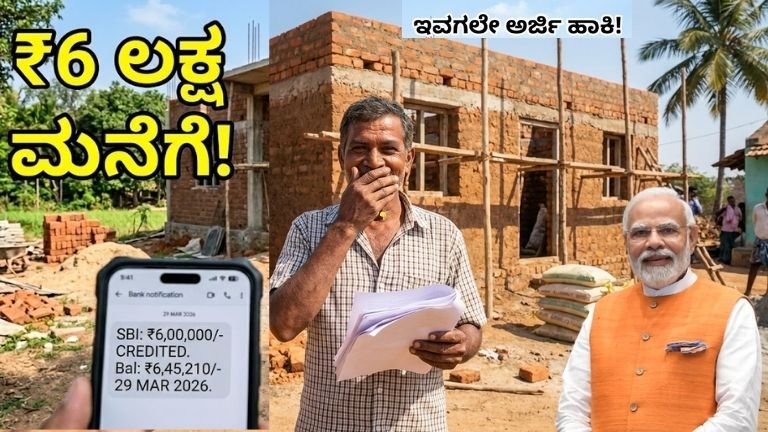
Building a home in India is a monumental milestone, and in 2026, the dream of “Housing for All” has become more accessible than ever. With the evolution of the Pradhan Mantri Awas Yojana (PMAY) Urban 2.0 and updated rural housing frameworks, eligible citizens can secure financial assistance of up to ₹6 Lakh through a combination of direct subsidies and interest subventions.
This guide provides a comprehensive roadmap to navigating the 2026 housing finance landscape in India.
Understanding the ₹6 Lakh Breakdown
It is important to clarify that “₹6 Lakh” usually refers to the maximum loan amount eligible for an interest subsidy, though in some specific state-rural combinations, the total benefit (subsidy + low-interest loan) can reach this valuation.
The Two Main Paths:
-
PMAY-Urban 2.0 (Credit Linked Subsidy Scheme): You get a massive discount on your home loan interest for the first ₹6 Lakh of your principal.
-
PMAY-Gramin (Rural): A combination of direct cash transfers (approx. ₹1.2–₹1.3 Lakh) and access to institutional loans (up to ₹2 Lakh) at subsidized rates.
PMAY-Urban 2.0: The Interest Subsidy Route
In 2026, the Interest Subsidy Scheme (ISS) remains the flagship for urban dwellers. If you take a home loan to build a house, the government pays a large chunk of your interest directly to the bank.
Eligibility Categories (2026 Updated)
| Category | Annual Income Limit | Max Subsidy Benefit |
| EWS (Economically Weaker) | Up to ₹3 Lakh | ~₹2.67 Lakh |
| LIG (Lower Income Group) | ₹3 Lakh – ₹6 Lakh | ~₹2.67 Lakh |
| MIG (Middle Income Group) | ₹6 Lakh – ₹9 Lakh | ~₹2.30 Lakh |
How the “₹6 Lakh” Works
For EWS and LIG categories, the government provides an interest subsidy of 6.5% on a loan amount up to ₹6 Lakh. Even if your total loan is ₹15 Lakh, the subsidy applies to the first ₹6 Lakh, significantly reducing your monthly EMI.
Step-by-Step Guide to Applying in 2026
Step 1: Check Your “Pucca House” Status
The primary rule of PMAY is that the beneficiary family (husband, wife, and unmarried children) must not own a pucca house anywhere in India.
Step 2: Documentation (The 2026 Checklist)
To claim the ₹6 Lakh benefit, you need:
-
Aadhaar Card: Mandatory for all family members.
-
Income Proof: Salary slips, Form 16, or a certificate from the Tehsildar (for self-employed).
-
Property Documents: Approved building plan and land ownership documents (Sale Deed/Patta).
-
Affidavit: A self-declaration stating you do not own a pucca house.
-
Bank Account: Linked to Aadhaar for DBT (Direct Benefit Transfer).
Step 3: Choose Your Application Mode
-
Online: Visit the official PMAY-MIS portal. Use the “Citizen Assessment” section and select “Benefit under 3 components.”
-
Offline: Visit a Common Service Centre (CSC) or a bank listed as a Primary Lending Institution (PLI) like SBI, HDFC, or ICICI.
Beneficiary-Led Construction (BLC)
If you already own a piece of land and want to build a new house, the BLC component is your best friend. In many states, the government provides a direct grant of ₹2.5 Lakh for construction, which is released in installments based on the progress of the building (Foundation -> Lintel -> Roof).
Tips for Faster Approval
-
Woman Ownership: In 2026, many states mandate that the house must be owned or co-owned by a female head of the household to qualify for the EWS/LIG subsidy.
-
Carpet Area Limits: Ensure your building plan stays within the allowed limits (typically 60 sq. mt. for LIG and up to 200 sq. mt. for MIG) to remain eligible for the subsidy.
-
Geotagging: Be ready for government officials to visit your site. They will take “geotagged” photos of the vacant land before and during construction to release funds.
Common Pitfalls to Avoid
-
Existing Loans: You cannot claim this subsidy if you have already availed of a central housing scheme benefit.
-
Delayed Filing: Apply before you finish construction. The subsidy is meant for the building phase, not for a completed house.
-
Middlemen: Never pay anyone to “get your name on the list.” The PMAY process is transparent and digital. Check your status only on the official
pmaymis.gov.in(Urban) orpmayg.nic.in(Rural) portals.Building a home in India is a monumental task that requires careful financial planning, legal navigation, and an understanding of government subsidies. In 2026, the landscape of affordable housing has been revolutionized by PMAY-Urban 2.0 and updated rural housing frameworks.
The Ultimate Guide: How to Get ₹6 Lakh for New House Building in India (2026 Edition)
Table of Contents
-
Introduction: The Shift in Indian Housing (2026)
-
The ₹6 Lakh Benefit Breakdown: Subsidy vs. Grant
-
PMAY-Urban 2.0: The Interest Subvention Scheme
-
PMAY-Gramin: The Rural Housing Revolution
-
Eligibility Criteria: Who Qualifies in 2026?
-
The Step-by-Step Application Process (Digital & Offline)
-
Document Checklist: Avoiding Rejections
-
State-Specific Top-Up Schemes (Adding to the ₹6 Lakh)
-
Technical Guidelines: Carpet Area and Geotagging
-
Common Pitfalls and How to Avoid Them
-
Conclusion: Your Path to Home Ownership
Introduction: The Shift in Indian Housing (2026)
By 2026, the Government of India has transitioned into the second phase of “Housing for All.” The focus has shifted from mere quantity to Quality, Sustainability, and Digital Transparency. With the launch of PMAY-U 2.0, the government has expanded the income slabs and increased the subsidy amounts to keep pace with inflation and rising construction material costs (cement, steel, and labor). Getting ₹6 Lakh for your house isn’t about receiving a single briefcase of cash; it’s a strategic combination of Interest Subvention (CLSS) and Direct Benefit Transfers (DBT).
The ₹6 Lakh Benefit Breakdown: Subsidy vs. Grant
Understanding how the “₹6 Lakh” figure is reached is crucial. In 2026, the benefit is categorized into two main streams:
A. The Interest Subsidy (CLSS)
For urban areas, the government provides a subsidy on the interest rate of your home loan. If you take a loan for house construction, the government pays a significant portion of the interest for the first ₹6,00,000 of your principal. Over a 20-year tenure, this “subsidy” equates to a savings of roughly ₹2.30 Lakh to ₹2.67 Lakh in upfront value.
B. The Direct Grant (BLC)
Under the Beneficiary-Led Construction (BLC) component, if you own land in an urban area and belong to the EWS (Economically Weaker Section) category, you receive a direct grant. Combined with state-level top-ups (like those in Uttar Pradesh, Madhya Pradesh, or Andhra Pradesh), the total direct assistance can reach ₹5 Lakh to ₹6 Lakh in certain jurisdictions.
PMAY-Urban 2.0: The Interest Subvention Scheme
In 2026, the Credit Linked Subsidy Scheme (CLSS) remains the most popular way to get the ₹6 Lakh benefit.
How it works:
When you apply for a “Construction Loan” from a bank, the bank checks your PMAY eligibility. If eligible, the National Housing Bank (NHB) or HUDCO calculates the “Net Present Value” (NPV) of the interest subsidy and credits it directly to your loan account.
Example:
-
Total Loan: ₹15,00,000
-
Subsidy-eligible amount: ₹6,00,000
-
Interest Rate: 9%
-
Subsidy Rate: 6.5%
-
Result: Your effective interest on the first ₹6 Lakh is only 2.5%. This saves you lakhs in EMIs over the years.
PMAY-Gramin: The Rural Housing Revolution
If you are building in a village, the process is different. In 2026, the PMAY-G (Gramin) provides:
-
Direct Cash: ₹1.20 Lakh (Plains) to ₹1.30 Lakh (Hilly/Difficult areas).
-
Labor Wages: Approximately ₹20,000–₹25,000 under MGNREGA for 90–95 days of labor.
-
Toilet Grant: ₹12,000 under the Swachh Bharat Mission.
-
Institutional Loan: Access to a subsidized loan of up to ₹2 Lakh at a 3% lower interest rate.
While the “direct cash” is lower than ₹6 Lakh, the total ecosystem support (subsidized loan + labor + toilet + LPG connection) brings the total economic value of the benefit close to the ₹5-6 Lakh mark for rural beneficiaries.
Eligibility Criteria: Who Qualifies in 2026?
To ensure the money reaches the needy, the 2026 guidelines are strict:
-
The “Pucca House” Rule: Neither you nor any member of your immediate family (spouse/unmarried children) should own a pucca house anywhere in India.
-
Income Slabs (Annual):
-
EWS: Up to ₹3 Lakh.
-
LIG: ₹3 Lakh to ₹6 Lakh.
-
MIG: ₹6 Lakh to ₹18 Lakh (split into MIG-I and MIG-II).
-
-
Female Ownership: Preference (and often mandatory status for EWS/LIG) is given to houses where a woman is an owner or co-owner.
-
Aadhaar Linking: Your Aadhaar must be linked to your mobile and bank account for biometric verification.
The Step-by-Step Application Process (Digital & Offline)
In 2026, the process is almost entirely paperless.
Step 1: Online Registration
Visit the official PMAYMIS portal. Select the “Citizen Assessment” link. You will need to enter your Aadhaar number.
Step 2: Selecting the Component
For building on your own land, select “Beneficiary-Led Construction” (BLC). For getting a loan discount, select “Credit Linked Subsidy” (CLSS).
Step 3: Banking Integration
If opting for CLSS, go to your bank (SBI, HDFC, ICICI, or any Rural Bank). Inform them you wish to apply for a Home Construction Loan under PMAY 2026.
Step 4: Verification
The local municipality (ULB) or Gram Panchayat will conduct a field visit. They will verify your land documents and take a photo of the “vacant site.”
Document Checklist: Avoiding Rejections
Missing one document can lead to a “De-duplication” error. Ensure you have:
-
Identity: Aadhaar Card, PAN Card, Voter ID.
-
Land Title: Sale Deed, Patta, or 7/12 Extract showing you are the owner.
-
Income Proof: Salary slips or an Income Certificate issued by the Tahsildar.
-
Building Plan: An approved blueprint from the local municipal authority.
-
Affidavit: A notarized document stating you don’t own other property.
State-Specific Top-Up Schemes
Many states in 2026 offer additional funds over the Central Government’s ₹2.5 Lakh (BLC).
-
Andhra Pradesh/Telangana: Often provide additional ₹1-2 Lakh for construction.
-
Uttar Pradesh: Aggressive implementation of the “Awas Plus” list.
-
Madhya Pradesh: “Mukhyamantri Jan Awas Yojana” adds to the PMAY funds.
Technical Guidelines: Carpet Area and Geotagging
The government won’t give you ₹6 Lakh for a mansion. There are size limits:
-
EWS: 30 sq. mt. (approx. 322 sq. ft.)
-
LIG: 60 sq. mt. (approx. 645 sq. ft.)
Geotagging: The funds are released in stages.
-
Stage 1: Foundation (Geotagged photo required).
-
Stage 2: Lintel Level (Photo required).
-
Stage 3: Roof/Completion (Photo required).
Common Pitfalls and How to Avoid Them
-
Middlemen Scams: No private agent can “get you” the subsidy. It is a direct bank-to-government process.
-
Incomplete Construction: If you take the first installment and don’t build, the government can initiate recovery proceedings.
-
Existing Home Loans: You cannot apply for PMAY on a house you have already finished building.
Conclusion: Your Path to Home Ownership
Securing ₹6 Lakh for your house in 2026 is a matter of eligibility and timing. By combining the PMAY-U 2.0 interest subsidy with state grants and labor benefits, you can effectively reduce your out-of-pocket construction cost by nearly 50%.
Action Plan:
-
Check your Aadhaar details.
-
Get your land title cleared.
-
Visit your nearest Public Sector Bank or Common Service Centre (CSC) today.
Disclaimer: Housing policies are subject to change by the Ministry of Housing and Urban Affairs (MoHUA). Always verify the latest circulars on the official PMAY portal before proceeding.
-
apply Link 1 / PM Awas Yojana
apply Link 2 / Free Housing Scheme
Summary of Benefits
By leveraging PMAY-Urban 2.0, you can effectively reduce the cost of a ₹6 Lakh loan by nearly 40% through interest subvention, making your dream of a permanent home a reality in 2026.