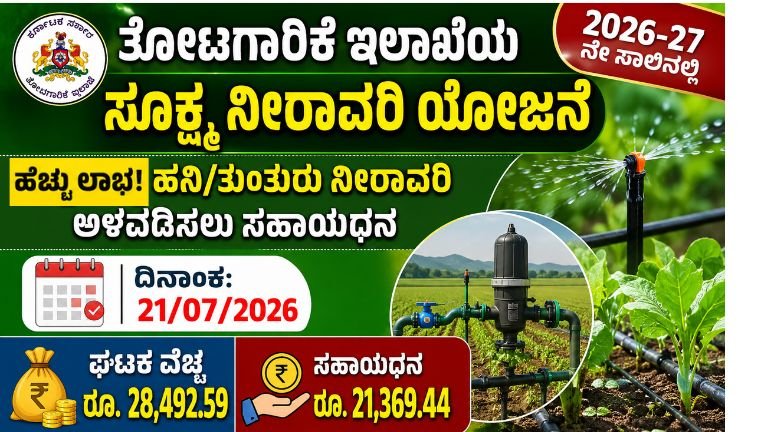
Karnataka Horticulture Department Micro Irrigation Scheme 2026–27 G 14
The Karnataka Horticulture Department has invited applications under the Micro Irrigation Scheme 2026–27 to encourage farmers to adopt modern irrigation methods such as Drip Irrigation and Sprinkler Irrigation. The scheme aims to improve water-use efficiency, reduce cultivation costs, and increase agricultural productivity across the state.
Micro irrigation has become one of the most effective technologies for sustainable farming. With declining groundwater levels and unpredictable rainfall, farmers need efficient irrigation systems that save water while ensuring better crop growth. Through this scheme, eligible farmers can receive government financial assistance to install drip or sprinkler irrigation systems in their agricultural fields.
According to the available notification details, applications are being accepted from 21 July 2026. The notified unit cost is ₹28,492.59. The final subsidy amount will be provided according to the applicable government norms, category of beneficiary, crop, and area covered.
Note: Farmers should verify the latest subsidy amount, eligibility, and application deadlines with their nearest Horticulture Department office before submitting an application.
Scheme Highlights
| Particular | Details |
|---|---|
| Scheme Name | Karnataka Micro Irrigation Scheme 2026–27 |
| Department | Department of Horticulture, Government of Karnataka |
| Financial Year | 2026–27 |
| Irrigation Types | Drip Irrigation & Sprinkler Irrigation |
| Application Start | 21 July 2026 |
| Unit Cost | ₹28,492.59 |
| Beneficiaries | Eligible Farmers |
| Purpose | Water Conservation & Increased Productivity |
What is the Micro Irrigation Scheme?
Micro irrigation is a modern irrigation technique that delivers water directly to the root zone of plants. Unlike traditional flood irrigation, this system supplies water slowly and efficiently, minimizing wastage.
The Karnataka Government promotes this technology to:
- Save irrigation water
- Improve crop productivity
- Reduce labour costs
- Minimize fertilizer wastage
- Encourage sustainable agriculture
- Increase farmers’ income
Objectives of the Scheme
The primary objectives include:
- Promoting efficient use of water resources.
- Supporting farmers facing water shortages.
- Increasing horticulture production.
- Reducing cultivation expenses.
- Improving crop quality.
- Encouraging scientific farming practices.
- Conserving groundwater resources.
- Supporting climate-resilient agriculture.
Types of Irrigation Covered
1. Drip Irrigation
Drip irrigation delivers water directly to plant roots through pipelines and emitters.
Suitable for:
- Mango
- Banana
- Pomegranate
- Coconut
- Arecanut
- Grapes
- Papaya
- Vegetables
- Flowers
- Plantation crops
Benefits
- Saves up to 60% water
- Better fertilizer efficiency
- Healthy crop growth
- Reduced weed growth
- Higher yields
2. Sprinkler Irrigation
Sprinklers distribute water uniformly across the field similar to rainfall.
Suitable for:
- Groundnut
- Maize
- Pulses
- Millets
- Vegetables
- Fodder crops
Benefits
- Uniform irrigation
- Suitable for uneven land
- Saves labour
- Prevents soil erosion
- Easy installation
Benefits of the Scheme
Farmers can enjoy several long-term benefits after installing micro irrigation systems.
Water Conservation
Micro irrigation significantly reduces water wastage compared to conventional irrigation.
Higher Crop Yield
Proper irrigation improves crop health and productivity.
Reduced Labour Cost
Automated irrigation reduces manual work.
Fertigation Support
Fertilizers can be supplied through irrigation pipelines, improving nutrient efficiency.
Better Quality Produce
Uniform irrigation helps produce healthier crops with improved market value.
Increased Farm Income
Higher production and lower costs contribute to better profitability.
Unit Cost and Subsidy
According to the available notification:
- Unit Cost: ₹28,492.59
Government assistance is generally provided under approved norms. The subsidy amount depends on several factors such as:
- Farmer category
- Land holding
- Crop type
- Irrigation system
- Area covered
- Government guidelines
Farmers should contact their local Horticulture Department office for the latest approved subsidy applicable to their case.
Who Can Apply?
Generally, the scheme is intended for eligible farmers in Karnataka.
Applicants are typically expected to:
- Be permanent residents of Karnataka.
- Own or legally cultivate agricultural land.
- Have access to a water source.
- Install an approved irrigation system.
- Follow departmental guidelines.
Required Documents
Applicants may be required to submit the following documents:
- Aadhaar Card
- Farmer ID (if applicable)
- RTC/Land Records
- Recent Passport Size Photograph
- Bank Passbook Copy
- Mobile Number
- Address Proof
- Caste Certificate (if applicable)
- Water Source Details
- Any additional documents requested by the department
How to Apply
The application process generally includes the following steps:
Step 1
Visit the nearest Horticulture Department office or the designated application center.
Step 2
Collect the Micro Irrigation Scheme application form.
Step 3
Fill in:
- Farmer details
- Land information
- Crop details
- Irrigation type
- Bank information
Step 4
Attach all required documents.
Step 5
Submit the completed application.
Step 6
Department officials may verify the land and documents.
Step 7
Eligible applications are processed according to departmental procedures.
Step 8
After approval and installation, financial assistance is released as per applicable rules.
Why Farmers Should Adopt Micro Irrigation
Traditional irrigation wastes a significant amount of water through evaporation and runoff. Micro irrigation delivers water precisely where it is needed.
Advantages include:
- Lower electricity consumption
- Better fertilizer utilization
- Reduced disease incidence
- Improved crop quality
- Increased water-use efficiency
- Lower maintenance costs over time
Crops That Can Benefit
Micro irrigation is suitable for a wide range of crops, including:
- Fruits
- Vegetables
- Plantation crops
- Spices
- Flowers
- Medicinal plants
- Commercial horticulture crops
Environmental Benefits
Modern irrigation also contributes to environmental sustainability by:
- Conserving groundwater
- Reducing soil erosion
- Lowering fertilizer runoff
- Preventing waterlogging
- Supporting climate-smart agriculture
Tips Before Applying
Before submitting your application:
- Check your land records.
- Ensure your Aadhaar is linked with your bank account.
- Keep all documents ready.
- Select the appropriate irrigation system.
- Consult local horticulture officers for technical guidance.
- Verify subsidy eligibility before installation.
Common Mistakes to Avoid
Farmers should avoid:
- Incomplete applications
- Incorrect land details
- Missing bank information
- Unapproved irrigation equipment
- Late submission
- Incorrect document uploads
Frequently Asked Questions (FAQs)
1. What is the Karnataka Micro Irrigation Scheme?
It is a government initiative promoting drip and sprinkler irrigation with financial assistance for eligible farmers.
2. Which department implements the scheme?
The Department of Horticulture, Government of Karnataka.
3. Who can apply?
Eligible farmers cultivating agricultural or horticultural crops in Karnataka.
4. What irrigation systems are covered?
Drip irrigation and sprinkler irrigation.
5. What is the notified unit cost?
The available notification mentions a unit cost of ₹28,492.59.
6. When did applications begin?
Applications started on 21 July 2026, according to the available information.
7. Is Aadhaar required?
Generally, Aadhaar is required for government schemes.
8. Is land verification necessary?
It may be conducted depending on departmental procedures.
9. Can small farmers apply?
Eligible small and marginal farmers may apply if they satisfy scheme conditions.
10. Where can farmers obtain more information?
From their nearest Horticulture Department office or official government announcements.
APPLY LINK
The Karnataka Horticulture Department’s Micro Irrigation Scheme 2026–27 is an important initiative to encourage efficient water management and sustainable farming practices. By promoting drip and sprinkler irrigation, the scheme helps farmers conserve water, improve crop productivity, reduce production costs, and increase agricultural income.
Farmers interested in modern irrigation systems should take advantage of this opportunity by preparing the required documents and applying through the appropriate department. Since subsidy amounts and eligibility may vary depending on government guidelines and beneficiary categories, applicants are encouraged to verify the latest official instructions before final submission.
Investing in micro irrigation today can lead to better yields, healthier crops, and a more sustainable future for agriculture in Karnataka.