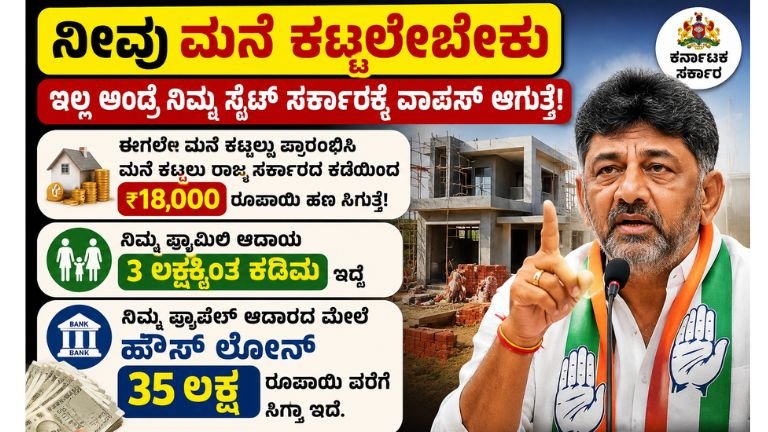
Mandatory 5-Year Home Construction Mandate in Karnataka: Rules, Financial Assistance, and Low-Income Housing Loans h22 h 25
Owning a piece of land in Karnataka is a cherished dream for lakhs of families across the state. However, recent announcements by Deputy Chief Minister and Bengaluru Development Minister D. K. Shivakumar have fundamentally shifted how civic-allotted plots are managed.
The Karnataka government has announced strict enforcement mechanisms targeting vacant plots, warning that failure to commence housing construction within a specified timeframe could lead to plot cancellation, repossession by the state, or hefty penalty taxes.
At the same time, the state and central governments have structured various subsidies and low-interest housing loan frameworks to ensure lower-income households receive the financial backing required to build their homes.
Here is a comprehensive analysis of the government’s direct policy warnings, available government construction grants, credit-linked subsidy loans, and step-by-step guidance on how site allottees can safeguard their real estate investments.
1. D. K. Shivakumar’s Warning: Build Within 5 Years or Face Cancellation
Speaking at the launch of the “Freedom from Waste” (Tyajyadinda Swatantra) civic campaign near Hebbal, D. K. Shivakumar issued a clear directive to holders of government-allotted residential plots:
“Whether it is a BDA or a Corporation site, the owner must ensure it is kept clean. Therefore, a house must be constructed within five years of obtaining the site. If it is not, either double tax will be imposed, or the site will be returned to authorities.” — D. K. Shivakumar
                     CIVIC SITE ALLOTMENT RULES

              [ Site Allotted by Civic Body / BDA / KHB ]
                                   │
                   ┌───────────────┴───────────────┐
                   ▼                               ▼
       Construct Within 5 Years           Leave Site Vacant > 5 Years
                   │                               │
        ┌──────────┴──────────┐          ┌─────────┴──────────┐
        ▼                     ▼          ▼                    ▼
   Home Built          Compound Built  Double Property Tax  Plot Repossessed
 (Fully Compliant)    (Basic Protection) (Immediate Penalty) (Cost Refunded + Interest)
Key Takeaways from the Government Statement
- Mandatory 5-Year Rule: All beneficiaries who have been allotted sites by civic bodies—including the Bangalore Development Authority (BDA), Karnataka Housing Board (KHB), erstwhile City Improvement Trust Board (CITB), and registered Cooperative Housing Societies—must construct at least a primary residential structure within 5 years of lease-cum-sale execution.
- Repossession with Interest Refund: If an allottee leaves the site vacant beyond the stipulated period, the government will cancel the allotment, repossess the plot, and refund the original amount paid along with interest.
- Double Property Tax: Plots left idle without any activity or basic boundary protection will face double property tax penalties until construction begins or repossession proceedings initiate.
- The Reason Behind the Order: Unattended vacant sites frequently turn into health hazards and garbage dumping yards across urban areas. Furthermore, keeping civic-subsidized plots idle for decades (some over 20 to 40 years) denies genuinely needy families the opportunity to secure housing.
- Private vs. Government Land: This enforcement strictly applies to sites allotted via government agencies, urban local bodies (ULBs), and cooperative societies. Private revenue plots or independently purchased layout plots fall under separate municipal regulations.
2. Government Financial Grants & Subsidies for House Construction
To support low-income families in meeting these construction timelines, Karnataka operates several social housing schemes alongside central sector partnerships.
| Housing Scheme / Head | Targeted Category | Max Grant / Financial Assistance | Eligibility Criteria |
| Dr. B.R. Ambedkar Nivas Yojana | SC / ST Beneficiaries | ₹1.75 Lakh to ₹2.00 Lakh (Rural/Urban) | Annual family income below ₹3,000,000; valid Caste/Income Certificate. |
| Devaraj Urs Housing Scheme | OBC, Special Minorities, Differently-Abled | ₹1.20 Lakh to ₹1.50 Lakh | Annual family income under ₹3 Lakh; non-ownership of existing pucca house. |
| Basava Vasathi Yojana | Rural EWS Households | ₹1.20 Lakh | Rural residents, homeless or living in kutcha structures; income < ₹3 Lakh. |
| PMAY-Urban (BLC Route) | Urban Economically Weaker Section (EWS) | Up to ₹1.50 Lakh (Central) + State Top-up | Valid urban plot ownership; household annual income ≤ ₹3 Lakh. |
| BOCWWDB Construction Allowance | Registered Construction Workers | Specific Welfare Financial Grants | Minimum 90 days active registration with Karnataka Building & Other Construction Workers Board. |
Note on Local/Municipal Direct Subsidies: Certain municipal corporations and local welfare boards disburse installment-based direct transfers (such as localized municipal aid installments ranging from ₹18,000 for initial foundation stages up to full project allocations) upon verification of physical construction progress through geo-tagged site images.
3. Housing Loans Up to ₹35 Lakh for Families Earning Under ₹3 Lakh
For lower-income households (EWS / LIG), securing a standard bank home loan can often feel out of reach due to strict formal income documentation rules. However, under the updated Priority Sector Lending (PSL) directives governed by the Reserve Bank of India (RBI) alongside national affordable housing frameworks, housing finance companies (HFCs) and public banks offer structured loans tailored to low-income property holders.
                          HOUSING LOAN FLOW CHART
                 (For Households Earning ≤ ₹3 Lakh / Annum)

               ┌──────────────────────────────────────────┐
               │  Annual Family Income: ≤ ₹3,000,000      │
               │  Property Ownership: Valid Site Document │
               └────────────────────┬─────────────────────┘
                                    │
                                    ▼
               ┌──────────────────────────────────────────┐
               │ Apply via Public Banks / HFCs / Micro-Fi │
               │ (Priority Sector Lending Scheme)         │
               └────────────────────┬─────────────────────┘
                                    │
                  ┌─────────────────┴─────────────────┐
                  ▼                                   ▼
       Low Collateral / Affordable               Interest Subvention
      Home Loans (Up to ₹35 Lakh)              Subsidies (CLSS Framework)
                  │                                   │
                  └─────────────────┬─────────────────┘
                                    │
                                    ▼
               ┌──────────────────────────────────────────┐
               │ Geo-Tagged Stage-wise Loan Disbursement  │
               │ (Foundation ➔ Plinth ➔ Lintel ➔ Roof)    │
               └──────────────────────────────────────────┘
Features of Affordable Housing Loans
- Higher Loan-to-Value Ratio (LTV): For affordable housing loans up to ₹30 Lakh–₹35 Lakh, banks can fund up to 80% to 90% of the estimated construction cost, requiring minimal upfront margin money from the applicant.
- Extended Repayment Tenure: Tenures range up to 20 to 30 years, ensuring monthly EMIs remain manageable for daily wage earners or small business operators.
- Interest Subvention / Affordable Rates: Under concessional credit facilities, eligible low-income borrowers receive interest rate relaxations ranging between 6.5% and 8.5% per annum, significantly lower than unorganized informal borrowing rates.
- Flexible Income Proof Processing: Many Affordable Housing Finance Companies (AHFCs) assess eligibility through surrogate financial metrics (cash flow analysis, UPI transaction history, utility bill consistency) rather than requiring multi-year Income Tax Returns (ITR).
4. Eligibility Criteria for Affordable Housing Loans
To successfully secure a housing loan of up to ₹35 Lakh under the subsidized/priority framework, applicants must meet the following parameters:
- Income Threshold: Total annual household income (husband, wife, and unmarried children) must not exceed ₹3,000,000 (3 Lakh Rupees) for EWS classification. (LIG bracket covers up to ₹6 Lakh).
- Property Ownership: The applicant or co-applicant must hold clear title ownership, an allotment letter, or a registered lease-cum-sale deed issued by BDA, KHB, or a recognized municipal local body.
- First-Time Homeowner Condition: Neither the applicant nor any member of their immediate family should own a registered pucca house anywhere in India.
- Plan Sanction & Approval: The proposed residential layout must have a sanctioned plan or basic building license approved by the local municipal body (BBMP, BDA, BMRDA, or respective Gram Panchayats).
5. Required Documents Checklist
Before visiting a financial institution or applying online via housing portals, assemble the following essential documents:
A. Personal Identification & Income Documents
- Identity Proof: Aadhaar Card, Voter ID, or Driving License.
- Address Proof: Aadhaar Card, Utility Bills (Electricity/Water), or Ration Card.
- Income Certificate: Officially issued Tahsildar Income Certificate confirming annual income ≤ ₹3 Lakh.
- Bank Statements: Last 6 months’ bank passbook copies or UPI transaction statements.
- Caste Certificate: Required if applying under reserved category housing concessions (SC/ST/OBC).
B. Property & Construction Documents
- Site Allotment Letter: Issued by BDA, KHB, Housing Society, or Municipal Corporation.
- Title Deed / Lease-Cum-Sale Agreement: Proof of legal possession.
- Khata Certificate & Latest Tax Paid Receipt: Form 10, E-Khata, or BDA Khata.
- Approved Building Construction Plan: Blueprints approved by the local municipal engineer.
- Detailed Cost Estimate: An itemized construction cost estimation prepared by a chartered engineer or registered architect.
6. Step-by-Step Application Process
Follow these steps to apply for financial assistance and start house construction:
Step 1: Verify Site Documentation and Clear Khata
Ensure your site has an updated E-Khata and that all property taxes are paid up to date. If your site was allotted by BDA or KHB, double-check your allotment date to confirm your 5-year timeline.
Step 2: Obtain Building Sanction & Construction Estimate
Engage a licensed civil engineer to draft a simple floor plan. Submit this to your local municipal authority (BBMP, City Municipal Council, or Gram Panchayat) to obtain a formal Building License.
Step 3: Apply for State Housing Schemes
Visit the official Rajiv Gandhi Housing Corporation Limited (RGHCL) portal (ashraya.karnataka.gov.in) or your local Gram Panchayat / Mahanagara Palike housing desk. Submit your details under schemes like Basava Vasathi, Ambedkar Nivas, or PMAY-U to claim state subsidies.
Step 4: Submit Housing Loan Application at Bank/HFC
Approach a nationalized public sector bank (e.g., State Bank of India, Canara Bank, Union Bank) or a dedicated Affordable Housing Finance Company. Submit your approved blueprint, site title documents, income certificate, and detailed cost estimate to apply for the Priority Sector Housing Loan.
Step 5: Initiate Construction and Receive Phased Disbursements
Once the loan is sanctioned, construct the boundary wall and initiate the foundation work. Government grants and bank loans disburse funds in stages corresponding to physical progress:
- Stage 1: Foundation / Earthwork
- Stage 2: Plinth Level
- Stage 3: Lintel & Roof Casting
- Stage 4: Plastering, Finishing & Sanitation
- Summary Checklist: Protect Your Site Today
- Check Your Allotment Date: If you have owned a BDA, KHB, or civic plot for over 5 years, prioritize immediate construction.
- Erect a Boundary Wall: Build a perimeter wall and clear debris to prevent the plot from becoming a dumping ground, which triggers double tax penalties.
- Leverage Low-Income Schemes: Take advantage of subsidies and loans up to ₹35 Lakh available for families with annual incomes under ₹3 Lakh.
- Keep Site Active: Start basic construction early to satisfy civic conditions, protect your ownership rights, and build a permanent home.