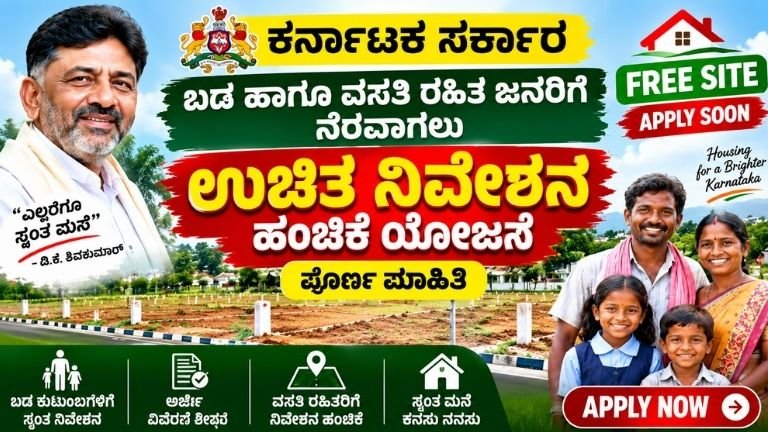
Free Site Distribution Scheme 2026: Karnataka Government Announces Free Sites for Poor and Homeless Families
The Karnataka Government has announced a major housing-site distribution initiative aimed at helping families who do not own a house or residential site. Under the newly announced programme, the government plans to distribute 15 lakh residential sites across Karnataka, with priority for poor and landless families and socially disadvantaged communities.
The announcement was made as part of the Karnataka Government’s 100-day initiatives. The Cabinet has decided to provide 50,000 sites in every district, which could cover approximately 15 lakh beneficiaries across the state. The distribution is planned in phases, beginning with 5 lakh sites in the first phase.
This announcement is expected to be particularly important for rural families who have a house but do not own residential land, families living in rented houses, and economically weaker households who cannot afford to purchase a site at current market prices.
What Is the Karnataka Free Site Distribution Scheme 2026?
The Karnataka Free Site Distribution Scheme 2026 is a government initiative to provide residential plots free of cost to eligible people who do not own a house or residential site.
According to the announcement, the government has set a target of 15 lakh residential sites across the state. Each district is expected to receive a target of around 50,000 sites.
The programme is intended to address the shortage of residential land among economically weaker and landless families. The government has also indicated that priority will be given to Scheduled Caste, Scheduled Tribe, backward-class, minority and other poor families who do not have houses or residential sites.
The programme should not be confused with an ordinary housing loan or house-construction subsidy. The major benefit announced under this initiative is the provision of a residential site, on which an eligible beneficiary can subsequently construct a house according to applicable government rules.
15 Lakh Free Sites Across Karnataka
One of the biggest highlights of the announcement is the proposed distribution of approximately 15 lakh sites throughout Karnataka.
The government has decided to distribute approximately 50,000 sites in each district. The programme is expected to be implemented in three phases, with approximately five lakh sites planned in each phase.
The first phase is therefore particularly important because it is expected to cover around 5 lakh families.
Government authorities have reportedly already identified around 10,000 acres of land, while Deputy Commissioners have been instructed to identify and develop additional land required for the programme.
This means the programme is not simply an announcement about identifying beneficiaries. Land identification, layout development, infrastructure and beneficiary selection will all be important stages before sites can actually be handed over.
Who May Get the Free Site?
The final eligibility rules will depend on the official government guidelines issued for the programme. However, the government’s announcement indicates that priority will be given to people who do not have a house or residential site.
The major categories mentioned include:
- Poor families without residential sites
- Landless families
- Families without houses
- Scheduled Caste families
- Scheduled Tribe families
- Backward-class families
- Minority families
- Other economically weaker households
The government has specifically stated that priority will be given to socially and economically disadvantaged groups.
However, simply belonging to one of these categories may not automatically guarantee a site. Beneficiaries will have to satisfy the final eligibility conditions and go through the government verification and selection process.
50,000 Sites in Every District
Another important feature of the announcement is the district-wise target.
The government has announced a target of around 50,000 sites for every district. With Karnataka having 31 districts, this works out to approximately 15.5 lakh sites mathematically, while government reports commonly describe the overall target as around 15 lakh sites.
The actual number distributed in each district may depend on the availability of suitable government land, beneficiary demand, layout development and administrative requirements.
Therefore, people should not assume that exactly 50,000 sites will immediately be available in every district.
First Phase: 5 Lakh Sites
The government plans to implement the programme in phases.
The first phase is expected to cover approximately 5 lakh sites, followed by additional phases.
According to reports on the announcement, the government has already identified a significant amount of land and instructed district administrations to identify additional land wherever required.
This phased approach is important because providing residential sites requires several steps:
- Identification of suitable government land
- Verification of land ownership
- Conversion and layout-related approvals where required
- Development of the site
- Identification of eligible beneficiaries
- Verification of beneficiary documents
- Final approval
- Site allotment
- Issuance of relevant allotment or title documents
Therefore, the announcement of 15 lakh sites does not mean that all 15 lakh sites will be handed over immediately.
What Size Will the Site Be?
Reports regarding the announcement have mentioned 30 × 40 feet residential sites in connection with rural distribution. However, beneficiaries should wait for the final official guidelines before treating the site dimensions as confirmed for every location.
Site size can depend on the type of layout, whether the area is rural or urban, land availability and the rules applicable to the particular programme.
Therefore, applicants should not rely on social-media videos or unofficial advertisements claiming that everyone will definitely receive a specific site size.
The final government notification should be considered the authoritative source for site dimensions, eligibility and allotment conditions.
Government Land Will Be Used
An important part of the programme is the identification and development of suitable land.
According to the reported Cabinet announcement, approximately 10,000 acres have already been identified, while district authorities have been directed to identify additional land.
This is significant because large-scale site distribution requires substantial land.
The government must also ensure that the selected land is suitable for residential purposes and that layouts have appropriate infrastructure. Roads, drainage, water supply, electricity and other basic facilities can determine whether an allotted site is practically useful to a family.
Free Site Does Not Necessarily Mean Free House
People should understand an important difference between a free site and a free house.
Under the announced site distribution programme, the main benefit is the allocation of residential land.
A beneficiary receiving a site should not automatically assume that the government will construct a complete house on that site.
Housing construction assistance may be available through separate government housing programmes, depending on the beneficiary’s eligibility.
Karnataka has several housing-related programmes administered through government departments and housing agencies. Therefore, eligible beneficiaries should check whether they can also receive housing assistance after obtaining a residential site.
Priority for SC and ST Families
The government has specifically highlighted the welfare of Scheduled Caste and Scheduled Tribe families.
Along with free residential sites, the government has also announced plans relating to the development of SC/ST colonies, particularly where basic facilities such as drinking water, roads, drainage and toilets are inadequate.
This indicates that the broader objective is not simply to distribute pieces of land but also to improve living conditions in disadvantaged communities.
If properly implemented, such infrastructure development could make the residential sites more useful for families.
Is There an Online Application Link?
At present, people should be careful about websites and social-media posts claiming that an official online application for the newly announced 15 lakh free-site programme is already open.
The government has announced the programme and its broad targets, but the final application procedure, beneficiary registration method, district-wise notification, documents and online portal for this specific initiative should be confirmed through official government notifications.
People should not pay money to agents or unknown websites promising guaranteed allotment.
For Karnataka government services, citizens can use the official Seva Sindhu platform where applicable. Seva Sindhu is the Karnataka Government’s integrated citizen-services platform.
For this particular free-site programme, however, applicants should wait for the concerned department or district administration to publish the official application instructions.
Documents That May Be Required
The final document list has not yet been clearly established for the new programme.
Depending on the final rules, applicants may be asked to provide documents such as:
- Aadhaar card
- Karnataka residence proof
- Ration card
- Income certificate
- Caste certificate, where applicable
- Mobile number
- Family details
- Proof that the applicant does not own a residential site
- Proof relating to existing housing status
- Bank details, if required
- Other documents specified by the department
Applicants should not prepare documents based solely on unofficial lists circulating on social media. The final notification should be followed.
How Beneficiary Selection May Work
Large-scale free-site distribution requires a beneficiary-selection process.
The government and local authorities may need to verify whether an applicant already owns a residential property, whether the family meets income conditions and whether the applicant falls within the priority categories.
Local administration may also be involved in verifying family and land records.
Because the programme is intended for people without houses or residential sites, ownership verification will likely be an important part of the process.
The final procedure could vary depending on whether the site is located in a rural area, town or urban local body.
What Poor Families Should Do Now
People who believe they may qualify should start keeping their basic documents ready.
First, applicants should ensure that their Aadhaar, ration card and residence details are updated.
Those applying under reserved or priority categories should also keep their valid caste and income certificates ready.
Families should also verify their land and property records where possible. If the government requires proof that the family does not own a residential site, accurate property information will become important during verification.
Most importantly, applicants should follow announcements from their Gram Panchayat, Taluk office, Revenue Department, district administration and other authorised government offices.
Beware of Fake Free-Site Applications
Whenever a major government scheme is announced, fake application websites and misleading social-media messages can appear.
Applicants should be particularly careful if a website asks for:
- Registration fees
- Processing charges
- OTP
- ATM or debit-card details
- Internet banking passwords
- UPI PIN
- Large payments for guaranteed allotment
A government site-allotment programme should not be treated as an opportunity for private agents to demand money.
Do not share your UPI PIN, banking password or OTP with anyone claiming to be a government officer.
Why This Scheme Is Important
Owning a residential site can make a significant difference to a low-income family.
For many poor households, purchasing land is one of the biggest financial barriers to building a permanent home. Land prices in and around growing towns have increased substantially, making home ownership difficult for families with limited income.
A government-provided site can reduce this initial burden.
For rural families, a residential site can also provide greater housing security and help them move away from temporary or rented accommodation.
The programme could therefore have a broader social impact if sites are distributed transparently and supported with basic infrastructure.
Government’s Larger Housing Objective
The free-site announcement is part of a broader set of initiatives announced by the Karnataka Government during the 100-day programme.
The government has also announced free houses and sites for homeless SC and ST families in rural areas. A separate announcement indicated plans to distribute five lakh housing sites to landless rural families.
These announcements show a focus on land access and housing support for economically weaker households.
However, the success of the programme will ultimately depend on implementation rather than the announcement alone.
Important Points for Applicants
Before applying, remember these important points:
The scheme is for eligible families: Not everyone will automatically receive a free site.
Priority categories matter: Poor, landless and socially disadvantaged families are expected to receive priority.
The target is 15 lakh sites: The programme is planned on a large scale, with approximately 50,000 sites targeted per district.
The first phase is 5 lakh sites: The distribution is expected to happen in phases.
Land identification is ongoing: Government authorities have already identified some land and are expected to identify additional land.
Application details may change: Final eligibility and registration procedures depend on official government guidelines.
Do not pay unofficial agents: Avoid anyone promising guaranteed allotment in exchange for money.
Check official notifications: District administration and concerned government departments should be treated as the primary sources for final instructions.
apply Link
The Karnataka Government’s Free Site Distribution Scheme 2026 is a major proposed housing-land initiative aimed at helping poor, landless and homeless families obtain residential sites.
The government has announced an overall target of approximately 15 lakh sites, with around 50,000 sites planned for each district and an initial phase covering approximately 5 lakh sites. Priority is expected for Scheduled Caste, Scheduled Tribe, backward-class, minority and other economically weaker families who do not own a house or residential site.
For eligible families, the programme could provide an important opportunity to obtain land for a permanent home. However, beneficiaries should wait for the official district-wise notification and application procedure before submitting documents or paying anyone.
The most important step now is to keep the required documents ready and follow official announcements from the Karnataka Government, district administration, Gram Panchayat and concerned departments.
Note: The 15-lakh target and first-phase announcements are government-announced plans. Final eligibility, site dimensions, application procedure, beneficiary selection and allotment conditions will depend on the official guidelines issued by the Karna