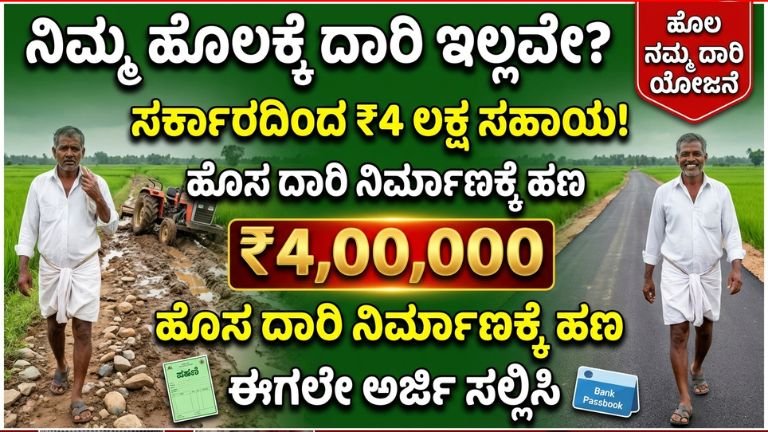
Our Land Our Road Scheme: Get Up to ₹4 Lakh Government Support for Farm Access Road Construction grama dari
Farmers across India often face a serious challenge — no proper road access to their agricultural land. Even when a pathway exists, it may be filled with stones, mud, or waterlogging, making it extremely difficult to transport crops, fertilizers, seeds, and equipment.
To solve this issue, the government has introduced the “Our Land Our Road Scheme” (Namma Hola Namma Daari Yojana), a farmer welfare initiative that provides financial assistance for constructing new access roads to agricultural land.
In this article, you will get complete details about eligibility, benefits, required documents, and step-by-step application process.
What Is the Our Land Our Road Scheme?
The Our Land Our Road Scheme is a government agricultural infrastructure support program designed to help farmers build proper access roads to their farmland.
Under this scheme:
- Farmers can receive financial assistance up to ₹4,00,000
- Funds are provided for new road construction
- The scheme aims to improve rural connectivity and farm productivity
This initiative is especially beneficial for farmers who:
- Do not have any access road to their land
- Have damaged or unusable mud roads
- Face transportation issues during rainy seasons
- Struggle to bring tractors or harvest equipment into their fields
Key Benefits of the Scheme
1. Financial Assistance up to ₹4 Lakh
Eligible farmers can receive government support of up to ₹4,00,000 for constructing a new access road.
2. Improved Farm Productivity
Better road access helps farmers transport:
- Crops to market
- Seeds and fertilizers
- Farm machinery
- Harvested produce
3. Reduced Transportation Cost
With proper road connectivity, farmers can reduce labor and transport expenses significantly.
4. All-Weather Accessibility
A constructed road ensures year-round access, even during monsoon season.
Who Is Eligible?
To apply for the Our Land Our Road Scheme, farmers must meet the following conditions:
- Must be a land-owning farmer
- Land must be legally registered
- Must not already have proper government-constructed access road
- Should provide valid land ownership proof
Both small and marginal farmers can apply, depending on local implementation guidelines.
Required Documents
Before applying, make sure you have the following documents ready:
- Land Pahani / RTC (Record of Rights)
- Bank Passbook (linked to Aadhaar)
- Aadhaar Card
- Mobile Number
- Passport Size Photo
- Caste / Income Certificate (if required by local authority)
The most important documents are:
- Land Pahani (proof of ownership)
- Bank Passbook for fund transfer
Step-by-Step Application Process
Here is the general process to apply:
Step 1: Visit Your Local Office
Go to your:
- Gram Panchayat Office
- Taluk Office
- Agriculture Department Office
Step 2: Collect Application Form
Ask for the Our Land Our Road Scheme application form.
Step 3: Submit Required Documents
Attach:
- Pahani copy
- Bank passbook copy
- Aadhaar copy
Step 4: Field Verification
Officials will inspect your farmland to verify:
- Lack of road access
- Practical need for construction
Step 5: Approval & Fund Release
After approval:
- Funds are transferred directly to your bank account
- Road construction work can begin
Important Points to Remember
- Apply before the deadline (if announced locally).
- Ensure your land records are updated.
- Keep photocopies of all documents submitted.
- Track application status through local office.
Why This Scheme Is Important for Farmers
Road access is not just convenience — it is essential infrastructure.
Without proper road connectivity:
- Crop transport becomes difficult
- Market access is limited
- Emergency access is delayed
- Farm income reduces
The Our Land Our Road Scheme directly supports rural farmers by strengthening agricultural infrastructure and improving income opportunities.
Frequently Asked Questions
How much financial support is available?
Up to ₹4,00,000 depending on approval and land requirement.
Can small farmers apply?
Yes, small and marginal farmers are eligible if they meet land ownership criteria.
Is bank account mandatory?
Yes. The bank passbook is required for direct benefit transfer (DBT).
If your farmland does not have proper road access or if the existing path is filled with stones and mud, this scheme can be a major relief.
The Our Land Our Road Scheme offers up to ₹4 lakh financial assistance to build proper access roads and improve agricultural productivity.
Eligible farmers should immediately contact their local Panchayat or Agriculture Office and submit the required documents.
Improved road connectivity means better farming, better transportation, and better income.
Apply today and secure your farm’s future.
How to Apply for Our Land Our Road Scheme in Gram Panchayat – Step-by-Step Guide
If your agricultural land does not have proper road access or the existing path is unusable due to mud, stones, or waterlogging, you can apply for government assistance under the Our Land Our Road Scheme (Namma Hola Namma Daari Yojana) through your local Gram Panchayat.
Below is a clear, professional step-by-step guide to help farmers complete the application process correctly.
Step 1: Visit Your Local Gram Panchayat Office
Go to your Gram Panchayat Office during working hours.
Meet the Panchayat Development Officer (PDO) or Village Accountant and inform them that you want to apply for road construction assistance under the scheme.
Explain clearly:
- Your land has no proper access road
OR - The existing road is damaged and not usable
Step 2: Collect the Application Form
Request the official application form for:
- Farm access road construction
- Rural infrastructure assistance
- Our Land Our Road Scheme (if available under that name locally)
Some Panchayats may provide a printed form, while others may ask you to submit a written request letter.
Step 3: Prepare Required Documents
Attach the following documents with your application:
- Pahani / RTC (Land Record Copy) – Proof of land ownership
- Bank Passbook Copy – For Direct Benefit Transfer (DBT)
- Aadhaar Card Copy
- Passport Size Photograph
- Mobile Number
- Caste / Income Certificate (if applicable)
Important:
Ensure that the name in the Pahani matches your Aadhaar and Bank Account details.
Step 4: Submit Application to Panchayat Office
Submit the completed application form along with all documents to:
- Gram Panchayat Office
OR - Village Accountant / Revenue Officer (as directed)
Ask for an acknowledgment receipt or inward number for future reference.
Step 5: Site Inspection by Officials
After submission, the Panchayat authorities will:
- Conduct a physical inspection of your land
- Verify that there is no proper road access
- Measure the required road length
- Check feasibility and public benefit
This verification is mandatory before approval.
Step 6: Proposal Approval Process
After inspection:
- The Panchayat prepares a proposal
- It may be forwarded to Taluk or Block Development Office
- Budget allocation is reviewed
- Final approval is granted based on eligibility and available funds
The approval timeline may vary depending on district procedures.
Step 7: Sanction Order Issued
Once approved:
- A sanction order is issued
- The approved amount (up to ₹4,00,000 depending on project) is confirmed
- Construction guidelines are provided
Step 8: Fund Release & Road Construction
Funds are usually:
- Transferred directly to your bank account
OR - Managed through Panchayat supervision
After fund release:
- Road construction begins
- Officials may monitor the work progress
- Completion report is submitted
Important Points to Remember
- Keep copies of all submitted documents
- Follow up regularly with Panchayat office
- Ensure land records are updated before applying
- Do not submit false information
- Check if there is a deadline in your district
Common Mistakes to Avoid
- Submitting unclear or outdated Pahani copies
- Bank account not linked with Aadhaar
- Land ownership disputes
- Not collecting acknowledgment receipt
Our Land Our Road Scheme: Complete Gram Panchayat Application Guide (Detailed 500+ Words)
Lack of proper road access to agricultural land is one of the biggest infrastructure challenges faced by farmers in rural areas. Without a proper pathway, transporting seeds, fertilizers, equipment, and harvested crops becomes difficult and expensive. During the rainy season, mud roads become unusable, leading to delays and financial losses.
To address this issue, the government introduced the Our Land Our Road Scheme (Namma Hola Namma Daari Yojana). This rural development initiative aims to provide financial assistance of up to ₹4 lakh for constructing access roads to farmland. Below is a more detailed explanation of how to apply through your Gram Panchayat and what farmers should know before submitting their application.
Purpose of the Scheme
The primary objective of the scheme is to:
- Improve rural agricultural infrastructure
- Provide permanent access roads to farmland
- Reduce transportation costs
- Increase agricultural productivity
- Support small and marginal farmers
Road connectivity is considered essential infrastructure because it directly impacts market access and income levels.
Where to Apply?
Farmers must apply through their local Gram Panchayat Office. In some cases, the Panchayat Development Officer (PDO) coordinates with:
- Taluk Office
- Rural Development Department
- Agriculture Department
The Gram Panchayat is the first and most important authority for processing the application.
Detailed Step-by-Step Application Process
1. Initial Inquiry
Visit your Gram Panchayat office and meet the concerned official. Explain clearly:
- Your land survey number
- The absence of proper road access
- The difficulties faced
Officials will guide you on the availability of the scheme and application format.
Application Submission
You must submit:
- A completed application form or written request letter
- Land details including survey number and extent
- A brief explanation of the road requirement
Ensure all information is accurate and matches official land records.
Mandatory Documents
The most important documents include:
- Pahani / RTC (Record of Rights) – Proof of land ownership
- Bank Passbook Copy – For direct fund transfer
- Aadhaar Card
- Mobile Number
- Passport Size Photograph
The name in all documents must match exactly to avoid rejection.
Field Verification
After submission, Panchayat officials conduct a site inspection. During verification, they check:
- Whether a road already exists
- Length and width required
- Whether the road benefits only one farmer or multiple farmers
- Feasibility and public utility
This stage is critical because approval depends largely on inspection findings.
Technical Estimation & Proposal
If verified, officials prepare:
- Road measurement details
- Estimated construction cost
- Project proposal
The proposal is forwarded to higher authorities for administrative and financial approval.
Approval & Sanction
Once approved:
- A sanction order is issued
- Maximum assistance may go up to ₹4,00,000 depending on project size
- Funds are allocated based on district budget availability
Approval time may vary depending on fund allocation.
Fund Release & Monitoring
Funds may be:
- Directly transferred to the farmer’s bank account (DBT)
OR - Managed under Panchayat supervision
Construction must follow guidelines, and officials may monitor progress to ensure proper utilization of funds.
Important Eligibility Conditions
- Applicant must be a legal landowner
- Land records must be updated
- There should be no existing permanent road
- No major land dispute should be pending
Priority is often given to small and marginal farmers.
Common Reasons for Rejection
- Incorrect or outdated Pahani
- Ownership disputes
- Already existing access road
- Incomplete documentation
Final Advice for Farmers
Applying through the Gram Panchayat is the official and safest method. Proper documentation and follow-up increase your chances of approval.
If your farmland truly lacks road access, this scheme can significantly improve transport, productivity, and income.
Visit your Gram Panchayat office today and start the application process.