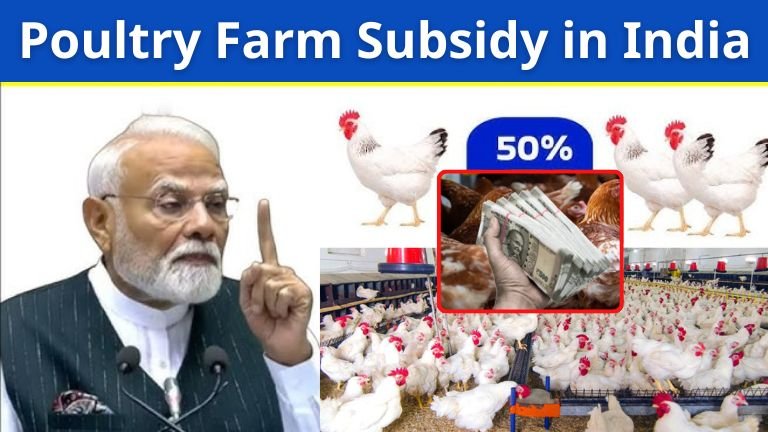
Poultry Farm Subsidy in India: Complete Guide to Government Schemes, Eligibility, Loan, and Application Process p1
Poultry farming has emerged as one of the fastest-growing segments of Indian agriculture. With increasing demand for eggs and chicken meat, poultry farming has become a highly profitable agribusiness, especially for rural youth, small farmers, women entrepreneurs, and first-time business owners. Recognizing its employment potential and contribution to food security, the Government of India and state governments provide poultry farm subsidies, low-interest loans, and training support to encourage new entrepreneurs.
This article explains everything you need to know about poultry farm subsidies in India, including government schemes, eligibility, subsidy percentage, loan process, documents required, application procedure, and profit potential.
What Is Poultry Farm Subsidy?
A poultry farm subsidy is financial assistance provided by the government to reduce the initial investment burden on individuals starting or expanding poultry farms. Subsidies are generally offered in the form of:
- Capital subsidy (percentage of project cost)
- Interest subsidy on loans
- Margin money subsidy
- Infrastructure development support
- Training and technical guidance
These subsidies are implemented through central and state government schemes, banks, and development institutions.
Why Government Promotes Poultry Farming
The government promotes poultry farming for several key reasons:
- Generates rural employment
- Requires relatively low land compared to crop farming
- Provides quick returns within 4–6 months
- Improves protein availability (eggs and meat)
- Encourages women and youth entrepreneurship
- Supports allied agricultural activities
Major Poultry Farm Subsidy Schemes in India
National Bank for Agriculture and Rural Development Poultry Development Support
NABARD plays a major role in financing poultry projects by refinancing banks that provide loans to farmers and entrepreneurs.
Key features:
- Loan-linked capital subsidy
- Support for broiler, layer, and hatchery units
- Available for small, medium, and large poultry projects
- Subsidy routed through banks
Ministry of Agriculture and Farmers Welfare Poultry Schemes
Under various animal husbandry and livestock development programs, the central government supports poultry farming through:
- Infrastructure Development Fund
- Backyard Poultry Development
- Rural Livelihood Missions
- Special focus on SC, ST, women, and marginal farmers
National Livestock Mission (NLM)
National Livestock Mission is one of the most important schemes for poultry farmers.
Benefits:
- Subsidy for poultry sheds
- Support for breeder farms
- Training and skill development
- Entrepreneurship promotion
Subsidy pattern:
- General category: up to 25%
- SC/ST/Women: up to 33%
Pradhan Mantri Formalisation of Micro Food Processing Enterprises (PMFME)
Although PMFME focuses on food processing, poultry processing units like egg grading, meat processing, and packaging are eligible.
Highlights:
- 35% subsidy on eligible project cost
- Maximum subsidy up to ₹10 lakh
- Suitable for value-added poultry businesses
State Government Poultry Subsidy Schemes
Each state implements its own poultry subsidy programs through Animal Husbandry Departments.
Common features:
- Free or subsidized chicks
- Poultry shed construction subsidy
- Feed and medicine support
- Special schemes for rural women and youth
States like Andhra Pradesh, Telangana, Tamil Nadu, Karnataka, Maharashtra, and Odisha actively promote poultry farming.
Types of Poultry Farms Eligible for Subsidy
The government supports different poultry models:
Broiler Poultry Farm
- Focus on meat production
- Batch cycle of 35–45 days
- Faster returns
Layer Poultry Farm
- Egg production
- Regular monthly income
- Longer production cycle
Backyard Poultry
- Small-scale
- Ideal for rural households
- Mostly supported under state schemes
Breeder & Hatchery Units
- Advanced operations
- Higher investment
- Higher subsidy limits
Poultry Farm Subsidy Percentage
Subsidy depends on category and scheme:
- General Category: 20%–25%
- SC/ST/Women/Disabled: 30%–35%
- Northeastern & Tribal Areas: up to 40%
Subsidy is usually credited after project completion and verification.
Poultry Farm Loan Along with Subsidy
Most poultry subsidies are loan-linked, meaning you must take a loan from a bank.
Loan providers:
- Commercial Banks
- Regional Rural Banks
- Cooperative Banks
- NABARD-refinanced institutions
Loan coverage:
- 75%–90% of project cost
- Remaining amount as margin money
Loan tenure:
- 5 to 7 years
- Grace period of 6–12 months
Interest rate:
- As per bank norms
- Interest subsidy applicable under some schemes
Eligibility Criteria for Poultry Farm Subsidy
Basic eligibility includes:
- Indian citizen
- Age between 18 and 60 years
- Land ownership or lease agreement
- Basic knowledge or training in poultry farming
- Bankable project report
- Priority to rural youth, women, SC/ST candidates
Documents Required
You generally need the following documents:
- Aadhaar card
- PAN card
- Address proof
- Caste certificate (if applicable)
- Bank passbook
- Land documents or lease agreement
- Poultry project report
- Training certificate (if available)
- Passport-size photographs
Poultry Farm Project Cost Example
Small Poultry Farm (1000 Birds)
- Shed construction: ₹3,00,000
- Chicks: ₹60,000
- Feed: ₹2,50,000
- Medicines & utilities: ₹40,000
- Total cost: ₹6,50,000
Possible subsidy (25%): ₹1,62,500
Application Process for Poultry Farm Subsidy
Step 1: Prepare a detailed poultry project report
Step 2: Approach nearest bank branch
Step 3: Submit loan + subsidy application
Step 4: Bank appraisal and site inspection
Step 5: Loan sanction
Step 6: Farm establishment
Step 7: Government verification
Step 8: Subsidy release to loan account
Training and Technical Support
Government-supported training is provided through:
- Animal Husbandry Department
- Krishi Vigyan Kendras (KVKs)
- NABARD-sponsored institutes
- State livestock training centers
Training improves approval chances and farm success.
Profit Margin in Poultry Farming
Broiler Farming Profit
- Net profit per batch: ₹40–₹70 per bird
- 6 batches per year possible
- Fast capital rotation
Layer Farming Profit
- Monthly egg income
- Stable long-term returns
- Additional income from manure
Common Mistakes to Avoid
- Poor project planning
- Ignoring biosecurity
- Low-quality chicks
- Improper ventilation
- No insurance coverage
Insurance for Poultry Farms
Many government schemes encourage poultry insurance to protect farmers from losses due to disease, natural disasters, or accidents.
Future Scope of Poultry Farming in India
- Growing urban demand
- Rising protein consumption
- Export opportunities
- Value-added poultry products
- Integration with cold chain and processing
apply Link
Poultry farming is one of the most practical and profitable agribusiness opportunities in India. With government-backed poultry farm subsidies, low-interest loans, and training support, even first-time entrepreneurs can successfully enter this sector. Proper planning, scheme selection, and bank coordination are the keys to availing subsidies and achieving long-term success.
If you are serious about starting a poultry farm, this is the right time to leverage government support and build a sustainable income source.