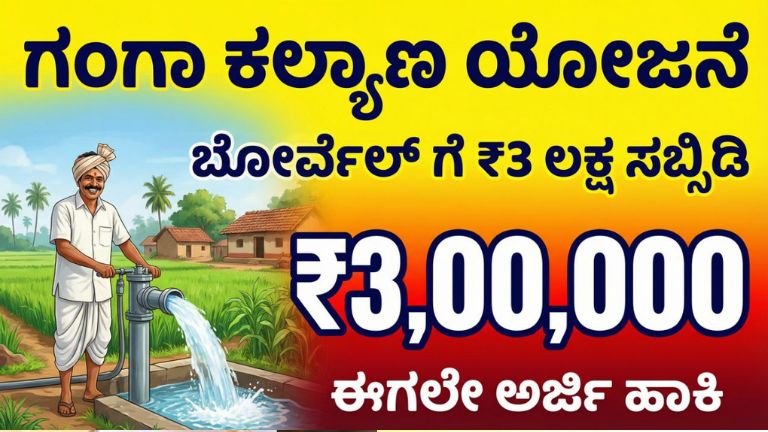
Ganga Kalyana Scheme: Get ₹3 Lakh Borewell Subsidy – Complete Guide for Farmers (2026)
Agriculture is the backbone of rural India. But for many small and marginal farmers, lack of irrigation facilities continues to be a major challenge. Rain-dependent farming leads to uncertainty, crop failure, and financial stress. To solve this issue and promote sustainable irrigation, the Government has introduced the Ganga Kalyana Scheme, which provides up to ₹3 lakh subsidy for borewell installation.
If you are a farmer looking for borewell subsidy assistance under this scheme, this detailed 3,000-word guide explains everything — eligibility, subsidy amount, documents required, application process, benefits, and frequently asked questions.
What is the Ganga Kalyana Scheme?
The Ganga Kalyana Scheme is a government initiative aimed at providing irrigation facilities to small and marginal farmers, particularly those belonging to Scheduled Castes (SC) and Scheduled Tribes (ST) communities.
The primary objective of the scheme is to:
- Provide irrigation through borewells
- Improve agricultural productivity
- Increase farmer income
- Reduce dependence on rainfall
- Support socially and economically weaker farmers
Under this scheme, eligible farmers can receive financial assistance up to ₹3 lakh for borewell drilling, pump set installation, and electrification.
Objective of the Scheme
The core objectives of the Ganga Kalyana Scheme include:
- Ensuring irrigation access to dry land farmers
- Empowering SC/ST farmers
- Increasing agricultural productivity
- Supporting sustainable groundwater usage
- Reducing rural poverty
Water availability directly impacts crop yield. By supporting borewell construction, the government ensures that farmers can cultivate multiple crops annually instead of depending on seasonal rainfall.
Subsidy Amount Under Ganga Kalyana Scheme
The scheme provides financial assistance up to:
- ₹3,00,000 (Three Lakh Rupees) per beneficiary
This amount typically covers:
- Borewell drilling charges
- Casing pipe installation
- Pump set cost
- Electrical connection
- Accessories and basic infrastructure
In some cases, the subsidy is fully funded (100%) depending on category and landholding. The amount is usually paid directly to the implementing agency or contractor.
Who Can Apply? (Eligibility Criteria)
To apply under the Ganga Kalyana Scheme, applicants must meet the following eligibility conditions:
1. Community Category
- SC / ST farmers (priority category)
- Other backward classes (in some districts based on availability)
2. Land Ownership
- Applicant must own agricultural land
- Land should be in the applicant’s name
- Land records must be updated
3. Land Type
- Dry land (non-irrigated)
- Suitable for borewell drilling
4. Income Criteria
- Annual family income must fall under government-defined limits
5. No Previous Benefit
- Applicant should not have previously received irrigation subsidy under the same scheme
Required Documents
Before applying, ensure you have the following documents ready:
- Aadhaar Card
- Caste Certificate
- Income Certificate
- RTC / Land Records
- Passport size photographs
- Bank account details
- Mobile number linked with Aadhaar
- Ration Card (if required)
All documents must be valid and updated to avoid rejection.
How to Apply for Ganga Kalyana Scheme?
The application process may vary by district, but generally follows these steps:
Step 1: Visit the Official Website or Department Office
Applications are usually processed through the Social Welfare or Tribal Welfare Department.
Step 2: Fill the Application Form
Provide personal details, land details, and irrigation requirement information.
Step 3: Submit Required Documents
Upload scanned copies or submit physical copies at the concerned office.
Step 4: Verification Process
Officials verify:
- Land ownership
- Eligibility
- Groundwater feasibility
Step 5: Technical Survey
A borewell feasibility survey may be conducted.
Step 6: Approval & Implementation
After approval:
- Borewell drilling is scheduled
- Pump installation is done
- Subsidy amount is utilized accordingly
How the Borewell Installation Works
Once approved, the government-authorized agency carries out:
- Site inspection
- Borewell drilling
- Casing installation
- Motor pump setup
- Electrical connection
The farmer is not required to directly manage contractors in most cases.
Key Benefits of the Scheme
1. Financial Relief
Farmers receive up to ₹3 lakh subsidy, reducing financial burden.
2. Assured Irrigation
Access to water improves crop yield.
3. Multiple Cropping
Farmers can grow 2–3 crops annually.
4. Income Increase
Higher production leads to better income.
5. Rural Development
Improves overall agricultural economy.
Why Borewell Irrigation is Important
In regions with irregular rainfall, irrigation plays a crucial role. Borewell irrigation:
- Provides year-round water supply
- Supports cash crops
- Enables horticulture
- Reduces crop failure risk
Without irrigation, farmers depend entirely on monsoon patterns, which are increasingly unpredictable due to climate change.
Selection Process
The beneficiary selection is usually based on:
- Community category
- Land ownership verification
- Economic background
- Availability of groundwater
- District-wise quota
Priority is often given to:
- Small and marginal farmers
- Women farmers
- First-time applicants
Common Reasons for Rejection
Applications may be rejected due to:
- Incomplete documentation
- Land disputes
- Already having irrigation facility
- Income exceeding limits
- Duplicate application
Always ensure documentation accuracy.
Timeline of Approval
Typically, the process may take:
- Application submission: 1–2 weeks
- Verification: 2–4 weeks
- Technical survey: 2 weeks
- Final approval: 1 month
- Implementation: 1–2 months
Timelines may vary depending on district workload.
Frequently Asked Questions (FAQ)
Q1: Is the ₹3 lakh subsidy given directly to farmers?
In most cases, the amount is released to the implementing agency.
Q2: Can women farmers apply?
Yes, if land is registered in their name.
Q3: Is there any application fee?
Generally, no major fee is charged.
Q4: Can farmers with existing borewells apply?
No, the scheme is intended for farmers without irrigation.
Q5: Can joint landowners apply?
Yes, but ownership clarity is required.
Important Points to Remember
- Update your land records before applying.
- Ensure Aadhaar is linked to bank account.
- Respond quickly to verification calls.
- Avoid middlemen or agents.
- Apply only through official channels.
Impact on Farmers
Thousands of farmers have benefited from irrigation schemes like Ganga Kalyana. With access to water:
- Crop diversification increases
- Vegetable farming becomes possible
- Dairy and allied activities improve
- Debt dependency reduces
Long-term impact includes financial stability and sustainable agriculture.
Role in Sustainable Agriculture
While borewells provide water access, sustainable groundwater management is essential. Farmers are encouraged to:
- Use drip irrigation
- Adopt water-efficient crops
- Practice rainwater harvesting
- Avoid over-extraction
Responsible water usage ensures long-term benefits.
Government Vision Behind the Scheme
The government aims to:
- Promote inclusive growth
- Empower marginalized communities
- Improve rural livelihoods
- Strengthen agriculture sector
Irrigation is a critical step toward doubling farmers’ income.
How This Scheme Helps Small Farmers
Small farmers often cannot afford borewell drilling, which can cost between ₹1.5 lakh to ₹3 lakh. This scheme removes the financial barrier and allows them to invest in productive farming.
With irrigation, farmers can grow:
- Vegetables
- Fruits
- Commercial crops
- Fodder crops
This diversifies income sources.
Comparison with Other Irrigation Schemes
Unlike loan-based irrigation programs, Ganga Kalyana provides subsidy support. It focuses specifically on marginalized communities and ensures implementation through authorized agencies.
This reduces corruption risks and ensures proper usage of funds.
Economic Benefits
The broader economic benefits include:
- Increased agricultural output
- Higher rural employment
- Improved local markets
- Strengthened rural economy
When farmers prosper, entire villages benefit.
Final Thoughts
The Ganga Kalyana Scheme is a powerful irrigation support initiative designed to uplift small and marginalized farmers. With a subsidy of up to ₹3 lakh for borewell installation, it provides financial relief and ensures reliable water supply.
If you are eligible, gather your documents and apply through official government channels. Proper irrigation can transform your farming journey and secure your financial future.
Water is life — and with the right support, it can also be prosperity.
Ganga Kalyana Scheme – Step-by-Step Application Guide for ₹3 Lakh Borewell Subsidy (2026)
The Ganga Kalyana Scheme provides up to ₹3 lakh subsidy to eligible farmers for borewell drilling, pump installation, and electrification. If you are planning to apply, follow this complete step-by-step guide carefully to avoid rejection.
Step 1: Check Your Eligibility
Before applying, confirm that you meet these conditions:
- You belong to SC / ST category (priority group)
- You own agricultural land (dry land preferred)
- Land is in your name in RTC records
- You do not already have irrigation facility
- Your family income is within government limits
- You have not taken benefit under the same scheme earlier
If all conditions match, proceed to the next step.
Step 2: Keep All Required Documents Ready
Prepare clear copies of:
- Aadhaar Card
- Caste Certificate
- Income Certificate
- RTC / Land Records
- Bank Passbook copy
- Passport size photo
- Mobile number linked with Aadhaar
Make sure:
- Land records are updated
- Name spelling matches in all documents
- Bank account is active
Incomplete documentation is the main reason for rejection.
Step 3: Visit the Concerned Department Office
Applications are generally processed through:
- Social Welfare Department (for SC farmers)
- Tribal Welfare Department (for ST farmers)
- District Minorities & Backward Classes Office (if applicable)
You can visit your Taluk Office or District Office and ask for the Ganga Kalyana Scheme application form.
In some districts, online applications may also be available through official government portals.
Step 4: Collect and Fill the Application Form
Carefully fill:
- Applicant name (as per Aadhaar)
- Father/Husband name
- Address
- Land survey number
- Land extent
- Category details
- Bank details
Do not leave any mandatory field blank.
Double-check:
- Survey number accuracy
- Mobile number correctness
- Bank IFSC code
Mistakes here can delay approval.
Step 5: Submit Application with Documents
Attach all required documents and submit:
- At Taluk Office
- At District Social Welfare Office
- Or upload online (if portal available)
Ask for:
- Acknowledgment receipt
- Application reference number
Keep this safely for future tracking.
Step 6: Verification Process
After submission, officials will:
- Verify land ownership
- Confirm caste certificate
- Check income eligibility
- Ensure you do not already have irrigation
You may receive:
- A phone call for confirmation
- A field visit from officials
Cooperate during inspection.
Step 7: Technical Feasibility Survey
A technical team may visit your land to:
- Check groundwater availability
- Confirm borewell feasibility
- Identify drilling location
If groundwater is not feasible, application may be postponed or rejected.
Step 8: Beneficiary Selection
Selection depends on:
- Category priority
- District quota
- Availability of funds
- Verification report
If approved, your name will be included in the beneficiary list.
Step 9: Borewell Drilling & Installation
After approval:
- Government-authorized agency handles drilling
- Borewell casing is installed
- Pump set is fitted
- Electrical connection arranged
You usually do not need to pay full cost upfront (depends on district implementation model).
The subsidy amount (up to ₹3 lakh) is directly released to the implementing agency.
Step 10: Completion & Final Inspection
After installation:
- Officials inspect the borewell
- Ensure work is completed properly
- Record project completion
Once finalized, your irrigation facility becomes operational.
Important Tips to Avoid Rejection
- Ensure land is dispute-free
- Update RTC before applying
- Do not submit fake documents
- Avoid middlemen or agents
- Track your application regularly
Application Timeline (Approximate)
- Application submission: 1–2 weeks
- Verification: 2–4 weeks
- Survey: 2 weeks
- Approval: 1 month
- Implementation: 1–2 months
Total process may take 2–4 months depending on district.
Frequently Asked Questions
Is the ₹3 lakh subsidy given to farmer directly?
Usually paid to authorized drilling agency.
Can women farmers apply?
Yes, if land is registered in their name.
Is online application available?
Depends on district notification.
Is there any application fee?
Generally no major fee is charged.
Click Hear to Apply
The Ganga Kalyana Scheme is a valuable opportunity for farmers who lack irrigation facilities. Follow each step carefully, maintain proper documentation, and respond quickly during verification.
Proper irrigation can significantly improve crop yield and increase annual income.