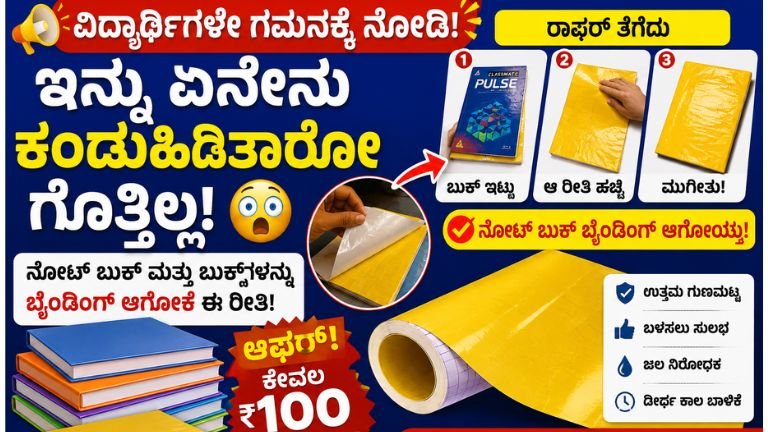
The Evolution of Student Life: How Self-Adhesive Book Covers are Revolutionizing Study Routines
Technology and innovation have a fascinating way of entering our lives. Often, we look at groundbreaking inventions like smartphones, electric vehicles, or artificial intelligence and marvel at human ingenuity. But sometimes, the most impactful innovations are the ones that solve the silent, everyday struggles we have faced for generations.
For students, parents, and teachers, one of those age-old struggles has been the tedious, frustrating, and time-consuming ritual of binding and covering school notebooks and textbooks.
Recently, a wave of curiosity has taken over social media and school corridors alike. People are amazed by a simple yet brilliant product that makes book binding as easy as peeling a sticker. As the viral observation goes: “Look at what they are inventing next! To bind notebooks and books, you just remove this kind of wrapper, place the book, and press it down like this—and that’s it, your notebook is bound! You get these binding covers on offer; you can get 50 binding sheets for just 100 rupees.”
This simple product—the self-adhesive, waterproof book cover sheet—is rapidly replacing the traditional plastic rolls, brown paper sheets, scissors, and adhesive tapes that families have relied on for decades. In this comprehensive deep-dive, we will explore why this minor innovation is causing such a major shift, the economics behind it, a step-by-step guide to using it perfectly, and how small utility innovations drastically improve our daily quality of life.
The Great School Ritual: Remembering the “Brown Paper” Era
To truly appreciate why a $100\text{-rupee}$ pack of self-adhesive sheets is causing such excitement, we have to look back at the traditional method of covering books.
For decades, the start of a new academic year meant one major chore for families: covering an entire stack of 20 to 30 notebooks and textbooks. This process was practically an art form, requiring a specific toolkit and an immense amount of patience:
-
A massive roll of brown paper or thick plastic sheeting.
-
A pair of scissors that inevitably went missing right when you needed them.
-
Rolls of clear adhesive tape or a bottle of liquid glue that took forever to dry.
-
Two people working in unison—one to hold the book flat and tight, and the other to cut, fold, and tape the corners.
The Struggles of the Traditional Method
Despite the nostalgia associated with the smell of new books and brown paper, the traditional process was riddled with flaws:
-
The “Bubble” Problem: Achieving a perfectly flat, bubble-free cover with a standard plastic roll was nearly impossible. One wrong move, and the plastic would crease, leaving unsightly air pockets across the cover.
-
Corner Tears: Folding the corners into perfect triangles required geometric precision. If done poorly, the corners of the book would exposed, leading to frayed edges within the first two months of school.
-
Time Consumption: Covering a single book properly could easily take 10 to 15 minutes. Multiply that by an entire syllabus of subjects, and parents were looking at dedicating a whole weekend to nothing but cutting and taping.
-
Short Lifespan: Brown paper covers tear easily under the rough handling of school life. Rainwater leaking into a schoolbag could ruin the cover instantly, turning it into mush and damaging the book underneath.
The self-adhesive binding sheet changes all of this. It eliminates the scissors, removes the need for external tape, and cuts the time required down from fifteen minutes to less than sixty seconds.
Anatomy of the Modern Self-Adhesive Book Binder
What exactly is this product that has people saying, “I wonder what they will invent next”?
At its core, a modern self-adhesive book cover sheet is a pre-cut, highly flexible, transparent polymer sheet designed specifically to fit standard textbook and notebook dimensions (such as A4 or King Size).
+---------------------------------------------------+
|               Release Paper (Grid Lines)          |
|  [ Peel Here ]                                    |
+---------------------------------------------------+
|       Pressure-Sensitive Adhesive (Glue Layer)     |
+---------------------------------------------------+
|   PP/PVC Waterproof Protective Film (Transparent) |
+---------------------------------------------------+
The engineering behind it relies on three distinct layers:
1. The Release Liner (The Wrapper)
This is the paper or plastic backing that keeps the adhesive fresh and non-sticky until you are ready to use it. High-quality variants feature grid lines printed on this backing sheet, allowing users to align their books perfectly straight before peeling.
2. The Pressure-Sensitive Adhesive (PSA)
Unlike traditional liquid glues that saturate paper and cause wrinkles, PSAs remain in a semi-solid state. They form a bond when pressure is applied to fuse the film with the book cover. The magic of this adhesive is that it is often repositionable during the first few seconds of application, allowing you to lift and fix it if you make an alignment mistake.
3. The Protective Film
Made from durable plastics like Polypropylene (PP) or Polyvinyl Chloride (PVC), this outer layer is scratch-resistant, spill-proof, and entirely clear. It preserves the original artwork and titles printed on the book cover while adding a protective shield.
Step-by-Step Guide: How to Apply Self-Adhesive Covers Without Bubbles
While the process is incredibly straightforward, achieving a flawless, professional finish requires a tiny bit of technique. Here is how you can transform a raw notebook into a neatly bound, protected book in under a minute:
Step 1: Clean Your Workspace and Alignment
Place your book on a clean, flat table. Dust off any particles from the book cover, as trapped dust will create permanent micro-bubbles under the transparent sheet.
Step 2: Position the Book
Take one self-adhesive sheet. Before peeling off the protective backing wrapper, place your book on top of it to check the alignment. Ensure there is an equal margin of extra sheet extending past all four edges of the book.
Step 3: The Partial Peel Technique
Do not rip off the entire wrapper at once! This is the most common mistake. Instead, peel back roughly 2 to 3 inches of the backing wrapper from one edge, exposing a small strip of the adhesive.
Step 4: Secure the Spine or Edge
Align the exposed adhesive strip with the front edge or the spine of the book. Press it down firmly using your fingers or a flat tool like a plastic ruler or an old ID card.
Step 5: Smooth and Peel Simultaneously
Slowly pull the remaining backing wrapper away with one hand. At the same time, use your other hand (equipped with a ruler or cloth) to smooth the transparent sheet onto the book cover moving from the center outward. This pushes out air and ensures zero bubble formation.
Step 6: Deal with the Corners and Borders
Once the main face of the cover is adhered, open the book. You will have extra flaps extending past the edges. Simply fold these over the inside margins of the cardboard cover and press down. The book is now completely sealed against dust, moisture, and rough handling.
The Economics: Dissecting the 100-Rupee Deal
One of the most attractive aspects mentioned is the incredible affordability: 50 sheets for just 100 rupees. Let’s break down the economics of this offer to understand why it represents an absolute bargain for students and parents.
| Component | Traditional Roll Method | Self-Adhesive Sheets (Offer Price) |
| Initial Cost | ₹60 – ₹80 per roll of plastic/paper | ₹100 for a pack of 50 pre-cut sheets |
| Additional Tools | Scissors (₹30), Clear Tape x2 (₹40) | None required |
| Total Monetary Investment | Approx. ₹130 – ₹150 | ₹100 flat |
| Average Yield | 10 to 12 books per roll | 50 books or notebook faces |
| Cost Per Book Face | ~₹12 to ₹15 per book | ₹2 per book |
| Time Investment | 10–15 minutes per book | Less than 1 minute per book |
When analyzed per unit, paying ₹2 per sheet to perfectly bind and protect a notebook is an incredibly smart financial decision. Beyond the raw monetary savings, the value of the time saved is immense. For a busy parent or a student balancing assignments, saving 3 to 4 hours of tedious manual labor at the start of a school term is well worth a ₹100 bill.
Why This Innovation Matters: The Power of Micro-Conveniences
It is easy to dismiss a product like an adhesive book cover as a trivial novelty. However, in the grand scheme of product design, this falls into a highly impactful category known as micro-convenience innovations.
A micro-convenience product takes an existing, functional task that contains high “friction” (steps that cause minor frustration, mess, or delays) and completely redesigns it to lower the barrier of effort.
[ Traditional Friction ]              [ Micro-Convenience Solution ]
Find Scissors -> Cut Straight      \
Buy External Tape -> Manage Tangling -> ===>  Pre-cut Sheet + Built-in Adhesive
Hold Book Down Flat -> Smooth Flaps /
Other historic examples of micro-conveniences include:
-
The transition from buttoned shirts to zippers on schoolbags.
-
The evolution of liquid glue bottles into solid glue sticks that don’t spill.
-
The shift from lace-up shoes to velcro straps for young children.
These inventions do not change the laws of physics, nor do they introduce complex computing power into our homes. Instead, they optimize human behavior. By eliminating the pain points of an activity, they free up mental energy and time for tasks that matter more—like studying, playing, or resting.
Environmental and Practical Advantages
Aside from saving money and time, these self-adhesive binding covers provide several practical advantages that align perfectly with the needs of modern students:
1. Superior Waterproof Protection
School bags are prone to accidents. Whether it’s an improperly closed water bottle leaking inside the bag or an unexpected downpour on the walk home from the bus stop, paper books are always at risk. Traditional paper covers soak up water, causing pages to wrinkle and ink to bleed. The PP/PVC material of modern adhesive wraps acts as a complete hydro-barrier; water simply beads up and slides off, keeping notes completely dry.
2. Reduced Bulk and Weight
Traditional heavy-gauge plastic wrapping adds noticeable thickness and weight to a book, especially when multiplied across seven or eight subjects in a backpack. Adhesive sheets are ultra-thin (measured in microns), providing maximum strength without adding bulk to an already heavy school bag.
3. Clear Identification
Because these sheets are crystal clear, students don’t need to peel back covers or create messy handwritten labels just to check which notebook belongs to which subject. The original design, color, or printed label of the book remains fully visible, streamlining organization during frantic class transitions.
A Lifesaver Across Demographics
While school-goers are the primary demographic benefitting from this product, the utility of quick, cheap adhesive binding sheets stretches far beyond primary education:
College Students and Competitive Exam Aspirants
Students preparing for intense competitive exams deal with heavy reference manuals that are referenced thousands of times over multiple years. Standard bindings easily fall apart under this level of wear. Using a self-adhesive wrapper reinforces the spine and external covers of thick paperbacks, ensuring they survive years of intense study library sessions.
Teachers and School Administrators
Teachers routinely maintain lesson plan logs, attendance registers, and academic diaries that remain in active use throughout the year. A quick, clean covering system allows educators to organize their desks neatly without dedicating precious personal hours to arts-and-crafts style book preparation.
Home Libraries and Book Lovers
For avid readers who take pride in maintaining their personal collections, these sheets offer an affordable way to safeguard
paperback novels from finger oils, dust accumulation, and edge yellowing without altering the look of their beloved covers.
The Joy of Simple Solutions
The fascination surrounding these simple self-adhesive sheets is a great reminder that true utility doesn’t always require high technology. Sometimes, all it takes is a clever twist on an old concept—taking a standard plastic protective film, pairing it with a smart, pressure-sensitive adhesive layer, and packaging it at an accessible price point that anyone can afford.
For ₹100 for 50 sheets, this product represents a massive win for efficiency, household budgeting, and stress reduction. It transforms a tedious, multi-step chore into a quick, satisfying task that even a child can execute safely.
The next time you prepare for a new academic term, step away from the tangled rolls of tape and clumsy scissors. Embrace the simplicity of modern utility design, pick up a pack of self-adhesive binding covers, and watch your books transform into neat, waterproof, durable learning tools with a simple peel and press. It truly is amazing to see how simple adjustments make everyday life a whole lot smoother!