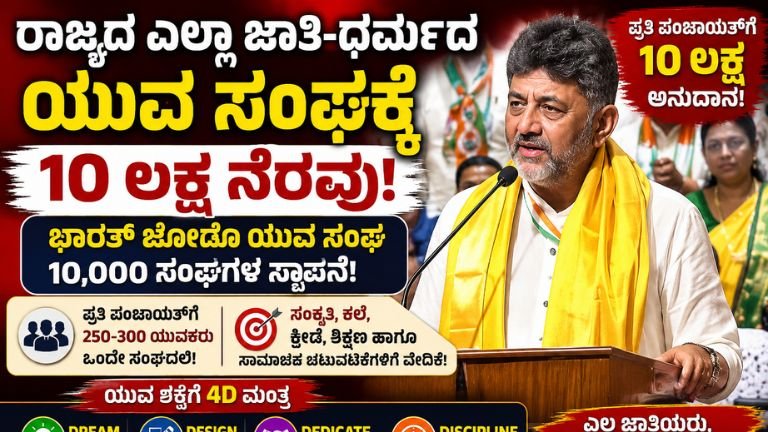
Bharat Jodo Yuva Sangha: A Vision to Build 10,000 Youth Organisations Across Gram Panchayats
A New Vision for Youth Unity, Culture and Rural Development
Young people are one of the greatest strengths of India. With a large and energetic youth population, the country has enormous potential for social development, cultural preservation, community participation and nation-building. However, this potential can be fully realised only when young people receive the right platform, guidance and opportunities to come together.
A new vision has been discussed around creating a network of youth organisations at the Gram Panchayat level under the name “Bharat Jodo Yuva Sangha.” The idea is to establish approximately 10,000 youth organisations, with each organisation bringing together around 250 to 300 young people from its respective Panchayat.
The proposed concept focuses on bringing young people from different communities and backgrounds together without discrimination. It aims to create a platform where youth can participate in cultural activities, preserve local traditions, organise community programmes and contribute to social development.
One of the major proposals associated with this vision is to provide ₹10 lakh for each Panchayat-level youth organisation to support its activities. This should be understood as a proposal or vision rather than an automatically approved government scheme unless and until an official government order or notification confirms the funding.
The Four D Formula for Achieving Dreams
At the heart of this vision is a simple but powerful philosophy known as the Four D formula.
The four Ds are:
- Dream
- Design
- Dedicate
- Discipline
These four principles can be useful for anyone who wants to achieve a meaningful goal in life.
1. Dream
Every major achievement begins with a dream.
Young people should be encouraged to dream about their future, their communities and their country. A dream gives direction and motivates a person to move forward.
A student may dream of becoming a doctor, engineer, teacher, entrepreneur, government employee, artist or social worker. Similarly, a village youth may dream of developing their community, protecting local culture or creating employment opportunities.
Without a dream, it can be difficult to decide where to go.
The first message of the Four D philosophy is therefore simple:
Dream big and believe that your dream is possible.
2. Design for the Dream
Dreaming alone is not enough. A dream needs a plan.
The second D is Design.
Once a person decides what they want to achieve, they need to create a practical plan. They need to identify the steps required to reach their goal.
For example, if young people want to improve their village, they can identify important issues such as education, cleanliness, employment, sports, cultural activities, digital literacy and environmental protection.
The youth organisation can then design activities around these needs.
A clear plan transforms a dream into an achievable objective.
3. Dedicate Yourself to the Dream
The third D is Dedication.
Every meaningful goal requires commitment. There may be obstacles, delays and failures along the way. Young people need the determination to continue working toward their objectives.
Dedication means giving time, effort and energy to the goal.
A youth organisation will also require dedicated members who are willing to participate in meetings, programmes, cultural activities, social-service initiatives and community development projects.
4. Discipline for the Dream
The fourth D is Discipline.
Even a great dream and a strong plan can fail without discipline.
Discipline means consistently following the plan, respecting responsibilities and continuing the work even when motivation becomes weak.
For young people, discipline can mean attending educational programmes, developing useful skills, participating in community activities and using their time productively.
The Four D formula therefore creates a simple journey:
Dream → Design → Dedicate → Discipline
This philosophy can encourage young people to move from ideas to action.
What Is Bharat Jodo Yuva Sangha?
The proposed Bharat Jodo Yuva Sangha is envisioned as a grassroots youth organisation that would operate at the Gram Panchayat level.
The central idea is to provide young people with a common platform where they can come together, irrespective of caste, community or social background.
Under the proposal, approximately 10,000 organisations could be established across Panchayats.
Each organisation could potentially include around 250 to 300 young people.
This would create a large network of youth members who could participate in social, cultural and community-oriented activities.
The objective would not simply be to create another organisation. The larger vision would be to create a platform through which young people can develop leadership skills, preserve cultural traditions and contribute to their communities.
Bringing Young People Together
One of the most important aspects of the proposed organisation is inclusiveness.
Young people from different castes, communities and backgrounds could become members of the same organisation.
India is known for its diversity. Every region has its own language, traditions, festivals, art forms, food, music and cultural practices.
Youth organisations can provide an opportunity for young people to understand and respect this diversity.
Instead of remaining divided by social differences, young people could work together on common objectives.
The concept of “Bharat Jodo” itself represents the broader idea of bringing people together.
Preserving Local Culture and Traditions
The proposed youth organisations could also play an important role in preserving local culture.
Many traditional art forms and local practices are gradually disappearing because younger generations may not always have opportunities to learn about them.
Panchayat-level youth organisations could organise programmes related to:
- Traditional music
- Folk dances
- Local festivals
- Traditional games
- Folk theatre
- Local history
- Traditional crafts
- Village cultural programmes
- Language and literature
- Heritage awareness
Such activities could help young people understand their roots while also providing opportunities for talented individuals to showcase their skills.
Sports and Youth Activities
Sports can be another major area of activity.
Rural youth often have talent in cricket, football, kabaddi, volleyball, athletics and other sports but may not always have sufficient platforms to participate.
A Panchayat-level youth organisation could organise:
- Village sports competitions
- Kabaddi tournaments
- Volleyball tournaments
- Cricket competitions
- Athletics events
- Traditional sports
- Fitness programmes
- Youth competitions
Such activities can encourage physical fitness, teamwork and healthy competition.
They can also help identify talented young athletes who may have the potential to compete at higher levels.
Education and Skill Development
Youth organisations could also focus on education and skill development.
Young people can organise awareness programmes about government examinations, scholarships, vocational training and employment opportunities.
Possible activities could include:
- Career guidance programmes
- Competitive examination awareness
- Digital literacy camps
- Computer training
- Spoken English programmes
- Entrepreneurship awareness
- Financial literacy
- Skill-development workshops
- Employment information sessions
This could be especially useful for rural students and young job seekers who may not have easy access to career guidance.
Social Service Activities
The proposed organisations could become platforms for community service as well.
Young volunteers could participate in activities such as:
- Village cleanliness drives
- Tree plantation
- Blood donation awareness
- Road-safety campaigns
- Anti-drug awareness
- Environmental programmes
- Helping elderly residents
- Supporting community events
- Disaster-response volunteering
Such programmes can help develop a sense of responsibility among young people.
Youth participation in community activities can also strengthen relationships between different sections of society.
The Proposed ₹10 Lakh Support
One of the major points in the vision is a proposal to provide ₹10 lakh for each Panchayat-level youth organisation for conducting activities.
If implemented through an appropriate government programme, such funding could potentially be used for youth-oriented activities, cultural programmes, sports, training, equipment and community initiatives.
However, it is important to clearly distinguish between a proposal and an officially sanctioned scheme.
The availability of ₹10 lakh should not be treated as guaranteed financial assistance unless the competent government authority issues an official order, budget allocation, notification or scheme guidelines confirming it.
If such funding is officially introduced in the future, transparent rules would be important.
There would need to be clear guidelines regarding:
- Eligibility
- Fund utilisation
- Account management
- Approved activities
- Auditing
- Reporting
- Monitoring
- Transparency
- Responsibilities of the organisation
Proper financial management would help ensure that funds are used for genuine youth and community development activities.
Why Panchayats Could Be the Right Level
Gram Panchayats are close to local communities.
Unlike large state-level organisations, Panchayat-level groups can understand the specific needs of their villages.
One village may need sports facilities, while another may need educational programmes. Some communities may have unique folk traditions that need preservation. Others may benefit more from employment and skill-development activities.
Local youth can identify these needs more effectively because they live in the community.
A Panchayat-level structure could therefore allow activities to be designed according to local priorities.
Building Youth Leadership
Another potential benefit of such organisations is leadership development.
Young people who participate in organising events can learn important skills such as:
- Team management
- Communication
- Public speaking
- Event planning
- Financial management
- Problem solving
- Decision making
- Conflict resolution
- Community engagement
These skills can be useful not only in social activities but also in education, employment and entrepreneurship.
A youth organisation can therefore become a practical leadership school for young people.
One Platform, Many Communities
The strength of the proposed concept lies in bringing different groups together.
A successful youth organisation should provide equal opportunities for participation.
Young people should be able to join activities based on their interests and abilities rather than their social background.
For example, one person may be interested in sports, another in music, another in technology and another in social service.
All of them can contribute to the same organisation in different ways.
This diversity can make the organisation stronger.
From a 25-Year-Old Idea to a New Vision
The concept is also connected to an earlier effort that was reportedly considered around 25 years ago.
At that time, the necessary financial resources were not available to develop the idea on a larger scale. Without sufficient funding and organisational support, the initiative could not progress as intended.
Today, the circumstances are different. Technology, communication systems and digital platforms have made it easier to connect young people across villages and districts.
A new generation of youth is also more connected through smartphones, social media and online education.
This creates an opportunity to rethink how grassroots youth organisations can function in modern India.
The Role of Technology
Technology could become an important part of a future Panchayat-level youth network.
Each organisation could potentially use digital platforms for:
- Membership management
- Event announcements
- Training programmes
- Online meetings
- Skill-development sessions
- Government scheme awareness
- Sports registrations
- Cultural programme promotion
- Volunteer coordination
Digital tools could also make it easier to maintain transparent records of activities and expenditure.
At the same time, organisations should ensure that people without advanced digital skills are not excluded.
A Vision for Rural Youth
The broader objective of the Bharat Jodo Yuva Sangha concept is to give rural youth a stronger platform.
Young people should not feel that opportunities are available only in cities.
With the right support, rural youth can become entrepreneurs, artists, athletes, teachers, skilled professionals and community leaders.
A well-organised Panchayat-level network could help connect young people with opportunities while allowing them to remain connected to their communities.
What Would Make the Initiative Successful?
If such a proposal is implemented, several factors would be important.
First, membership should be inclusive.
Second, the organisation should have clearly defined objectives.
Third, financial support should be managed transparently.
Fourth, activities should focus on genuine youth development rather than becoming limited to ceremonial programmes.
Fifth, young people should have an active role in decision-making.
Finally, the success of the programme should be measured through actual outcomes such as participation, skills developed, cultural programmes conducted, sports opportunities created and community-service activities completed.
Conclusion
The vision of establishing 10,000 Bharat Jodo Yuva Sanghas across Gram Panchayats represents an ambitious idea focused on youth participation, social unity, culture and rural development.
The proposal suggests bringing approximately 250 to 300 young people together in each Panchayat, irrespective of caste or background, and creating a common platform for cultural, educational, sporting and social activities.
The philosophy behind the initiative can be remembered through the Four Ds: Dream, Design, Dedicate and Discipline.
Young people must first dream of a better future. They must then design a practical path to achieve that dream, dedicate themselves to the goal and maintain discipline throughout the journey.
The proposal for ₹10 lakh per Panchayat could provide substantial support if it is formally approved and implemented through official government guidelines. Until an official notification confirms such funding, however, it should be treated as a proposal rather than a guaranteed government benefit.
Apply Link: Official application link will be updated after the scheme is officially launched.
Ultimately, the success of any youth initiative depends on the participation and commitment of young people themselves. If young citizens come together, respect diversity, preserve their culture, develop useful skills and work for their communities, they can become a powerful force for positive change.
Bharat Jodo Yuva Sangha, if formally established with proper rules, transparent funding and inclusive participation, could provide a grassroots platform for young people to dream, plan, dedicate themselves and work with discipline toward a stronger and more united society.