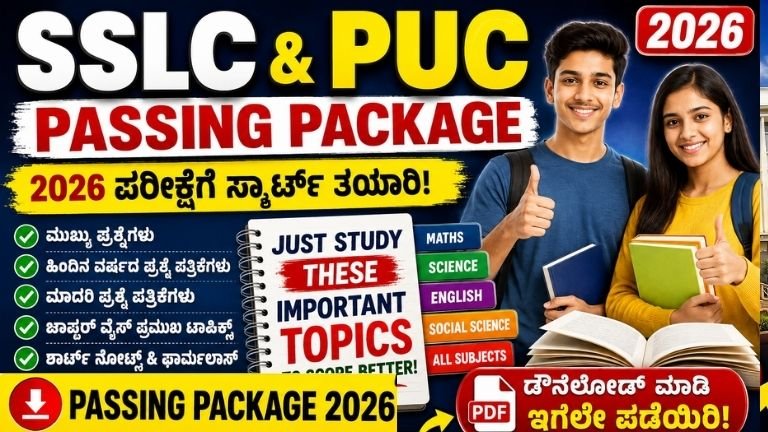
SSLC & PUC Passing Package 2026: Important Topics, Smart Study Plan and Exam Preparation Guide
SSLC & PUC Passing Package 2026: Board examinations can be stressful, especially when students have limited preparation time and a large syllabus to complete. Many Karnataka students search for important questions, repeated topics, model papers and quick revision materials to make their preparation more organised.
The SSLC and PUC Passing Package 2026 is designed as an exam-oriented study resource that can help students identify important areas and plan their revision efficiently. Instead of spending the same amount of time on every chapter, students can use a structured approach to prioritise concepts, practise questions and revise frequently.
However, students should remember one important point: no passing package can guarantee marks or a particular result. It should be used as a supporting study resource along with textbooks, classroom notes, previous examination papers and the official syllabus.
What Is the SSLC & PUC Passing Package 2026?
A passing package is essentially a focused revision resource created to help students prepare for examinations in a systematic manner.
Depending on the subject and study material, such a package may contain:
- Important chapter-wise questions
- Frequently discussed concepts
- Short-answer questions
- Long-answer questions
- Definitions and key points
- Important formulas
- Previous-year question patterns
- Model question papers
- Revision notes
- Practice exercises
- Answer-writing guidance
The biggest advantage of this type of material is organisation. Instead of searching through several sources, students can use a single revision framework to identify areas that deserve additional attention.
The package should not be considered a replacement for the complete syllabus. Students should first understand their subjects and then use important-question materials to strengthen their preparation.
Why Students Look for Passing Packages
Board examinations require consistent preparation. Students sometimes know what they need to study but struggle to decide what to study first.
This becomes particularly difficult when examinations are approaching and there are many chapters remaining.
A focused package can help students divide their preparation into manageable sections.
For example, a student can first revise important concepts from a chapter, practise questions based on those concepts, and then move to the next chapter.
This method can reduce unnecessary confusion and make revision more practical.
A good revision package can help students:
- Organise their study schedule
- Identify high-priority topics
- Revise difficult chapters
- Practise likely question formats
- Improve writing speed
- Strengthen memory through repeated revision
- Find weak areas
- Build examination confidence
The key is to use the package actively rather than simply downloading it and reading it once.
SSLC 2026 Preparation Strategy
SSLC students should create a subject-wise preparation plan. Every subject requires a slightly different approach.
Reading a theory chapter and solving a mathematics problem are completely different activities. Therefore, students should adjust their study method according to the subject.
1. Language Subjects
Language subjects can become scoring subjects when students understand the expected answer format and practise regularly.
Students should revise:
- Prose lessons
- Poetry
- Grammar
- Vocabulary
- Writing skills
- Letter writing
- Essay writing
- Comprehension
- Textbook questions
- Short-answer questions
Rather than memorising every answer word-for-word, students should understand the central idea of each lesson.
For essays and letters, practise the correct format. Proper structure, relevant points and clear handwriting can make answers easier for examiners to evaluate.
Grammar also deserves regular practice because students can improve accuracy by solving exercises repeatedly.
2. Mathematics
Mathematics requires practice rather than passive reading.
A student may understand a solution while watching someone else solve it but still struggle when attempting a similar problem independently.
For this reason, students should maintain a separate mathematics practice notebook.
Important preparation areas may include:
- Formulas
- Algebra
- Geometry
- Theorems
- Graph-related questions
- Constructions
- Mensuration
- Statistics
- Probability
- Repeated problem patterns
Students should first understand the formula or method and then solve several problems without looking at the solution.
Previous examination papers can also help students become familiar with the way questions are presented.
3. Science
Science preparation should include conceptual understanding as well as memorisation of important facts.
Students should revise Physics, Chemistry and Biology systematically.
Pay attention to:
- Definitions
- Laws
- Formulae
- Chemical equations
- Scientific processes
- Diagrams
- Experiments
- Differences between concepts
- Short-answer questions
- Descriptive questions
For diagram-based questions, students should practise drawing and labelling diagrams correctly.
In theory answers, important scientific terms should be used appropriately. Students should avoid unnecessarily long answers when a question can be answered clearly in a few relevant points.
4. Social Science
Social Science can appear difficult because of the volume of information students need to remember.
The best solution is to break the syllabus into smaller sections.
Students can create short notes covering:
- Historical events
- Important personalities
- Dates
- Movements
- Geographical concepts
- Maps
- Political institutions
- Government-related topics
- Economic concepts
Instead of attempting to memorise entire textbook paragraphs, students can convert longer information into headings and bullet points.
For long answers, use an introduction, main points and conclusion wherever appropriate.
PUC 2026 Preparation Plan
PUC students should follow a more detailed strategy because the subjects can involve deeper concepts and more extensive answer writing.
Students should first identify their stream and then prepare subject-wise.
Science Stream
Science students should combine conceptual learning with numerical and written practice.
Depending on the subject, revision can include:
- Important concepts
- Derivations
- Formulae
- Numerical problems
- Chemical reactions
- Diagrams
- Definitions
- Application-based questions
- Previous question papers
For Physics and Mathematics, regular problem-solving is essential.
For Chemistry, students should understand reactions and concepts rather than simply memorising isolated equations.
For Biology, diagrams, terminology and conceptual explanations deserve particular attention.
Commerce Stream
Commerce students need a balance between theory and practical problem-solving.
Accountancy
Practise accounting problems repeatedly. Students should understand the format and sequence used in solving different types of questions.
Pay attention to:
- Journal entries
- Ledger-related concepts
- Financial statements
- Accounting adjustments
- Important formats
- Numerical problems
Business Studies
Business Studies requires strong understanding of definitions, principles, functions and concepts.
Students should practise writing answers using clear headings and relevant points.
Economics
Economics preparation should include:
- Definitions
- Concepts
- Graphs
- Diagrams
- Important theories
- Numerical or application-based areas where applicable
Writing practice is particularly useful because students need to present economic concepts clearly within the available examination time.
Arts Stream
Arts students generally need strong memory, conceptual understanding and answer-writing skills.
Students can revise:
- History
- Political Science
- Geography
- Sociology
- Economics
- Important thinkers and personalities
- Major events
- Definitions
- Long-answer topics
For descriptive subjects, students should practise writing complete answers rather than merely reading them.
How to Use the Passing Package Effectively
Downloading a passing package is only the first step.
Students should follow a practical process to get the most benefit from it.
Step 1: Compare It With Your Syllabus
Before beginning, compare the material with your current official syllabus.
Do not spend excessive time studying topics that are not part of the examination syllabus.
Step 2: Mark Strong and Weak Chapters
Divide chapters into three groups:
Strong: Topics you already understand.
Average: Topics requiring additional revision.
Weak: Topics you find difficult or have not studied properly.
Spend more time on the weak and average sections while continuing to revise strong chapters.
Step 3: Study the Concept First
Do not immediately memorise an important question.
First understand the concept behind it.
Once the concept is clear, remembering the answer becomes easier.
Step 4: Practise Writing
Take important questions and write answers without looking at your notes.
After finishing, compare your response with your study material and identify missing points.
Step 5: Revise Again
Revision should happen multiple times.
A useful pattern is:
Learn → Practise → Revise → Test → Correct → Revise Again
This approach is more effective than studying a chapter only once.
Previous Question Papers Are Important
Previous question papers can help students understand the examination structure.
They can reveal:
- Question formats
- Marks distribution
- Repeated concepts
- Difficulty level
- Time requirements
- Frequently tested areas
However, students should not assume that a question appearing several times in previous years will definitely appear again.
Past papers should be used to understand patterns, not to predict the exact future paper.
Model Papers and Mock Tests
Mock tests are one of the most useful parts of last-stage preparation.
Choose a model paper and attempt it under examination conditions.
Keep your phone away, set a timer and complete the paper within the prescribed duration.
After finishing, evaluate:
- Which questions were difficult?
- Which answers were incomplete?
- Where did you lose time?
- Did you make calculation mistakes?
- Did you forget important points?
- Was your handwriting clear?
- Did you attempt every question correctly?
Use these observations to improve the next test.
A Simple Daily Study Routine
Students do not necessarily need to study continuously for the entire day.
A focused timetable can be more productive.
Morning Session
Revise formulas, definitions, vocabulary and previously studied topics.
Afternoon Session
Study a new chapter or difficult concept.
Evening Session
Solve mathematics, science numericals or other practice questions.
Night Session
Conduct a short revision of everything studied during the day.
Students should also take short breaks between study sessions. Adequate sleep is important because tiredness can reduce concentration and memory.
How to Improve Answer Writing
Knowing the answer is only part of examination preparation. Students must also present it properly.
Follow these simple principles:
Use Headings
Divide long answers into meaningful sections.
Write Relevant Points
Avoid adding unrelated information simply to make an answer longer.
Underline Important Terms
Where appropriate, underline key words or phrases so important points are easy to identify.
Draw Diagrams When Required
Use diagrams for questions where they are relevant.
Maintain Neatness
Clear handwriting and proper spacing can improve the readability of your paper.
Manage Time
Do not spend too much time on one difficult question.
If necessary, move forward and return to it later.
Can the Passing Package Guarantee a Pass?
No study package can honestly guarantee that a student will pass an examination.
Results depend on many factors, including:
- Preparation
- Understanding
- Revision
- Practice
- Answer writing
- Time management
- Examination performance
The package should therefore be considered a revision aid, not a shortcut to success.
Students who combine the package with textbooks, classroom teaching, previous papers and mock tests can create a stronger preparation strategy.
Common Mistakes Students Should Avoid
Depending Only on Important Questions
This is one of the biggest mistakes.
A student who studies only selected questions may struggle if the examination paper asks questions in a different format.
Ignoring Difficult Subjects
Students sometimes repeatedly study their favourite subjects and avoid difficult ones.
Instead, allocate additional time to weak subjects.
Reading Without Writing
Reading an answer several times does not necessarily mean you can reproduce it during an examination.
Practise writing.
Studying Everything at the Last Minute
Last-minute preparation can create unnecessary stress.
Divide the syllabus into smaller daily targets.
Not Solving Full Papers
Even well-prepared students can struggle with time management if they have never completed a full-length paper.
Take regular mock tests.
Final Revision Checklist
Before the examination, students should make sure they have revised:
- Important formulas
- Definitions
- Diagrams
- Important concepts
- Grammar
- Writing formats
- Previous papers
- Model papers
- Difficult chapters
- Frequently practised questions
Keep your stationery, hall ticket and other required examination materials ready in advance.
Avoid learning completely new and complicated topics immediately before entering the examination hall unless absolutely necessary. Use the final revision period to strengthen what you already know.
SSLC & PUC Passing Package 2026 Download
Students searching for the SSLC PUC Passing Package 2026 can use the study material as an additional revision resource.
The package can be particularly useful for students who want to organise important questions and topics in one place.
However, always compare any online material with the official syllabus and current examination instructions.
Download or view the Passing Package here:
Students should use the resource for revision and practice rather than treating it as a guaranteed list of examination questions.
Final Words
The SSLC & PUC Passing Package 2026 can be a useful resource for students who need a structured way to revise important topics before their board examinations.
The most effective strategy is not to depend on one PDF, one question list or one prediction. Instead, combine multiple preparation methods:
Official Syllabus + Textbook + Important Questions + Previous Papers + Model Tests + Regular Revision
Students who follow this approach can identify their weak areas, improve answer-writing skills and enter the examination with greater confidence.
Remember that every student’s preparation time and learning speed are different. Create realistic daily targets, complete them consistently and revise regularly.
Most importantly, do not panic if some chapters seem difficult. Break them into smaller topics, understand the basic concepts and practise one section at a time.
Study smart, practise regularly and revise consistently.
Disclaimer: This article is for educational and informational purposes. Important-question materials and passing packages cannot guarantee specific questions, marks or examination results. Students should always follow the latest official syllabus, examination instructions and materials issued by the relevant education authorities.