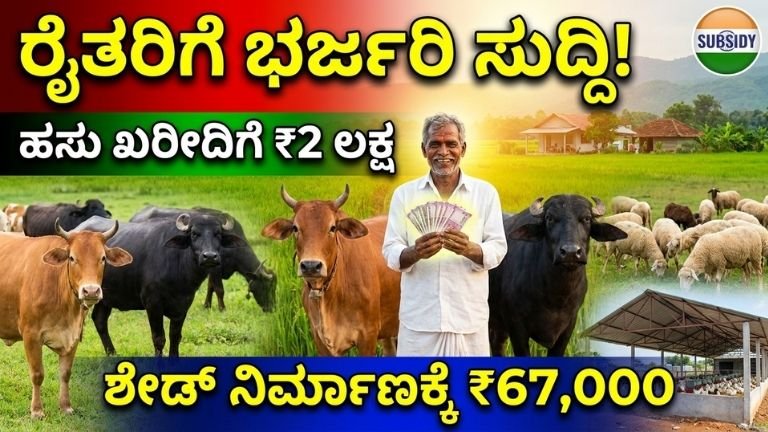
Comprehensive Guide to Government Subsidies for Livestock Farming: Claim Rs. 2 Lakh for Cattle and Rs. 67,000 for Shed Construction januvaru
The agricultural landscape is evolving rapidly, and the government is stepping up to support rural livelihoods by boosting the allied agricultural sectors. In a massive announcement that has brought a wave of relief and excitement to the farming community, new funds have been released to provide substantial subsidies to farmers rearing cows, buffaloes, sheep, and poultry.
If you are a farmer looking to expand your livestock or secure your current animals with better infrastructure, this is your golden opportunity. The government is now offering Rs. 2,000,000 (2 Lakh) for the purchase of cattle (cows and buffaloes) and providing financial aid of Rs. 67,000 for the construction of dedicated sheep and poultry sheds.
This professional guide breaks down everything you need to know about these schemes, the immense benefits they offer, eligibility criteria, and a step-by-step process on how you can apply immediately to secure your funds.
Introduction: The Push Towards Animal Husbandry
Animal husbandry has always been the backbone of the rural economy. Recognizing that crop cultivation alone is highly vulnerable to climate change and market fluctuations, state and central governments are aggressively promoting mixed farming.
By integrating dairy, sheep, and poultry farming into traditional agriculture, farmers can secure a steady, year-round income. The newly released funds are specifically designed to remove the high initial capital barrier that prevents many small and marginal farmers from venturing into or expanding their livestock operations.
Key Highlights of the Scheme
-
Dairy Farming Boost: Up to Rs. 2 Lakh allocated for the procurement of high-yielding cattle.
-
Infrastructure Support: Rs. 67,000 granted specifically for building safe, weather-resistant sheds for sheep and poultry.
-
Immediate Implementation: Funds have been released, and the application windows are currently open.
Deep Dive: Rs. 2 Lakh Subsidy for Dairy Farming (Cows & Buffaloes)
India is the largest producer of milk in the world, yet the demand for high-quality dairy products continues to surge. The Rs. 2 Lakh financial assistance is aimed at encouraging farmers to purchase high-yielding breeds of cows (like Holstein Friesian, Jersey, Gir, Sahiwal) and buffaloes (like Murrah).
How the Funds Can Be Utilized
The Rs. 2 Lakh allocation is typically structured as a mix of direct subsidy and subsidized bank loans. It is designed to cover:
-
Animal Procurement: The actual cost of buying 2 to 4 high-yielding milch animals.
-
Transportation: Safely transporting the animals from certified breeders or cattle markets to your farm.
-
Initial Insurance: Securing cattle insurance to protect the farmer against sudden loss due to disease or accidents.
-
Basic Milking Equipment: Procurement of hygienic milking cans or small-scale milking machines.
Why Dairy Farming is a Lucrative Investment
-
Daily Cash Flow: Unlike seasonal crops, milk provides daily or weekly income.
-
Organic Manure: Cattle dung is a premium organic fertilizer that drastically reduces the cost of chemical fertilizers for your main crops.
-
Biogas Potential: Larger herds can power biogas plants, providing free, clean cooking fuel for the household.
Deep Dive: Rs. 67,000 Financial Aid for Shed Construction (Sheep & Poultry)
One of the leading causes of livestock mortality—especially in sheep, goats, and poultry—is improper housing. Exposure to extreme heat, heavy monsoon rains, and predator attacks can wipe out an entire flock in days. To combat this, the government is providing Rs. 67,000 specifically for shed construction.
This initiative is often linked with rural employment guarantee schemes (like MGNREGA) or state-specific Animal Husbandry infrastructure programs.
Specifications of the Subsidized Sheds
To ensure the funds are used effectively, the government requires the sheds to meet certain scientific criteria:
-
Space Allocation: Adequate square footage per animal to prevent overcrowding (which leads to disease outbreaks).
-
Ventilation: Proper airflow systems to reduce ammonia buildup from waste.
-
Roofing: Weather-proof roofing (usually asbestos, tin, or high-quality thatch depending on regional guidelines) to protect against rain and heat.
-
Flooring: Slatted or raised flooring for sheep to keep them dry, or scientifically managed litter floors for poultry.
-
Feeding Troughs: Built-in mangers and waterers to ensure hygienic feeding and reduce feed wastage.
The Impact of a Proper Shed
Investing this Rs. 67,000 into a solid structure guarantees:
-
Reduced Disease: Dry, well-ventilated environments drastically lower the rate of foot rot, pneumonia, and parasitic infections.
-
Better Growth Rates: Animals that are not stressed by weather put their energy into growing and producing meat/eggs.
-
Predator Protection: Secure fencing and solid walls protect poultry from wild animals and theft.
Eligibility Criteria: Who Can Apply?
While the government wants to empower as many farmers as possible, there are specific eligibility criteria to ensure the funds reach those who genuinely need them and have the capacity to maintain the livestock.
| Criteria | Details Required |
| Farmer Status | Must be a recognized small, marginal, or agricultural laborer. |
| Age Limit | Typically between 18 and 60 years of age. |
| Land Holding | Must possess some agricultural land (usually a minimum of 0.5 to 1 acre is required to grow green fodder), though landless laborers can sometimes apply for smaller poultry/sheep schemes. |
| Training | Preference is often given to farmers who have undergone basic livestock rearing training from a recognized Krishi Vigyan Kendra (KVK) or Animal Husbandry Department. |
| Previous Defaults | The applicant must not be a defaulter in any nationalized bank or cooperative society. |
Essential Documents Required
To apply for either the Rs. 2 Lakh cow purchase scheme or the Rs. 67,000 shed construction scheme, you must have a complete dossier of documentation. Keep these ready before visiting the authorities:
-
Identity Proof: Aadhaar Card, Voter ID, or PAN Card.
-
Address Proof: Ration Card or Utility Bill.
-
Land Records: RTC, Pahani, or land ownership documents proving you have space for the shed and fodder cultivation.
-
Bank Details: A copy of the bank passbook (front page) for Direct Benefit Transfer (DBT).
-
Photographs: 3-4 recent passport-size photographs.
-
Caste Certificate: If applying under SC/ST/OBC special quotas (which often carry higher subsidy percentages).
-
Project Report: A simple estimation or quotation of the shed construction or cattle cost (often provided by the local veterinary officer).
Step-by-Step Guide: How to Apply Immediately
Do not delay your application, as funds are usually disbursed on a first-come, first-served basis, and quotas fill up quickly at the district level.
Step 1: Visit Your Local Authorities
Head immediately to your local Gram Panchayat office, Veterinary Dispensary, or the Taluk/District Animal Husbandry Department (Pashupalana Ilaakhe).
Step 2: Collect the Application Form
Request the specific application form for the “Livestock Purchase Subsidy” or “Animal Shed Construction Scheme” (under MGNREGA or state schemes).
Step 3: Consult the Veterinary Officer
The local government Veterinary Officer is your best resource. They must inspect your land, verify your capacity to rear animals, and ultimately sign off on your application. Ask them to help you draft the basic project report required for the bank.
Step 4: Bank Linkage
Submit the application to a nationalized bank, regional rural bank, or cooperative bank. The bank will process the Rs. 2 Lakh loan/subsidy component.
Step 5: Verification and Approval
Once submitted, a committee (usually involving Panchayat officials and veterinary staff) will verify your documents and land. Upon successful verification, the funds will be sanctioned.
Step 6: Direct Benefit Transfer (DBT)
For the shed construction (Rs. 67,000), funds are often released in stages directly to your bank account—first as an advance to start foundation work, and the rest upon completion and photo-verification of the shed.
Pro-Tips for a Successful Application
-
Ensure Aadhaar is Linked: Make sure your Aadhaar card is linked to your active bank account and your mobile number. The government utilizes the DBT system, and any mismatch will stall your funds.
-
Maintain Clean Land Records: Ensure your RTC/Pahani is updated and free of immediate disputes.
-
Take Training: If you haven’t already, enroll in a 2-day free training camp at your local KVK. Attaching a training certificate to your application puts you at the front of the line.
-
Follow Specifications strictly: If you are building the shed, do not deviate from the engineer’s or veterinary officer’s dimensions. Subsidy money will be withheld if the shed is smaller or uses substandard materials.
Conclusion: A Step Towards Agricultural Prosperity
The release of these funds marks a significant milestone in agricultural empowerment. By offering Rs. 2 Lakh for cattle purchase and Rs. 67,000 for shed construction, the government is not just giving handouts; it is building a sustainable, resilient rural economy. Livestock farming acts as a vital safety net against crop failures, ensuring that farmers can feed their families and educate their children regardless of the weather.
Do not wait. The funds have been released, and the application process is live. Gather your documents, visit your nearest Gram Panchayat or Veterinary office today, and take the first step towards a more profitable and secure farming future!
Here are the official government portal links you need to apply for these livestock and shed construction subsidies.
Because you originally asked in Kannada, I have included the specific portals mandatory for Karnataka, alongside the Central Government portals that apply across India.
1. Mandatory First Step for Karnataka Farmers: FRUITS Portal
If you are applying from Karnataka, you cannot get any agriculture or animal husbandry subsidy without a Farmer ID (FID). You must first register your land and Aadhaar details here:
-
FRUITS Portal Link: https://fruits.karnataka.gov.in/
(Once registered, your details are automatically pulled when you apply for the cow or shed schemes).
2. For Sheep, Goat, and Poultry Subsidies (Central Scheme)
For massive subsidies regarding sheep and poultry farming (including infrastructure and breeding units), you need to apply through the National Livestock Mission (NLM) portal.
-
NLM Online Application Link: https://nlm.udyamimitra.in/
(Click on “Login as Entrepreneur” or “Apply Here” to start your application).
3. For Dairy & Cattle Infrastructure (Central Scheme)
If you are looking to set up a larger dairy unit or require infrastructure funds under the Animal Husbandry Infrastructure Development Fund (AHIDF):
-
AHIDF Portal Link: https://ahidf.udyamimitra.in/
4. For Rs. 67,000 Shed Construction (MGNREGA & State Level)
Most individual shed construction subsidies (like the Rs. 67k grant) are distributed under state-specific schemes (like Pashu Bhagya in Karnataka) or through the MGNREGA employment scheme.
-
Application Process: Currently, the initial application for small-scale shed construction is offline. You must physically submit a written request and your FRUITS ID/Job Card to your local Gram Panchayat or the Taluk Veterinary Hospital.
-
Tracking Link: Once applied, your application and daily progress can be tracked online via the official NREGA portal: https://nrega.nic.in/
5. Karnataka Animal Husbandry Department (For Scheme Updates)
To check the latest state notifications, deadlines, and download offline application forms for dairy (cow/buffalo) purchases:
-
Pashupalana Ilaakhe Website:
apply Link
💡 Pro-Tip Before You Click: Keep your Aadhaar Card, Land Records (RTC/Pahani), Bank Passbook, and Passport Photos ready as soft copies (PDF/JPEG) before you start filling out the online forms on the NLM or FRUITS portals!
Q: Can I apply for both the Rs. 2 Lakh cow scheme and the Rs. 67,000 shed scheme?
Yes, subject to state guidelines and your financial capacity. If you have the land and resources to manage both dairy and poultry/sheep, you can submit separate applications. Your local veterinary officer will guide you on the feasibility.
Q: Do I have to repay the Rs. 67,000 for the shed?
Generally, funds allocated for shed construction under schemes like MGNREGA or specialized state grants are 100% subsidies (grants) and do not need to be repaid, provided you complete the construction as per the approved guidelines.
Q: Is the Rs. 2 Lakh for cattle a full subsidy or a loan?
The Rs. 2 Lakh is usually a composite package. A portion of it (often 25% to 50%, depending on your caste category and state) is a non-repayable government subsidy, while the remainder is a low-interest bank loan that you will repay via your milk earnings.
Q: Where can I buy the cows?
Animals must be purchased from certified markets, government farms, or approved breeders. The local veterinary doctor usually has to be present during the purchase to certify the health, age, and breed of the animal before the bank releases the funds.
Q: Can women farmers apply?
Absolutely! In fact, many government schemes offer higher subsidy percentages and priority processing for female farmers and women-led Self Help Groups (SHGs).