Comprehensive Guide to the Government’s Free Sewing Machine Scheme: Separating Myth from Reality under the PM Vishwakarma Yojana s9
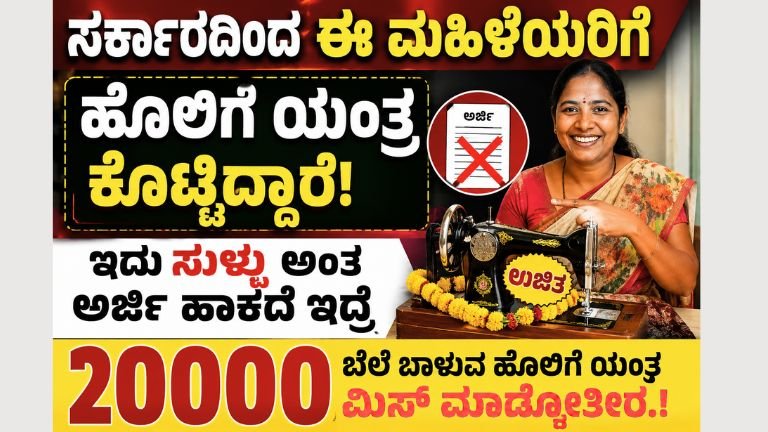
In recent months, social media platforms, WhatsApp groups, and local community forums have been flooded with viral messages and sensational headlines. You might have seen notifications claiming: “The government is giving away free sewing machines! If you think this is fake and fail to submit your application immediately, you will miss out on a high-quality sewing machine worth ₹20,000!”
While these posts are highly effective at grabbing attention, they often blend a kernel of truth with a significant amount of exaggeration and misinformation. If you are a woman looking to achieve financial independence, a tailor aiming to scale your business, or an android-smartphone user trying to help a family member register, it is absolutely vital to look past the clickbait.
The truth is, the Government of India does have a massive, highly structured initiative that helps women and traditional artisans procure sewing machines and master tailoring skills. This is orchestrated primarily through the PM Vishwakarma Yojana, alongside various state-specific welfare programs. However, the government does not simply hand out ₹20,000 cash or distribute physical machines to anyone who clicks a random link. There is a strict, structured application process, mandatory skill verification, and a formal training curriculum involved.
This comprehensive, 3,000-word definitive guide unpacks the entire reality behind the “Free Sewing Machine Scheme.” By reading further, you will learn the exact mechanics of the scheme, the eligibility criteria, the financial breakdown of the toolkit incentives, the step-by-step application architecture, and how to protect yourself from cyber-scams operating under the guise of this scheme.
Deconstructing the Viral News: Is It Fact or Fiction?
When a message claims that an applicant will lose out on a machine worth ₹20,000 if they do not apply immediately, it creates a false sense of urgency. Let us look at what is factually true and what is exaggerated:
-
The Fiction: The government is directly distributing thousands of physical, premium-branded sewing machines via unregulated web links, and any citizen can claim one without verification.
-
The Fact: The central government offers a ₹15,000 Toolkit Incentive specifically for purchasing modern sewing machines and associated apparatus. This benefit is tied directly to a rigorous training program under the PM Vishwakarma Yojana (for Darzis/Tailors) and requires biometric authentication at authorized centers.
The misconception about the “₹20,000 price tag” stems from combining the toolkit grant ($\text{₹15,000}$) with the daily training stipends ($\text{₹500}$ per day for up to 15 days, totaling up to $\text{₹7,500}$). When you look at the entire lifecycle of the program, the total value invested by the government into an individual beneficiary actually exceeds ₹20,000. However, this is given as an ecosystem of support—comprising skill upgrades, digital certification, direct benefit transfers (DBT), and credit support—rather than a free product drop off.
The Core Program: Understanding the PM Vishwakarma Yojana
Launched by the Ministry of Micro, Small, and Medium Enterprises (MoMSME), the PM Vishwakarma Yojana is a flagship central sector scheme designed to support and provide end-to-end assistance to traditional artisans and craftspeople. Among the 18 traditional trades recognized and uplifted by this scheme, the trade of the Darzi (Tailor) is one of the most popular and heavily utilized, particularly by women across rural and urban India.
The ultimate objective of this scheme is not just to hand over an asset, but to ensure that the recipient knows how to maximize its economic output. The scheme recognizes that providing a tool without training results in underutilization, whereas providing training alongside the tool creates a sustainable livelihood.
The Structural Pillars of the Scheme
The scheme is built around five core pillars engineered to elevate an applicant from an informal worker to a certified entrepreneur:
-
Recognition: Upon successful registration and verification, the artisan receives a formal PM Vishwakarma Certificate and an ID Card. This serves as official recognition of their skills and can be used to secure future commercial work or corporate textile contracts.
-
Skill Upgradation: Beneficiaries do not just receive tools; they undergo structured skill training. This includes basic training to refine foundational skills and advanced training for modern garment manufacturing processes.
-
Toolkit Incentive: This is the heart of the “free sewing machine” news. Upon the completion of basic training, a digital voucher worth ₹15,000 is credited via Direct Benefit Transfer (DBT) to the beneficiary’s linked bank account or provided as an e-voucher to purchase specialized trade tools.
-
Credit Support: For women who want to scale their tailoring units into full-scale boutique shops or manufacturing garments at scale, the scheme offers enterprise development loans. The first tranche offers up to ₹1,00,000 with a flexible repayment period of 18 months. Once repaid, a second tranche of up to ₹2,00,000 is unlocked with a 30-month repayment window.
-
Incentives for Digital Transactions: To encourage financial literacy and inclusion, the scheme credits 1 Rupee per digital transaction (up to a maximum of 100 transactions per month) directly to the artisan’s account for every commercial sale or purchase made digitally.
Financial Breakdown of Benefits
To clear up any confusion regarding the money and assets distributed under this program, let’s look at the financial math of the PM Vishwakarma Scheme for a single tailor applicant:
| Benefit Component | Financial Value / Rate | Maximum Structural Payout |
| Daily Training Stipend | ₹500 per day | ₹2,500 to ₹7,500 (Based on 5 to 15 days of training) |
| Toolkit Incentive Grant | One-time fixed e-Voucher / DBT | ₹15,000 (Specifically allocated for the sewing machine) |
| Digital Transaction Reward | ₹1 per transaction | Up to ₹100 per month ($\text{₹1,200}$ annually) |
| First Tranche Loan Facility | Concessional Converted Interest (5%) | Up to ₹1,00,000 (Collateral-free enterprise expansion) |
| Second Tranche Loan Facility | Concessional Converted Interest (5%) | Up to ₹2,00,000 (For established business scaling) |
By examining this breakdown, it becomes clear why viral internet posts mention values around ₹20,000. If an applicant undergoes 10 days of advanced training, they earn $\text{10} \times \text{₹500} = \text{₹5,000}$ in stipends. Combine this with the $\text{₹15,000}$ toolkit incentive, and the direct, non-repayable fiscal aid equals exactly ₹20,000.
Eligibility Criteria: Who Can Actually Apply?
One of the main reasons applications get rejected is that people apply without understanding the eligibility rules. The government has put strict filters in place to ensure that these funds reach genuinely underprivileged artisans, preventing commercial exploitation of the system.
To qualify for the tailoring (sewing machine) benefit under the PM Vishwakarma Yojana, an applicant must satisfy the following criteria:
-
Trade Alignment: The applicant must be actively engaged in the trade of tailoring (Darzi) or a related artisan craft on an informal basis at the time of application.
-
Age Requirement: The minimum age of the applicant must be 18 years on the date of registration. There is no upper age limit, provided the applicant is physically capable of undergoing training.
-
Family Limitation: The scheme explicitly states that its benefits are restricted to one member per family. For the purposes of this scheme, a “family” is defined as a unit comprising the husband, wife, and their unmarried children. If a mother-in-law and a daughter-in-law living in the same ration-card unit apply simultaneously, only one application will be approved.
-
Exclusion of Government Servants: No member of the applicant’s immediate family should be employed in any form of government service (Central, State, Public Sector Undertakings [PSUs], or autonomous government bodies).
-
No Recent Credit Duplication: The applicant must not have availed of credit-based loans under similar self-employment or livelihood generation schemes of the Central or State Governments (such as the PMEGP, PM SVANidhi, or Mudra loans) within the past 5 years. However, if a Mudra loan has been fully paid off, the applicant may be deemed eligible based on local discretion.
Required Documentation Checklist
Before visiting an application center, you should gather all required documents. Missing documentation is a major cause of delays and system rejections.
Ensure you have clean, legible copies (and original versions for physical verification) of the following items:
-
Aadhaar Card: This serves as the primary proof of identity and age. Your Aadhaar card must be actively linked to a functioning mobile number, as the portal uses secure OTP (One-Time Password) generation for identity verification.
-
Ration Card / Family Identity Proof: Since the scheme enforces a strict “one benefit per family” rule, a Ration Card, BPL (Below Poverty Line) card, or state-issued family ID card is mandatory to map the household structure.
-
Bank Account Details: You will need a passbook or a cancelled cheque. The bank account must be fully active, compliant with KYC regulations, and Aadhaar-seeded. Because the toolkit incentive is distributed via Direct Benefit Transfer (DBT), funds cannot be routed to accounts that lack proper Aadhaar linking.
-
Active Mobile Number: Used to receive communication regarding training dates, verification statuses, and digital vouchers.
-
Category / Caste Certificate (If Applicable): While the scheme is open to all traditional tailors, certain sub-allocations and reporting metrics track benefits provided to Scheduled Castes (SC), Scheduled Tribes (ST), Other Backward Classes (OBC), and minority communities.
Step-by-Step Application Architecture
You cannot apply for this scheme through basic, unofficial mobile applications or untrusted links. The entire registration lifecycle must flow through the secure, official channels established by the central government.
Here is the exact step-by-step framework to successfully submit your application without missing out:
[Gather Documents & Active Mobile]
                │
                ▼
  [Visit CSC (Biometric Login)]
                │
                ▼
 [Mobile & Aadhaar OTP Verification]
                │
                ▼
 [Fill Form & Select Trade: "Darzi"]
                │
                ▼
  [Three-Tier Verification Stage]
  (Gram Panchayat -> District -> Centre)
                │
                ▼
   [Approved -> Training & Stipend]
                │
                ▼
[E-Voucher Issued -> Buy Sewing Machine]
Step 1: Locate an Authorized Registration Hub
The PM Vishwakarma Yojana application infrastructure relies heavily on physical biometric verification to eliminate fake profiles. Therefore, self-registration via a personal smartphone home browser is generally restricted to the initial log-in phases. For full enrollment, you must visit a Common Service Center (CSC), a local Digital Seva Kendra, or an authorized municipal corporation desk.
Step 2: Mobile and Aadhaar Authentication
At the CSC, the operator will open the official government portal (pmvishwakarma.gov.in). The registration begins with a two-step verification process:
-
Mobile Verification: An OTP is sent to your mobile number to establish communications.
-
Aadhaar Verification: The applicant places their finger on a biometric fingerprint scanner or looks into an iris scanner linked to the CSC terminal to verify their identity via the UIDAI database.
Step 3: Registration of Professional Profile
Once your identity is verified, the registration form opens. Here, you must enter your personal information, address, and bank details.
-
Critical Action: Under the “Trade/Profession” dropdown selection menu, you must explicitly select Darzi (Tailor). Choosing an incorrect trade will invalidate your application for a sewing machine toolkit and redirect your profile to a different training track.
Step 4: Submission of Family Declaration
You must input your Ration Card number. The portal automatically pulls your family data from the national food security servers. You will need to confirm that no other family member has claimed this benefit, and submit the form.
Step 5: The Three-Tier Verification Process
Once submitted, your application is not instantly approved. It undergoes a rigorous three-step validation framework:
-
Level 1 (Local Verification): Your application is reviewed by the Gram Panchayat Head (Pradhan/Sarpanch) in rural areas, or the Executive Officer of the Urban Local Body (ULB) in towns. They verify that you are a practicing tailor in their jurisdiction.
-
Level 2 (District Screening): The District Implementation Committee reviews the local recommendations and checks for duplicate entries or industrial non-compliance.
-
Level 3 (Screening Committee Approval): The final list is authenticated by the state-level representation team on behalf of the central Ministry.
Step 6: Onboarding for Skill Training
Once your application passes all three verification levels, your status changes to “Approved.” You will receive an SMS alert directing you to a local training center (often managed by the National Skill Development Corporation – NSDC). You will complete a minimum of 5 days of Basic Skill Training. During this time, you do not pay anything; instead, you receive a daily stipend of ₹500 directly in your bank account.
Step 7: Procurement of the ₹15,000 Toolkit Incentive
Upon successfully passing the basic training module and receiving your course completion certificate, the portal issues an e-Voucher or transfers ₹15,000 via DBT. This voucher can be redeemed at designated partner stores or authorized machinery distributors to purchase your digital, automatic, or heavy-duty sewing machine.
Educational Insight: The Evolution of Tailoring Tools
When choosing a machine through your government toolkit incentive, it is helpful to understand what kind of equipment your business actually needs. Tailoring technology has evolved significantly over the years, and selecting the right machine will determine how fast and efficiently you can complete your work.
Manual Mechanical Machines
These are traditional, hand-cranked or foot-treadle machines. They operate purely on mechanical power without requiring electricity.
-
Pros: Highly durable, easy to repair locally, and completely independent of power grids (ideal for rural areas with frequent power outages).
-
Cons: Slower production speeds, requires more physical effort, and lacks advanced stitching options.
Electronic Sewing Machines
Driven by a basic integrated electric motor, these machines feature a foot pedal to control operating speeds. They offer multiple built-in stitch patterns (such as zig-zag patterns, buttonholing, and overlocking).
-
Pros: Drastically increases output speeds, reduces physical strain on the legs, and enables decorative stitching for modern garments.
-
Cons: Requires a stable electrical connection and features more delicate components that require careful maintenance.
Computerized Industrial Sewing Machines
These advanced systems feature programmable LCD touchscreens, automatic thread cutters, precision tension adjustments, and high-torque direct-drive motors.
-
Pros: Exceptional production speed, automated precision, and perfect for heavy fabrics like denim or canvas.
-
Cons: Expensive, requires specialized technical training to operate, and replacement parts carry a premium cost.
With a ₹15,000 toolkit grant, an applicant can easily purchase a high-quality motorized electronic sewing machine along with an assortment of premium scissors, measuring instruments, and initial thread inventories.
State-Level Variations of Sewing Machine Schemes
While the PM Vishwakarma Yojana is a national program available across India, several state governments run concurrent welfare programs for women. These schemes often use different names but offer similar benefits:
1. Karnataka (Kayaka Yojana & Shrama Shakti Scheme)
In Karnataka, the state government provides financial assistance and advanced tooling grants to women from minority groups, backward classes, and self-help groups (SHGs) like Stree Shakti. The state often integrates sewing machine distribution with institutional training through the Karnataka Skill Development Corporation (KSDC).
2. Uttar Pradesh (Bhagirathee & Mukhyamantri Yuva Swarozgar Yojana)
The UP government frequently runs targeted distribution drives under the Vishwakarma Shram Samman Yojana. This program mirrors the central scheme, providing free local toolkits to traditional tailors and laborers across districts to discourage migration to metropolitan cities.
3. Maharashtra (Maher Scheme & State Women Development Initiatives)
The Department of Women and Child Development in Maharashtra drives localized allocation schemes. These focus primarily on widows, destitute women, and rural BPL families, providing sewing toolkits to encourage entrepreneurship.
Important Note: If you apply for a state scheme, remember that you cannot claim toolkits for the exact same trade under the central PM Vishwakarma scheme within the same 5-year window. Choose the program that offers the fastest processing time and best local training facilities in your specific district.
Cybersecurity Alert: How to Avoid Fake Free Sewing Machine Scams
Because “Free Scheme” announcements generate immense interest online, bad actors and cyber-criminals frequently use them to run online scams. Clicking on suspicious links can expose you to financial fraud or identity theft.
Here is how you can spot and protect yourself from fraudulent schemes:
Common Warning Signs of a Scam
-
Unofficial Web Addresses: If the website address ends in
.blogspot.com,.wordpress.com,.xyz,.site, or.info, it is completely fake. Authentic central government websites always end with the.gov.inor.nic.indomains. -
Requests for Advance Payments: If a website, WhatsApp message, or local agent asks for an “application fee,” “processing fee,” or a “security deposit of ₹500” to secure your machine, stop immediately. Registration for the PM Vishwakarma Scheme on the official government infrastructure is 100% free. The government never demands upfront payments to unlock welfare benefits.
-
Demands for Sensitive Personal Information: Be highly suspicious of any unofficial form that asks for your ATM PIN, online banking passwords, or a photo of your debit card.
-
Unbelievable Claims: Watch out for messages that say “No eligibility checks required! Just click here and collect your machine within 24 hours!” As explained above, the actual government program requires structured validation levels and mandatory skill training.
Best Practices for Digital Safety
-
Never share your OTP: Never read out an OTP to an unknown caller claiming to be a “Government Verification Officer.”
-
Verify via Official Channels: Always navigate directly to
pmvishwakarma.gov.inby typing it into your browser yourself, rather than clicking links embedded inside WhatsApp forward messages. -
Report Cyber Fraud: If you have been tricked into sending money or sharing confidential data on a fake website, file an immediate complaint at the official national portal:
cybercrime.gov.in.
Apply Link
Frequently Asked Questions (FAQs)
Q1: Can men apply for the sewing machine scheme under the PM Vishwakarma Yojana?
Yes. The PM Vishwakarma Yojana is gender-neutral. Any traditional artisan or tailor (Darzi), whether male, female, or transgender, can apply as long as they meet the professional criteria and eligibility parameters.
Q2: What happens if I fail the skill training program?
The training modules are structured to support your growth, emphasizing practical, hands-on learning rather than complex written exams. If you attend the mandatory training days and participate actively, you will receive your certificate and toolkit voucher without issue.
Q3: Is the ₹15,000 toolkit incentive a loan that I have to repay later?
No. The ₹15,000 toolkit incentive is a direct grant. It is entirely non-repayable. However, if you choose to take an additional enterprise loan ($\text{₹1,00,000}$ or $\text{₹2,00,000}$) to expand your shop, that loan component must be repaid under a highly concessional 5% interest structure.
Q4: My Aadhaar card is linked to an old phone number that is no longer working. Can I still register?
You can start the initial query process, but you will not be able to complete the biometric or identity verification phases. You must visit a local Aadhaar Seva Kendra or post office to update your Aadhaar card with your current, active mobile number before trying to register on the PM Vishwakarma portal.
Q5: Can I buy a different tool instead of a sewing machine with the voucher?
The ₹15,000 toolkit grant is locked to your selected trade. If you register under the Darzi (Tailor) trade category, your e-Voucher will be designated for tailoring tools and equipment at participating retailers. It cannot be used to buy unrelated household electronics or items from other trades.
Summary: Key Steps to Take Right Now
If you want to secure your government benefit and avoid missing out on this opportunity, here is your clear, actionable checklist:
-
[ ] Check Your Household Status: Confirm that no other family member living on your ration card has registered for this scheme or received a central toolkit grant in the last 5 years.
-
[ ] Confirm Your Aadhaar Status: Verify that your Aadhaar card is properly linked to your active mobile phone number.
-
[ ] Gather Your Paperwork: Put your Aadhaar card, Ration Card, and active bank passbook into a single folder.
-
[ ] Skip the Social Media Links: Do not click on random WhatsApp links or fill out unverified online forms.
-
[ ] Visit an Authorized Center: Go directly to your nearest Common Service Center (CSC) or Digital Seva Hub. Ask the operator to register you for the PM Vishwakarma Yojana under the Darzi (Tailor) trade.
-
[ ] Complete Your Verification: Wait for local verification, attend your training sessions, collect your ₹500 daily stipend, and claim your ₹15,000 toolkit grant to purchase your new sewing machine.
By following these official steps, you can safely navigate the system, avoid online scams, and secure a valuable government asset to build a successful, independent business.