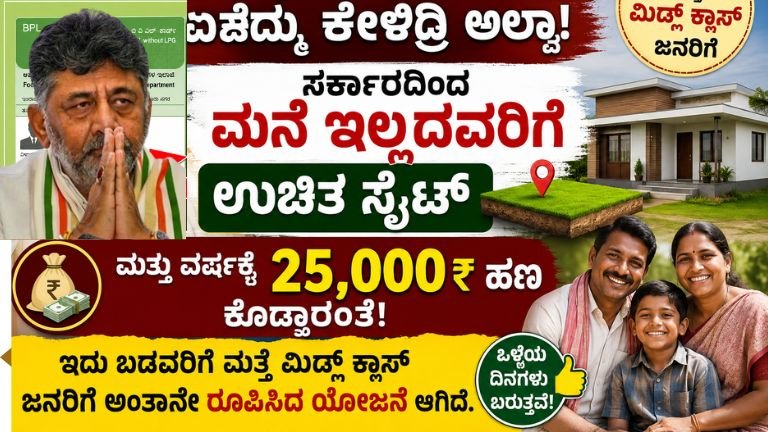
Decoding the Truth: Karnataka’s Free Housing Site Schemes and Financial Aid Explained k 21
Every citizen dreams of owning a home—a piece of land to call their own, where their family can live with dignity and security. In Karnataka, rumors and viral updates frequently circulate on social media regarding new welfare programs. Recently, discussions have surged around an alleged announcement claiming that the state government is launching a scheme to distribute free housing sites along with a direct annual cash assistance of ₹25,000 specifically tailored for lower-income and middle-class families.
When navigating the complex landscape of public welfare, it is vital to separate viral hearsay from actual, active government policies. While the state of Karnataka runs some of India’s most ambitious housing and direct benefit transfer (DBT) programs, the specific combination of a “free site paired with an annual ₹25,000 stipend” requires a closer, fact-driven look.
This comprehensive guide dissects the reality of Karnataka’s current housing policies, analyzes where these viral figures might originate, and provides a legitimate roadmap for eligible families to secure housing benefits through official state channels.
Fact-Checking the “Free Site + ₹25,000” Claim
When a claim regarding a government scheme spreads rapidly among communities, it often contains a mixture of existing flagship policies, historical financial benchmarks, and misaligned numbers.
1. Is there an active “₹25,000 Annual Housing Cash” Scheme?
To put it directly: No official program currently exists under this exact name or specific financial breakdown. The Government of Karnataka does not offer a standalone, recurring annual stipend of ₹25,000 intended specifically for housing maintenance or site acquisition.
2. The Link to the Flagship Gruha Lakshmi Scheme
The figure of roughly “₹25,000 per year” closely mirrors one of Karnataka’s most prominent active welfare programs: the Gruha Lakshmi Scheme.
-
Under Gruha Lakshmi, the female head of an eligible household (holding a BPL, APL, or Antyodaya ration card) receives a direct monthly cash transfer of ₹2,000.
-
Compounded over twelve months, this equates to ₹24,000 annually ($2,000 \times 12$).
-
Public discourse and casual conversations often round this figure up to ₹25,000 when discussing the general annual financial support families receive from the state. However, this fund is intended to offset general household inflationary pressures and empower women financially—it is not legally tied to land or housing site allocation.
3. The Reality of “Free Sites”
The state government, via local urban development authorities (like BDA, MUDA, etc.) and gram panchayats, occasionally conducts site distributions or allotts land to those without shelter. However, these are strictly regulated, merit-and-poverty-mapped distributions managed via statutory bodies, rather than open-ended free declarations for the general middle class.
Legitimate Housing Frameworks in Karnataka
Instead of relying on unverified viral claims, citizens seeking housing support should look toward Karnataka’s robust, deeply institutionalized housing programs. These operations are centrally managed by the Rajiv Gandhi Housing Corporation Limited (RGRHCL) and are systematically updated to ensure structural transparent delivery.
The state operates several highly active housing initiatives designed to assist the poor and economically vulnerable segments of society:
+-----------------------------------------------------------------------------------------+
|                              OFFICIAL HOUSING SCHEMES IN KARNATAKA                      |
+------------------------------------+----------------------------------------------------+
| Scheme Name                        | Primary Target Focus                               |
+------------------------------------+----------------------------------------------------+
| Basava Vasati Yojana               | Rural homeless, BPL families, and kutcha homeowners|
+------------------------------------+----------------------------------------------------+
| Dr. B.R. Ambedkar Niwas Yojana     | SC/ST communities in both urban and rural areas    |
+------------------------------------+----------------------------------------------------+
| Chief Minister’s 1 Lakh Housing    | Subsidized multi-storey housing units in Bengaluru |
+------------------------------------+----------------------------------------------------+
1. Basava Vasati Yojana (Ashraya Yojana)
The Basava Vasati Yojana is a cornerstone rural development scheme in Karnataka designed to eradicate homelessness. It specifically focuses on individuals who either have no shelter or own a dilapidated “kutcha” house but lack the capital to build a permanent, weather-resistant “pucca” home.
-
The Subsidy Mechanism: Rather than handing out raw cash like an annual stipend, the state provides heavily subsidized construction support. If an eligible applicant owns a raw plot of land, the government covers up to 85% of the raw material costs required to construct a permanent house.
-
Funding Delivery: The financial aid is released progressively in distinct tranches. These disbursements are tied directly to geo-tagged verification of construction milestones (e.g., foundation level, lintel level, roofing level) to eliminate middle-tier leakage and guarantee that funds are strictly spent on building infrastructure.
2. Chief Minister’s 1 Lakh Multi-Storey Housing Scheme
Geared specifically toward congested urban centers like Bengaluru, this scheme tackles the acute shortage of affordable municipal space.
-
The Structure: The government constructs multi-storey residential complexes on state-allocated plots.
-
Financial Incentives: Eligible urban poor and lower-income individuals receive substantial state subsidies ranging from ₹2.70 Lakh to ₹3.50 Lakh per housing unit, depending on their demographic category. The remaining balance can be financed through structural tie-ups with commercial banks at stabilized interest rates.
3. Dr. B.R. Ambedkar Niwas Yojana
This dedicated initiative provides completely subsidized or heavily incentivized housing grants to individuals belonging strictly to Scheduled Caste (SC) and Scheduled Tribe (ST) communities. The financial assistance framework under this specific banner ranges between ₹1.75 Lakh and ₹3.00 Lakh, heavily insulating marginalized communities from structural real estate debt.
Comprehensive Eligibility Architecture
To qualify for legitimate state-backed housing benefits or site allocations in Karnataka, applicants must pass rigorous statutory filters. Because these schemes are funded by public taxpayers to uplift marginalized citizens, they are tightly controlled based on verifiable socio-economic criteria.
Income Caps and Thresholds
Welfare programs are strictly tiered based on economic classifications. General middle-class earners often fall outside the maximum income limits designated for completely free or heavily subsidized structural grants.
-
Rural Frameworks (e.g., Basava Vasati): The maximum allowable household income is generally capped around ₹32,000 per annum. This ensures that the most destitute, daily-wage earners receive absolute priority.
-
Urban Frameworks (e.g., CM 1 Lakh Scheme): Recognizing the higher cost of living in urban ecosystems, the income threshold is expanded. Eligible applicants under the Economically Weaker Section (EWS) category must typically show an annual family income of less than ₹87,000, while the Low-Income Group (LIG) cap sits near ₹1,200,000.
Property Ownership Restrictions
A core principle across all RGRHCL schemes is the elimination of real estate hoarding. An applicant, along with their immediate nuclear family members, must not own a pucca house anywhere in the state of Karnataka or across India. The program operates strictly under a “one family, one home” mandate.
Residential Mandates
Applicants must be permanent, documented residents of Karnataka. This is verified using state-issued identity parameters and continuous localized living records spanning a set number of years.
Step-by-Step Guide to Applying for Government Housing
If you meet the structural eligibility benchmarks outlined by the RGRHCL or local municipal development boards, you can apply using the standardized online and offline state service portals.
Step 1: Document Collection and Verification
Before initiating an application, ensure you have pristine, updated copies of all legal identifiers. Missing or mismatched data across documents is the primary reason public applications face systemic rejections.
-
Identity & Address Proof: Aadhaar Card, Voter ID, and a valid Ration Card (BPL/Antyodaya cards are highly weighted for prioritizing aid).
-
Financial Standing: A formalized Income Certificate issued by a competent revenue authority (such as the local Tehsildar).
-
Land Assets: If applying for a construction subsidy on an existing site, clear titles, land possession certificates, or “Hakku Patra” must be presented.
-
Banking Channels: A copy of the applicant’s bank passbook. The account must be linked to Aadhaar to facilitate smooth Direct Benefit Transfer (DBT) transactions.
Step 2: Accessing the Portal
Applications can be processed digitally through the official Ashraya Portal (ashraya.karnataka.gov.in) or via unified citizen service centers like Karnataka One, Grama One, or your local Bapuji Seva Kendra.
Step 3: Submission and Local Inspection
Once the digital form is filled out and documents are attached, the file is routed to local administrative units.
-
For rural areas, the Block Development Officer (BDO) or Gram Panchayat secretary reviews the documentation.
-
A physical, on-site verification visit is conducted to inspect the applicant’s current living conditions and confirm the lack of a permanent structure.
Step 4: Final Beneficiary Selection
The verified names are compiled into a master list and presented before the local Grama Sabha or municipal allocation committee for final democratic approval. Once cleared, the beneficiary status goes live on the Ashraya portal, allowing individuals to track their financial releases transparently.
Protecting Yourself from Digital Scams and Misinformation
As digital penetration grows, bad actors frequently leverage the names of Chief Ministers and high-profile state guarantees to siphon personal data or money from gullible citizens. To ensure your financial safety, keep the following rules in mind:
Click Hear to Apply
Security and Verification Alert
No Upfront Fees: Genuine government housing schemes do not require you to pay private agents, brokers, or unofficial channels processing fees to fast-track your approval.
Official Portals Only: Never enter your Aadhaar details, bank account passwords, or OTPs on unofficial third-party blogs or WhatsApp links. Ensure the URL ends with a trusted domain like
.gov.inor.karnataka.gov.in.Verify at Local Offices: If you hear an announcement that sounds too good to be true, walk into your local Gram Panchayat office or City Municipal Corporation to verify its authenticity before sharing personal documents.
By relying on verified frameworks like the Basava Vasati Yojana and the Gruha Lakshmi program, citizens can protect their assets while systematically utilizing legitimate government channels to build their dream homes.
Summary Checklist for Applicants
-
Check Your Income: Is your annual household income within the official limits for EWS or rural housing support?
-
Organize Ration Cards: Ensure your BPL/APL card reflects accurate household details.
-
Link Aadhaar to Bank: Confirm with your bank branch that your account is fully mapped for DBT to avoid payment failures.
-
Track Status Online: Use the official Ashraya portal using your reference number to monitor progress securely.