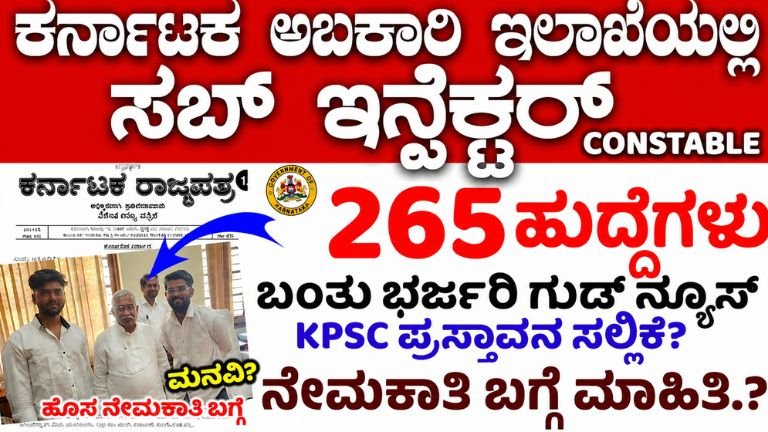
Karnataka Excise Department Recruitment 2026: Official Blueprint for ESI & Constable Posts
The Government of Karnataka, in coordination with the Karnataka Public Service Commission (KPSC), has formally initiated the administrative framework to address critical personnel shortages within its enforcement wing. An official proposal has been structured to recruit eligible candidates for 265 vacant positions distributed across the cadres of Excise Sub Inspector (ESI) and Excise Constable.
This document serves as an exhaustive, professional roadmap detailing the structural hierarchy, post-wise eligibility matrices, strict physical fitness metrics, and the multi-staged examination architecture governing the 2026 recruitment cycle.
1. Executive Summary & Administrative Framework
The State Excise Department operates as a premier enforcement agency responsible for monitoring revenue collection, preventing the illicit distillation of alcohol, and regulating narcotics throughout Karnataka. The upcoming centralized recruitment drive is designed to optimize field capabilities by introducing a fresh cohort of supervisory and ground-level personnel.
Key Recruitment Parameters
| Operational Metric | Specification & Regulatory Detail |
| Recruitment Authority | Karnataka Public Service Commission (KPSC) |
| Enforcing Agency | State Excise Department, Government of Karnataka |
| Current Progress Status | Proposal Phase Completed; Awaiting Detailed Notification |
| Aggregated Vacancies | 265 Posts (Subject to final administrative scaling) |
| Target Cadres |
• Excise Sub Inspector (Technical/Supervisory Tier) • Excise Constable (Skilled Field/Ground Tier) |
| Selection Methodology | Objective Competitive Written Examination + Physical Standards Assessment |
| Official Web Domain | kpsc.kar.nic.in |
2. Comprehensive Table of Contents
-
1. Executive Summary & Administrative Framework
-
2. Detailed Vacancy Breakup & Remuneration Structure
-
3. Statutory Eligibility Criteria (Academic & Age Matrices)
-
4. Mandatory Physical Standard Tests (PST) & Metrics
-
5. Physical Efficiency & Endurance Testing (PET)
-
6. Examination Architecture & Marks Distribution
-
7. Step-by-Step Digital Application Protocol
-
8. Official Resource Directory & Community Links
3. Detailed Vacancy Breakup & Remuneration Structure
The 265 notified vacancies are structurally partitioned to maintain operational balance between administrative field supervisors and frontline defense personnel. Both designations fall under the statutory jurisdiction of the Karnataka Civil Services Rules, entitling selected officers to standard state allowances, comprehensive medical insurance, and grade-appropriate pensions.
Total Allocation: 265 Vacancies
 ├── Excise Sub Inspector (ESI): Group-C Executive Cadre
 └── Excise Constable: Frontline Tactical Field Cadre
Salary Architecture Breakdown
-
Excise Sub Inspector (ESI): Positioned within the Group-C Executive category, this rank commands a premium state pay tier. Remuneration reflects the high-responsibility nature of the position, which includes heading local sub-divisional ranges, managing anti-smuggling raids, and executing judicial warrants.
-
Excise Constable: Operating as the foundational layer of the department’s tactical presence, these officers handle border checkpoints, transit monitoring, and field intelligence gather. The basic pay scale starts within the standard state scale of ₹21,400 to ₹42,000, heavily supplemented by Dearness Allowance (DA), House Rent Allowance (HRA), and uniform allowances.
4. Statutory Eligibility Criteria (Academic & Age Matrices)
Candidates must completely fulfill all academic qualifications and age limits on or before the formal cutoff date specified in the upcoming KPSC Centralised Notification.
Academic Prerequisites
-
Excise Sub Inspector (ESI): Applicants must hold a validated Bachelor’s Degree in any discipline from a university established by law in India and recognized by the University Grants Commission (UGC). Candidates with qualifications from unaccredited distance-education institutions will face automatic disqualification.
-
Excise Constable: Applicants must have successfully cleared their 10th Standard (SSLC) / Matriculation Examination or an equivalent intermediate certification recognized by the Karnataka Secondary Education Examination Board (KSEEB) or national equivalents like CBSE/ICSE.
Domicile & Language Competence
Because this recruitment is for the state civil service, candidates must possess functional fluency in reading, writing, and speaking the regional language (Kannada).
Age Ceiling and Statutory Relaxations
The minimum baseline age for entry into either cadre is 18 years. The maximum upper age boundaries are structurally distributed as follows to accommodate statutory reservation guidelines:
-
General Merit (GM) Candidates: 18 to 35 Years
-
Other Backward Classes (Categories 2A, 2B, 3A, 3B): 18 to 38 Years
-
Scheduled Castes (SC) / Scheduled Tribes (ST) & Category-1: 18 to 40 Years
5. Mandatory Physical Standard Tests (PST) & Metrics
Candidates targeting field enforcement positions must possess specific physiological attributes. These metrics are verified by an official medical board during the initial stages of physical screening.
Physical Dimension Thresholds
| Gender Category | Minimum Height Criteria | Mass & Chest Measurements |
| Male Applicants | 163 Centimeters (Minimum) | Chest: 81 cm unexpanded (A mandatory expansion capacity of at least 5 cm must be demonstrated). |
| Female Applicants | 157 Centimeters (Minimum) | Body Weight: A minimum scale weight of 45 Kilograms is mandatory. |
Crucial Medical Caveat: Candidates must not display physical deformities such as knocked knees, flat feet, varicose veins, or advanced color blindness. Visual acuity must align strictly with the standard medical codes specified for state uniform services.
6. Physical Efficiency & Endurance Testing (PET)
The Physical Efficiency Test (PET) functions strictly as a qualifying stage. While performance here does not add points to the final academic merit calculation, failure to clear any individual event results in immediate elimination from the recruitment cycle.
Endurance Performance Matrix
-
Male Field Events:
-
1600-Meter Run: Must be completed within a strict timeline (typically under 7 minutes).
-
Long Jump / High Jump: Achieving a minimum distance threshold within three permitted attempts.
-
Shot Put: Throwing a standard-weight metallic sphere to a designated distance mark.
-
-
Female Field Events:
-
400-Meter Run: Designed to test sprint capabilities within defined time limits.
-
Long Jump: Meeting baseline distance requirements.
-
Shot Put: Demonstrating upper-body physical leverage using modified weights for female personnel.
-
7. Examination Architecture & Marks Distribution
The competitive assessment is structured to evaluate a candidate’s analytical capacity, understanding of administrative frameworks, and general awareness.
[Stage 1: Written MCQ Assessment] ──> [Stage 2: PET / PST Field Screening] ──> [Stage 3: Verification & Medical Board Approval]
Blueprint of the Written Examination
The examination is traditionally split into two core papers, administered via conventional Optical Mark Recognition (OMR) sheets or a secure Computer-Based Test (CBT) platform.
Paper I: General Cognitive Ability & State Awareness
-
Total Marks: 100 Marks
-
Core Topics: Indian Polity & Constitution, Indian History, Geography of Karnataka, Basic Economic Principles, Everyday Science, and Mental Aptitude.
Paper II: Language Competence & Literacy
-
Total Marks: 100 Marks
-
Core Topics: Advanced Kannada vocabulary, precise essay mapping, translation exercises, and functional grammar evaluation.
Negative Scoring Penalties
To discourage random guessing, a strict penalty system is built into the testing software. For each incorrect entry, 0.25 marks (or 1/4th of the allocated point) will be deducted from the candidate’s cumulative raw score. Unanswered items remain neutral.
8. Step-by-Step Digital Application Protocol
Once the KPSC portal formally opens the submission gateway for the Excise cadre, applicants must execute their filings through the One-Time Registration (OTR) system using the following protocol:
[OTR Portal Entry] ──> [Profile Upgradation] ──> [Document Upload] ──> [Fee Transaction] ──> [Print Form]
-
Portal Authentication: Access the official KPSC online interface and log in via your existing OTR user credentials. New users must register using a unique mobile number, active email address, and a valid government ID profile.
-
Post Selection & Data Ingestion: Locate the active link labeled Excise Sub Inspector and Constable Recruitment (CEN 2026). Input your exact academic achievements, reservation category claims, and preferred regional testing zones.
-
Digital Asset Uploading: Upload high-definition digital scans of your 10th Standard (SSLC) marks card, Degree Certificate (for ESI), and relevant caste/income certificates. Ensure your signature and passport photograph comply with the specified dimensions and file size limits.
-
Fee Processing: Complete the application fee payment via the integrated online portal (Net Banking, UPI, or Credit/Debit cards). Retain the transaction receipt as proof of payment.
-
Final Submission archiving: Verify all entered data points for accuracy, submit the application, and save a digital PDF printout for future reference.
9. Official Resource Directory & Community Links
To stay informed and avoid false information or viral social media rumors, always rely exclusively on official state communication channels for updates on exam dates, center changes, and admit card releases.
Verified Government Domains
-
Primary Administrative Portal: Karnataka Public Service Commission (KPSC)
-
Enforcing Agency Portal: Karnataka State Excise Department Official Site
Candidate Connection Network
For real-time exam alerts, daily syllabus tracking, peer-to-peer discussion groups, and instant notification updates, consider connecting with our active candidate network:
Disclaimer: This guide is structured based on the official administrative proposals and preliminary notifications submitted to the KPSC. Final distributions of seats, sub-categories, and exam dates remain subject to modification via subsequent gazette publications issued by the Department of Personnel and Administrative Reforms (DPAR), Government of Karnataka.