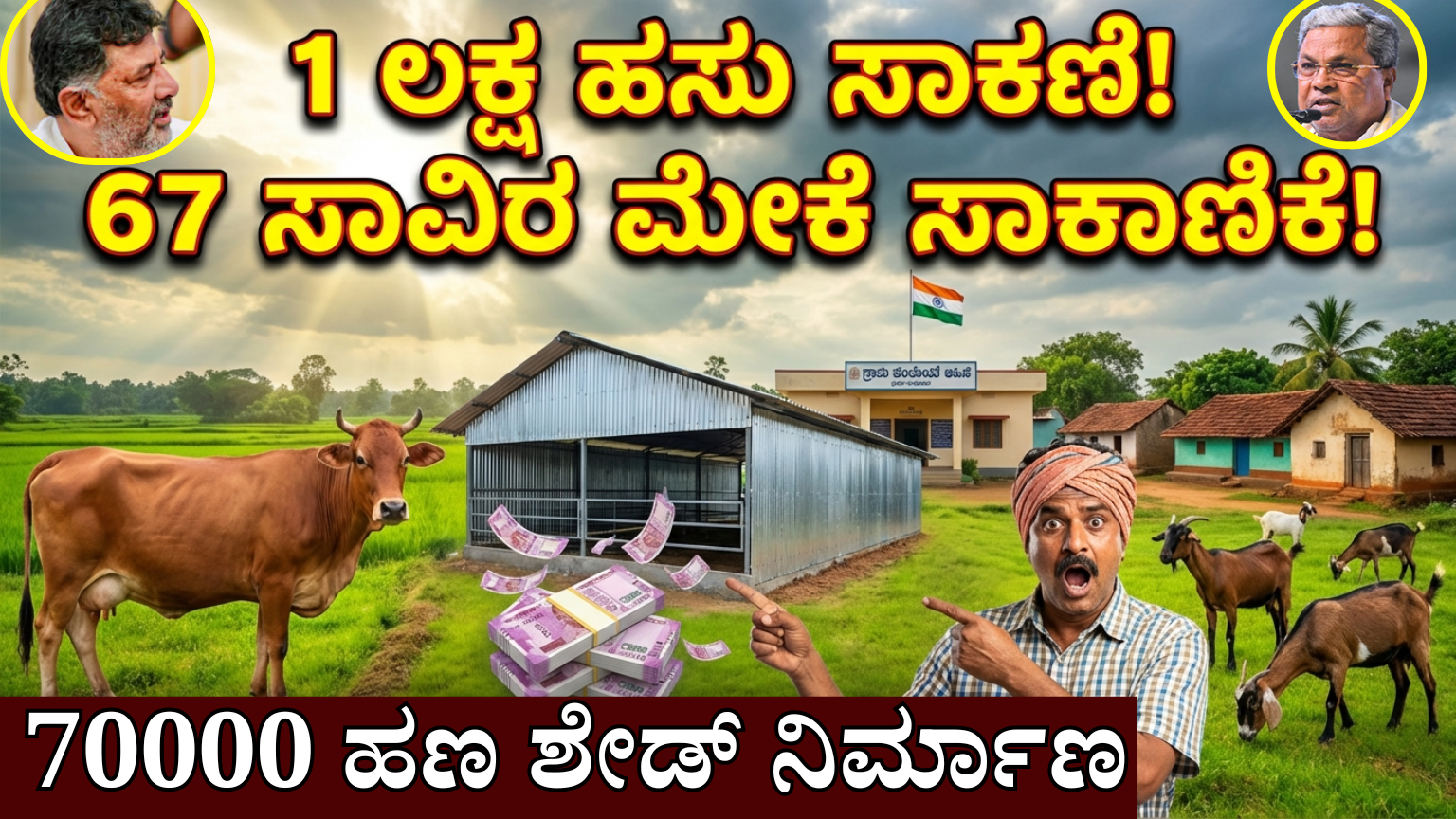
Karnataka Gram Panchayat Livestock Subsidy 2026 ₹1 Lakh for Cow Rearing, ₹67,000 for Goat Farming & ₹70,000 for Shed Construction – Complete Professional Guide G 4
Livestock farming is one of the most reliable income sources in rural Karnataka. For small and marginal farmers, cow rearing and goat farming provide regular cash flow, dairy income, manure for agriculture, and long-term financial security. To strengthen rural livelihoods, various subsidy schemes are implemented through Gram Panchayats, the Animal Husbandry Department, and state-supported rural development programs.
Many people hear that ₹1 lakh is available for cow rearing, ₹67,000 for goat farming, and ₹70,000 for livestock shed construction. However, very few understand how these subsidies actually work, who qualifies, how to apply, and what documents are required.
This complete 2026 professional guide explains everything in detail.
Understanding Livestock Subsidy in Karnataka
Livestock subsidy programs are designed to:
- Increase rural income
- Support small farmers and landless families
- Promote dairy and meat production
- Reduce rural unemployment
- Strengthen self-help groups (SHGs)
- Improve animal shelter standards
These subsidies are typically implemented under the supervision of:
- Department of Animal Husbandry and Veterinary Services
- Government of Karnataka
- Gram Panchayat-level rural development offices
The schemes may differ slightly depending on district, category, and available budget allocation.
Section 1: ₹1 Lakh Subsidy for Cow Rearing
Objective
The cow rearing subsidy aims to:
- Promote dairy farming
- Increase milk production
- Support indigenous and crossbreed cows
- Generate monthly income for rural families
Dairy farming remains one of the most profitable small-scale agricultural businesses in Karnataka.
Who Can Apply?
Eligibility generally includes:
- Permanent resident of Karnataka
- Small or marginal farmer
- Landless agricultural laborer
- Member of Self Help Group (SHG)
- SC/ST/OBC category (priority in many cases)
- Applicant above 18 years
Priority is often given to economically weaker sections.
What Does ₹1 Lakh Cover?
The subsidy may include:
- Purchase of 1–2 milch cows
- Transportation cost
- Insurance coverage
- Initial feed support
- Veterinary health check
In most cases, the government does not provide full 100% subsidy. It may work as:
- 40% to 60% subsidy
- Remaining amount as beneficiary contribution or bank loan
The exact structure depends on the scheme active in your district.
Required Documents
Applicants usually need:
- Aadhaar Card
- Ration Card
- Caste Certificate (if applicable)
- Income Certificate
- Bank Passbook copy
- Land ownership document or lease proof
- Passport-size photos
- Gram Panchayat recommendation
Incomplete documentation may lead to rejection.
Application Process
Step 1: Visit Gram Panchayat Office
Meet the Panchayat Development Officer (PDO).
Step 2: Collect Application Form
Fill livestock subsidy form carefully.
Step 3: Submit Required Documents
Attach self-attested copies.
Step 4: Field Verification
Officials may inspect your house/farm.
Step 5: Approval & Fund Transfer
If approved, subsidy is credited to bank account.
Processing time may range from 30 to 90 days.
Section 2: ₹67,000 Subsidy for Goat Farming
Goat farming is gaining popularity in Karnataka due to low investment and high demand for meat.
Why Goat Farming Is Profitable
- Low maintenance cost
- Fast breeding cycle
- High market demand
- Suitable for dry regions
- Small land requirement
Goat farming is ideal for small rural households.
What Does ₹67,000 Subsidy Include?
This subsidy may support:
- Purchase of 5–10 goats
- Breeding buck
- Vaccination support
- Basic shed construction
- Initial feed assistance
The actual number of goats depends on scheme guidelines.
Eligible Beneficiaries
- Rural women SHGs
- SC/ST families
- BPL households
- Unemployed youth
- Small farmers
Women beneficiaries are often prioritized under rural empowerment programs.
Important Conditions
- Animals must be purchased from approved vendors
- Insurance is mandatory
- Regular vaccination required
- Selling animals within certain period may cancel subsidy
Always follow guidelines strictly.
Section 3: ₹70,000 Subsidy for Livestock Shed Construction
Proper animal housing increases productivity and reduces disease.
Why Shed Construction Is Important
- Protects animals from rain & heat
- Reduces infection
- Improves milk production
- Enhances hygiene
- Increases animal lifespan
Government promotes scientific shed construction.
What Does ₹70,000 Cover?
- Cement flooring
- Roofing sheets
- Brick walls
- Water drainage
- Feeding space
- Storage room
Amount varies depending on shed size and beneficiary category.
Technical Requirements
- Minimum square feet requirement
- Proper ventilation
- Waste disposal system
- Distance from residential house
Technical approval may be required from local engineer.
Financial Structure of Subsidy
Most livestock subsidies follow this pattern:
- Government subsidy portion
- Beneficiary contribution
- Bank loan (if required)
Banks may be involved for financing remaining amount.
Role of Gram Panchayat
Gram Panchayat plays a critical role:
- Application verification
- Beneficiary recommendation
- Monitoring implementation
- Conducting inspections
- Certifying completion
Without Panchayat approval, subsidy cannot be processed.
Common Mistakes to Avoid
- Applying without proper documents
- Buying animals before approval
- Ignoring insurance
- Not following shed specifications
- Providing incorrect bank details
Mistakes can delay payment.
How Funds Are Disbursed
After approval:
- Funds are transferred directly to beneficiary bank account
- In some cases, vendor payment is made directly
- Shed subsidy may be released in stages
Keep SMS alerts active on bank account.
Income Potential from Cow & Goat Farming
Cow Rearing Income Estimate
- 10–15 liters milk per day
- ₹30–₹40 per liter (average rural rate)
- Monthly income: ₹9,000–₹18,000 per cow
Expenses include feed, medical care, labor.
Goat Farming Income Estimate
- Goat meat high demand
- Breeding every 6–8 months
- Selling price per goat: ₹6,000–₹12,000
- Annual income depends on herd size
Proper management increases profit margin.
Insurance and Veterinary Support
Insurance is mandatory under most schemes.
Benefits include:
- Compensation if animal dies
- Coverage against disease
- Reduced financial risk
Veterinary support provided through government centers.
Frequently Asked Questions
Is subsidy 100% free money?
Usually partial subsidy. Beneficiary contribution required.
Can urban residents apply?
Most schemes target rural residents.
Is bank loan compulsory?
Depends on scheme amount.
Can I apply for all three subsidies?
Possible if eligible and scheme budget allows.
Transparency and Verification
Always verify:
- Official notification
- Eligibility criteria
- District-level circular
- Gram Panchayat confirmation
Do not rely on rumors.
Long-Term Benefits of Livestock Subsidy
- Stable monthly income
- Asset creation
- Rural employment
- Women empowerment
- Nutritional security
Livestock farming remains recession-proof.
Challenges in Implementation
- Budget limitation
- High demand
- Delays in inspection
- Documentation errors
Early application increases chance of approval.
Final Checklist Before Applying
✔ Aadhaar linked bank account
✔ Active mobile number
✔ Updated land records
✔ Clear shed location
✔ Vendor identification
✔ Income certificate ready
Preparation improves approval speed.
How to Apply Online for Cow, Goat & Livestock Subsidy in Karnataka (Beginner Guide – Step by Step)
If you want to apply online for cow rearing subsidy (₹1 lakh), goat farming subsidy (₹67,000), or shed construction support (₹70,000) in Karnataka, follow these simple beginner steps carefully.
Most livestock schemes are handled by the
Department of Animal Husbandry and Veterinary Services under the Government of Karnataka.
Before applying, keep all documents ready and ensure you have a valid farmer registration.
STEP 1: Get Your FRUITS Farmer ID (Very Important)
You cannot apply without FRUITS registration.
FRUITS means Farmer Registration and Unified Beneficiary Information System.
How to Register:
- Visit the official FRUITS portal
https://fruits.karnataka.gov.in - Click on Farmer Registration
- Enter your:
- Aadhaar number
- Mobile number (linked with Aadhaar)
- Verify using OTP
- Fill basic details:
- Name
- Address
- Land details (if applicable)
- Bank account details
- Submit the form
After approval, you will receive your FRUITS ID number.
Save this number carefully.
STEP 2: Visit Animal Husbandry Online Portal
Now go to the official Animal Husbandry portal:
Look for Online Application / Pashu Bhagya / Livestock Schemes section.
STEP 3: Login Using FRUITS ID
- Click on Apply Online
- Enter your FRUITS ID
- Verify with OTP
- Your basic details will auto-fill
This makes the process easier for beginners.
STEP 4: Choose the Scheme
Select the scheme you want:
- Cow rearing subsidy
- Goat farming subsidy
- Sheep/pig unit subsidy
- Livestock shed construction
Read eligibility criteria carefully before selecting.
STEP 5: Upload Required Documents
You will need clear scanned copies or mobile photos of:
- Aadhaar Card
- Bank Passbook (first page)
- Income Certificate
- Caste Certificate (if applicable)
- Land document or lease agreement
- Passport size photo
Make sure file size is within portal limit.
STEP 6: Fill Additional Details
Enter:
- Number of animals
- Estimated cost
- Shed details (if applying for construction)
- Village and Gram Panchayat details
Double-check everything before submitting.
STEP 7: Submit Application
After reviewing:
- Click Submit
- Note your Application Reference Number
- Take screenshot or print receipt
This number is important for tracking.
STEP 8: Field Verification
After submission:
- Local veterinary officer or Panchayat official may visit your location
- They verify land and space availability
- They confirm eligibility
Cooperate during inspection.
STEP 9: Approval & Fund Transfer
If approved:
- You will receive SMS notification
- Subsidy amount is transferred directly to your bank account
- In some cases, payment may go directly to approved animal supplier
Processing time: 30 to 90 days (depends on district budget).
Important Tips for Beginners
✔ Use only official government websites
✔ Do not pay middlemen
✔ Keep bank account Aadhaar-linked
✔ Maintain proper space for animals
✔ Check scheme availability at your Gram Panchayat
If Online Option Not Visible
Some schemes are district-based.
In that case:
- Visit your nearest Veterinary Hospital
- Ask about current livestock subsidy
- Fill offline form
- Submit through Gram Panchayat
Many subsidies are processed in hybrid mode (online + offline verification).
Final Advice
Applying online is simple if you:
- Complete FRUITS registration first
- Keep documents ready
- Follow official steps carefully
- Track your application regularly
Livestock subsidy can become a strong financial support if applied correctly.
| Scheme Name | Apply Link |
|---|---|
| Pashu Bhagya ಪಶು ಭಾಗ್ಯ | Apply Link |
| FRUITS Registration ನೋಂದಣಿ | Apply Link |
| National Livestock Mission (NLM) ರಾಷ್ಟ್ರೀಯ ಜಾನುವಾರು ಮಿಷನ್ | Apply Link |
The livestock subsidy programs in Karnataka offer a valuable opportunity for rural families to strengthen their income through cow rearing, goat farming, and scientific shed construction. With potential support of ₹1 lakh for cows, ₹67,000 for goats, and ₹70,000 for shed building, these schemes aim to promote sustainable agriculture and rural entrepreneurship.
However, beneficiaries must understand that subsidies are structured programs with eligibility conditions, documentation requirements, and official verification. Applying through the Gram Panchayat and following official procedures is essential.
Livestock farming, when managed properly, can provide long-term financial security and growth. Those interested should visit their Gram Panchayat office, consult local veterinary officers, and ensure complete compliance with guidelines.