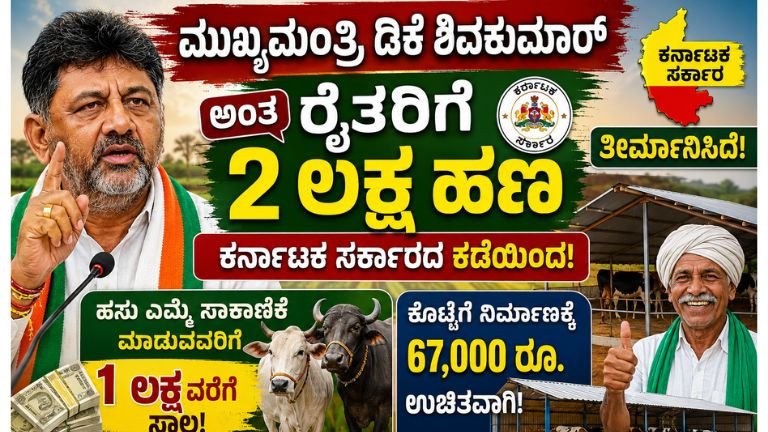
Karnataka Rural Transformation Scheme 2026: CM D.K. Shivakumar Announces ₹2 Lakh Farmer Relief, ₹1 Lakh Cattle Loans, and ₹67,000 Free Cattle Sheds hasu
-
Target Keyword: Karnataka government schemes for farmers 2026
-
Secondary Keywords: D.K. Shivakumar animal husbandry scheme, Karnataka cattle loan 1 lakh, free cattle shed scheme 67000, Karnataka ₹2 lakh farmer assistance, dairy farming subsidy Karnataka.
-
Meta Description: Massive boost for rural Karnataka! Chief Minister D.K. Shivakumar announces a major welfare package: ₹2 lakh direct support for farmers, ₹1 lakh easy cattle loans, and a ₹67,000 free cattle shed subsidy. Learn how to apply.
The rural landscape of Karnataka is witnessing a rapid economic overhaul. Following his transition to the state’s top office on June 3, 2026, the newly appointed 18th Chief Minister of Karnataka, D.K. Shivakumar, along with Deputy CM G. Parameshwara, has launched an aggressive, multi-pronged financial support matrix specifically designed to uplift smallholders and dairy farmers.
Moving far beyond traditional agricultural credit, the state government has unveiled a comprehensive Rural Transformation and Animal Husbandry Package. The policy features a direct ₹200,000 (₹2 Lakh) financial assistance framework for farmers, paired with a specialized dairy support engine offering up to ₹1 Lakh in hassle-free cattle purchase loans and a ₹67,000 100% free cattle shed (Kottige) construction subsidy.
If your household relies on cultivation, dairy production, or cattle rearing, this comprehensive guide provides detailed information on eligibility metrics, financial breakdowns, and online/offline registration routes.
The Dynamic Policy Shift under CM D.K. Shivakumar
When Chief Minister D.K. Shivakumar took the oath of office in early June 2026, he made it explicitly clear that rural empowerment would not depend on single-track initiatives. Recognizing that unpredictable weather patterns heavily impact traditional crop farming, the administration is shifting focus toward mixed farming models—specifically encouraging smallholders to integrate dairy farming (cows and buffaloes) as a reliable, climate-resilient secondary source of daily income.
By linking direct crop-centric capital support (₹2 Lakh) with foundational animal husbandry infrastructure (₹1 Lakh bovine loans + ₹67,000 direct infrastructure grant), this 2026 policy aims to establish an economic safety net directly at the village level across all 31 districts of Karnataka.
Structural Breakdown of the 2026 Rural Welfare Matrix
The comprehensive relief and development package is divided into three distinct, high-impact pillars to ensure clarity:
| Scheme Pillar | Financial Value | Benefit Type | Target Group |
| Agricultural Relief Program | ₹2,00,000 (₹2 Lakhs) | Direct Financial Clearance / Institutional Support | Small, Marginal & Stressed Cultivators |
| Bovine Expansion Loan | ₹1,00,000 (Subsidized up to ₹1 Lakh) | Collateral-Free Purchase Credit | Active Dairy Farmers & Rural Entrepreneurs |
| Cattle Shed (Kottige) Grant | ₹67,000 | 100% Free Construction Subsidy | Registered Bovine Rearers & MGNREGA Job Card holders |
Pillar 1: The ₹2 Lakh Farmer Financial Support Framework
The anchor of this rural package is the ₹2 Lakh direct farmer assistance framework. Administered jointly by the Department of Agriculture and the state treasury, this program targets the immediate cash-flow issues faced by farmers during sowing and harvesting periods.
Objective and Execution
This initiative focuses on clearing financial bottlenecks for families whose farming operations have been disrupted by rising seed, fertilizer, and labor costs over the last two fiscal quarters. The government coordinates directly with State Cooperative Banks and regional rural outlets to ensure eligible accounts reflect the structured credit adjustments smoothly. This step helps restore the credit ratings of smallholders, allowing them to secure low-interest institutional capital for the upcoming farming seasons without relying on high-interest local money lenders.
Pillar 2: ₹1 Lakh Dairy Farming & Cattle Purchase Loan
To make dairy farming a viable livelihood option for smallholders, the Department of Animal Husbandry and Fisheries has streamlined the ₹1 Lakh Dairy Bovine Loan Scheme.
[Apply via Local Dairy Cooperative (DCS)]
                  │
                  ▼
[Digital Verification of Milk Pouring History / Micro-KYC]
                  │
                  ▼
[Direct Disbursal of up to ₹1 Lakh for Bovine Purchase]
Core Features of the Dairy Loan:
-
Collateral-Free Access: To ensure accessibility for landless laborers and smallholders, loans up to ₹1 Lakh for purchasing high-yielding milch cows (such as Jersey or HF crosses) or Murrah buffaloes do not require land pledging.
-
Low/Subsidized Interest Rates: The state government heavily subsidizes the interest rate through co-operative networks, bringing effective interest rates down significantly compared to standard commercial loans.
-
Repayment Tied to Milk Supply: Repayments can be automatically linked to regular milk supply accounts at local Dairy Cooperative Societies (DCS), making repayment simple and stress-free.
Pillar 3: The ₹67,000 Free Cattle Shed (Kottige Construction) Subsidy
One of the biggest obstacles to expanding a small dairy setup is the high cost of building clean, hygienic housing for livestock. Poor flooring and improper drainage lead to frequent bovine health issues like mastitis, which directly reduces milk yields.
To address this, CM D.K. Shivakumar has introduced a dedicated ₹67,000 Free Cattle Shed Construction Scheme.
Key Elements of the Shed Subsidy:
-
100% Non-Repayable Grant: This is a pure construction subsidy, not a loan. The ₹67,000 is provided to cover materials and masonry costs.
-
Integration with MGNREGA: The construction blueprint is linked with the Mahatma Gandhi National Rural Employment Guarantee Act framework, allowing family members or local laborers to earn wages while constructing the shed.
-
Standardized Scientific Design: The subsidy requires the construction of a scientific cattle shed featuring concrete flooring, an integrated feeding trough, a dedicated urine collection channel, and a sturdy roof structure designed to accommodate 2 to 4 animals safely.
Comprehensive Eligibility Criteria
To ensure these resources reach genuine, hard-working rural families, the state government has established clear eligibility parameters across all three program components.
1. General Demographics
-
The applicant must hold a valid permanent residence status within Karnataka.
-
Preference is given to small and marginal farmers owning less than 5 acres of cultivable land, as well as landless rural laborers engaged in dairy activities.
2. Dairy & Shed Component Specifics
-
Milk Union Affiliation: For the ₹1 Lakh cattle loan, the applicant should ideally be an active member pouring milk at a registered local village Dairy Cooperative Society (DCS) under KMF (Karnataka Milk Federation / Bamul, Kolar Gold, etc.).
-
Job Card Requirement: For the ₹67,000 free cattle kottige component, owning an active MGNREGA rural job card accelerates the processing and work order approval phase.
-
Minimum Livestock: The applicant must either currently own at least 2 milch animals or show formal intent to purchase them via the companion loan program.
Required Documentation Checklist
To prevent delays at verification counters, ensure your household file contains clean, updated copies of the following documents:
-
Identity Verification: Aadhaar Card cleanly linked with an active bank account.
-
Rural Group Classifications: Valid BPL Ration Card or comprehensive family data sheet.
-
Land Ownership Records (Where Applicable): Current RTC / Pahani (ಪಹಣಿ) and land mutation files.
-
Dairy Membership Proof: Active Milk Pouring Passbook or a certified statement from the local DCS Secretary.
-
Employment Tracking: Active MGNREGA Job Card (highly recommended for the cattle shed subsidy).
-
Bovine Fitness: A basic certificate issued by a local government veterinary doctor confirming livestock health when purchasing animals.
Step-by-Step Application Process
Eligible families can navigate the enrollment process through both digital channels and local administrative offices.
Step 1: Secure Local Endorsements
Begin by visiting your local village Panchayat office and your regional Dairy Cooperative Society (DCS) secretary. Request the unified “Animal Husbandry and Integrated Farmer Assistance Form.”
Step 2: Upload Documents Online
Alternatively, you can visit the state’s integrated portal (such as Fruits Karnataka or Seva Sindhu). Log in using your Aadhaar credentials, select the Animal Husbandry department tab, and upload your structural documents, land records, and dairy passbook details.
Step 3: Site Inspection for the Cattle Shed
For the ₹67,000 cattle shed component, a Gram Panchayat Junior Engineer (JE) or a local PDO will visit your property to verify the space allocation. They will mark the location for the concrete flooring and issue a formal asset creation work order.
Step 4: Verification and Direct Benefit Transfer (DBT)
Once approved, the funds follow a highly transparent route:
-
The ₹1 Lakh bovine loan is disbursed directly to clear transactions with verified cattle sellers or breeders.
-
The ₹67,000 shed allocation is released in structured installments directly into your linked bank account based on construction milestones (Foundation, Walling, and Roofing).
apply Link
Structural Impact on the Rural Economy
Economists and rural policy experts view this comprehensive package as a highly strategic move for Karnataka’s agrarian sector.
[Crop Vulnerability / Monsoons] ──► Balanced By ──► [Daily Milk Revenue (KMF)]
                                                            │
                                                            ▼
                                              [Sustained Family Cash Flow]
By providing direct crop-centric capital alongside robust support for dairy infrastructure, the administration is establishing a highly reliable dual-income model. If a seasonal crop faces challenges due to erratic monsoon patterns, the household can rely on daily or weekly payouts from milk federations to maintain financial stability. This balanced approach helps reduce rural financial vulnerability and drives steady economic growth from the ground up.
Summary and Next Steps for Farmers
The coordinated rollout of the ₹2 Lakh assistance framework, ₹1 Lakh cattle loans, and ₹67,000 free cattle shed grants represents a major step forward by Chief Minister D.K. Shivakumar’s administration. It addresses immediate financial challenges while building the foundational infrastructure needed for long-term rural prosperity.
If you qualify for these programs, visit your local Gram Panchayat office, nearest Veterinary Clinic, or your village Dairy Cooperative Society today to update your documentation and begin the enrollment process.
Important Notice: Avoid third-party commercial agents charging fees for processing these forms. The Karnataka government provides all registration materials and software access completely free of cost across all authorized state digital centers and panchayat offices.