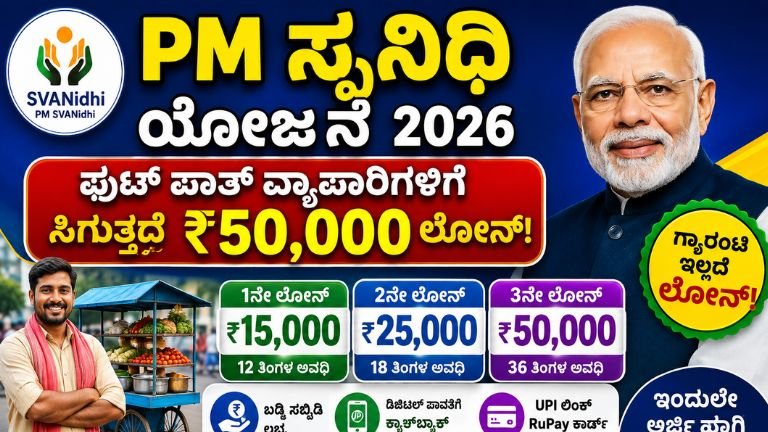
PM SVANidhi Scheme 2026: Get Up to ₹50,000 Loan for Street Vendors – Eligibility, Benefits, Documents and How to Apply k32
The PM SVANidhi Scheme 2026 is an important Central Government initiative designed to provide financial support to street vendors and help them expand or restart their small businesses. The scheme provides collateral-free working capital loans in three progressive stages of up to ₹15,000, ₹25,000 and ₹50,000.
The scheme was originally launched in June 2020 to help street vendors affected by the COVID-19 pandemic. Since then, PM SVANidhi has developed into a broader financial-inclusion programme supporting street vendors through formal credit, digital payments, interest subsidies, credit guarantee support and social-security linkages.
There is also an important new update for 2026. The Union Cabinet approved the restructuring and extension of PM SVANidhi in August 2025, and the lending period has now been extended until March 31, 2030. The restructured scheme aims to benefit 1.15 crore street vendors, including 50 lakh new beneficiaries.
This article explains the PM SVANidhi Scheme 2026, including the loan amounts, eligibility, repayment periods, interest subsidy, digital payment incentives, required documents, application process and important precautions.
What is PM SVANidhi Scheme?
PM SVANidhi stands for Prime Minister Street Vendor’s AtmaNirbhar Nidhi.
It is a Central Sector Scheme implemented jointly by the Ministry of Housing and Urban Affairs (MoHUA) and the Department of Financial Services. The scheme was launched in June 2020 to provide affordable working-capital credit to street vendors who often have difficulty accessing formal bank loans.
Street vendors play an important role in India’s local economy. They sell vegetables, fruits, food, tea, clothes and other products, and provide services such as barbering, shoe repair and laundry.
Many small vendors traditionally depend on informal lenders when they need money for their businesses. PM SVANidhi provides an opportunity to access formal institutional credit without requiring traditional collateral.
The government has now restructured the scheme and extended its lending period until March 31, 2030.
PM SVANidhi Loan Amount 2026
One of the biggest changes under the restructured scheme is the enhancement of the first and second loan tranches.
Eligible vendors can receive working-capital loans through progressive stages:
| Loan Tranche | Maximum Loan Amount |
|---|---|
| First Tranche | Up to ₹15,000 |
| Second Tranche | Up to ₹25,000 |
| Third Tranche | Up to ₹50,000 |
The first tranche was increased from ₹10,000 to ₹15,000, while the second tranche was increased from ₹20,000 to ₹25,000. The third tranche continues at up to ₹50,000.
The loans are progressive, which means successful repayment of an earlier loan can make a vendor eligible for the next loan tranche, subject to the applicable scheme and lender conditions.
PM SVANidhi Repayment Period
The repayment period depends on the loan tranche.
According to the latest government information:
- ₹15,000 first tranche: up to 12 months
- ₹25,000 second tranche: up to 18 months
- ₹50,000 third tranche: up to 36 months
The loan is generally repaid through monthly instalments. The exact repayment schedule and applicable terms should be confirmed with the lending institution before accepting the loan.
Who Can Apply for PM SVANidhi?
The scheme is designed for eligible street vendors.
A street vendor or hawker can generally be a person who sells goods, articles, food or merchandise in streets, footpaths, pavements or other permitted public vending locations, either from a temporary structure or by moving from place to place.
Examples include:
- Vegetable sellers
- Fruit sellers
- Tea vendors
- Food vendors
- Snack sellers
- Street-food sellers
- Clothes vendors
- Small household-item sellers
- Barber shops
- Cobblers
- Laundry service providers
- Other eligible street vendors
The official definition covers people engaged in vending goods and providing services to the public in streets and other relevant locations.
The restructured scheme is also being expanded beyond statutory towns to include census towns, urban agglomerations and peri-urban areas in a graded manner, increasing the potential coverage of the programme.
PM SVANidhi Eligibility
Eligibility is determined through the applicable government and local-body identification and verification process.
Street vendors may be considered under the scheme if they are identified or recognized through the prescribed process by the relevant Urban Local Body or other authorized mechanism.
The government has stated that States and Urban Local Bodies are responsible for identification of eligible street vendors and mobilisation of new applications.
Therefore, simply being a small business owner does not automatically guarantee approval of a PM SVANidhi loan.
The applicant must meet the applicable requirements and undergo the required verification.
What Documents Are Required?
The exact documents can vary depending on the applicant’s circumstances and the verification process.
Commonly required information or documents may include:
- Aadhaar Card
- Mobile number
- Street Vendor Certificate or Certificate of Vending, where applicable
- Letter of Recommendation, where applicable
- Bank account details
- Identity and address information
- Other documents requested during verification
Applicants should keep their Aadhaar and bank details updated.
If the local authority or lending institution asks for additional documents, those should be provided according to the official process.
Is Collateral Required for PM SVANidhi?
PM SVANidhi provides collateral-free working-capital loans to eligible street vendors.
This is one of the important advantages of the scheme because many small vendors do not own assets that can be offered as traditional collateral for a bank loan.
However, collateral-free does not mean that every applicant is automatically approved.
The application is still subject to eligibility, verification, lending rules and the concerned financial institution’s procedures.
Interest Subsidy Under PM SVANidhi
Another important benefit of PM SVANidhi is the interest subsidy available to eligible beneficiaries for timely repayment.
Government information describes the scheme as providing interest subsidy and credit guarantee support.
The interest subsidy can reduce the effective interest burden for eligible borrowers who meet the applicable repayment conditions.
Applicants should ask their lending institution about:
- Applicable interest rate
- Interest subsidy
- Repayment schedule
- Instalment amount
- Eligibility for subsidy
- Conditions for receiving the subsidy
This is important because the loan is not the same as a grant. PM SVANidhi provides a loan that must be repaid.
Digital Payment Incentive
PM SVANidhi also encourages street vendors to adopt digital payment methods.
Eligible vendors can receive incentives for digital transactions. Under the restructured scheme, the government has provided for cashback incentives of up to ₹1,600 for eligible retail and wholesale digital transactions.
Digital payments can help vendors:
- Accept UPI payments
- Reduce dependence on cash
- Maintain transaction records
- Build a digital financial history
- Improve access to formal financial services
The exact cashback conditions depend on the applicable scheme rules and transaction requirements.
UPI-Linked RuPay Credit Card
Another new feature under the restructured PM SVANidhi scheme is the introduction of a UPI-linked RuPay Credit Card for eligible vendors.
Vendors who successfully repay the second loan tranche can become eligible for a UPI-linked RuPay Credit Card with a limit of up to ₹30,000, subject to the applicable eligibility and issuing-bank conditions.
This can provide an additional formal credit facility for eligible street vendors.
However, a credit card is also a form of credit and must be used responsibly. Borrowers should understand the applicable terms, repayment requirements and charges before using it.
SVANidhi Se Samriddhi
PM SVANidhi is not limited to providing loans.
Under the SVANidhi Se Samriddhi component, eligible beneficiaries and their families can be socio-economically profiled and linked with selected Central Government welfare schemes.
The objective is to create a broader social-security network for street vendors and their families.
The programme can help eligible families access relevant welfare schemes based on their socio-economic profile and eligibility.
As of July 12, 2026, the government reported that socio-economic profiling had been completed for 50.63 lakh PM SVANidhi beneficiaries and 1.06 crore family members, with 1.56 crore scheme sanctions extended to them.
How to Apply for PM SVANidhi Loan 2026?
The application process involves identification or verification of the street vendor and submission of the required information through the official system and participating lending institutions.
A general process is as follows.
Step 1: Check your eligibility
First, confirm that you are an eligible street vendor under the scheme.
If you are already recognized by the relevant Urban Local Body, keep your vendor-related documents ready.
Step 2: Keep your documents ready
Prepare your Aadhaar, mobile number, bank account information and applicable street-vending documents.
Step 3: Submit the application
Applications can be facilitated through the PM SVANidhi system and participating lending institutions.
The application may involve assistance from authorized functionaries, Urban Local Bodies or lending institutions.
Step 4: Verification
The relevant authorities may verify the applicant’s street-vending status and other details.
Step 5: Loan processing
After verification, the application is processed by the concerned lending institution.
Loan approval is subject to applicable eligibility and lender procedures.
Step 6: Loan disbursement
If approved, the sanctioned loan amount is disbursed according to the applicable banking process.
Step 7: Repay on time
Timely repayment is important because successful repayment can help the vendor become eligible for higher loan tranches and other benefits.
How to Get the Next PM SVANidhi Loan?
PM SVANidhi follows a progressive lending structure.
A vendor may start with the first tranche of up to ₹15,000.
After successfully meeting the repayment requirements, the vendor can become eligible for the second tranche of up to ₹25,000.
After successfully repaying the second tranche, the vendor can potentially progress to the third tranche of up to ₹50,000, subject to the applicable conditions.
Therefore, timely repayment is an important part of the scheme.
The government reported that, as of July 12, 2026, more than 29.71 lakh vendors had availed the second tranche and more than 8.49 lakh had availed the third tranche.
PM SVANidhi Scheme Extended Till 2030
The government approved the restructuring and extension of PM SVANidhi in August 2025.
The lending period has been extended until March 31, 2030.
The restructured scheme has a total outlay of ₹7,332 crore and aims to benefit 1.15 crore street vendors, including 50 lakh new beneficiaries.
This extension is significant because it allows more street vendors to access formal working-capital credit over the coming years.
PM SVANidhi Latest 2026 Statistics
The latest government information shows that the scheme continues to reach millions of street vendors.
As of July 12, 2026, the government reported:
- 76.95 lakh street vendors had availed loans
- 1.15 crore loans had been availed
- Total loan amount was ₹18,475.06 crore
- 29.71 lakh vendors had received the second tranche
- 8.49 lakh vendors had received the third tranche
These figures demonstrate the continued scale of PM SVANidhi across India.
Why PM SVANidhi Is Important for Small Vendors
Small street vendors often require working capital every day.
For example, a vegetable vendor may need money to purchase fresh stock in the morning. A tea vendor may need funds to purchase milk, tea powder, sugar and other supplies. A food vendor may need money to purchase ingredients and packaging materials.
Without access to formal credit, vendors may have to borrow from informal sources.
PM SVANidhi attempts to provide an affordable formal-credit pathway while also encouraging digital payments and financial inclusion.
The scheme’s impact assessment has also reported positive outcomes. A 2025 assessment found that average annualized business income among PM SVANidhi borrowers grew by around 20% between 2023 and 2025.
Important Things to Remember Before Applying
Applicants should remember that PM SVANidhi is a loan scheme, not free financial assistance.
The money borrowed must be repaid according to the agreed repayment schedule.
Before accepting a loan, understand:
- Total loan amount
- Interest rate
- Interest subsidy conditions
- Monthly instalment
- Repayment period
- Applicable charges
- Conditions for the next tranche
- Terms of any RuPay Credit Card
Never pay an unknown agent claiming that they can guarantee loan approval.
Use only official PM SVANidhi channels, authorized Urban Local Bodies and participating financial institutions.
Beware of Fake PM SVANidhi Websites and Loan Offers
Because PM SVANidhi is a popular government scheme, fake websites and social media messages may sometimes use its name.
Be careful if someone promises:
- Guaranteed ₹50,000 loan
- Instant government money
- Loan without verification
- Guaranteed approval for a fee
- Cashback for paying an agent
- Loan approval through an unknown WhatsApp link
Do not share your banking PIN, UPI PIN, ATM PIN or confidential OTP with unknown people.
Always verify information through the official government portal or authorized institutions.
Official PM SVANidhi Portal
Applicants and existing beneficiaries should use the official PM SVANidhi portal for scheme-related information and services.
Official website:
The Ministry of Housing and Urban Affairs and the Department of Financial Services are responsible for implementation of the scheme.
Frequently Asked Questions
What is PM SVANidhi?
PM SVANidhi is a Central Government scheme providing collateral-free working-capital loans to eligible street vendors.
How much loan can I get under PM SVANidhi?
The current progressive loan amounts are up to ₹15,000, ₹25,000 and ₹50,000.
Is the PM SVANidhi loan free money?
No. It is a loan and must be repaid according to the applicable repayment schedule.
Is collateral required?
The scheme provides collateral-free working-capital loans to eligible street vendors.
What is the maximum PM SVANidhi loan?
The third tranche provides up to ₹50,000, subject to eligibility and applicable conditions.
How long is the scheme available?
The lending period has been extended until March 31, 2030.
Can I get a second loan?
Eligible vendors who successfully meet the repayment requirements of the previous tranche can progress to the next loan tranche, subject to applicable conditions.
Can I get a RuPay Credit Card?
Eligible vendors who successfully repay the second tranche may be eligible for a UPI-linked RuPay Credit Card with a limit of up to ₹30,000, subject to the applicable conditions.
Can street food vendors apply?
Eligible street food vendors can be covered under the street-vendor definition, subject to the required identification and verification.
Is PM SVANidhi available only in big cities?
The restructured scheme is expanding coverage beyond statutory towns to census towns, urban agglomerations and peri-urban areas in a graded manner.
Conclusion
The PM SVANidhi Scheme 2026 provides an important formal-credit opportunity for eligible street vendors across India.
Under the latest structure, vendors can access progressive collateral-free working-capital loans of up to ₹15,000, ₹25,000 and ₹50,000. The scheme also includes interest subsidy, credit guarantee support, digital transaction incentives and a UPI-linked RuPay Credit Card facility for eligible beneficiaries.
The government has extended the lending period until March 31, 2030, with a target of supporting 1.15 crore street vendors, including 50 lakh new beneficiaries.
Street vendors who need working capital should check their eligibility through the appropriate official channels and keep their documents ready. Timely repayment is particularly important because it can help eligible borrowers progress to higher loan tranches.
Most importantly, applicants should remember that PM SVANidhi is a loan and not a free cash scheme. Always verify the interest, repayment schedule and eligibility conditions before accepting the loan.
For the latest application information and official services, visit the PM SVANidhi official portal:
Disclaimer: PM SVANidhi eligibility, lending procedures, documentation, digital incentives and other conditions are subject to applicable government guidelines and lender processes. The information in this article is for general awareness. Applicants should verify the latest requirements through the official PM SVANidhi portal, Urban Local Body or participating financial institution before applying.