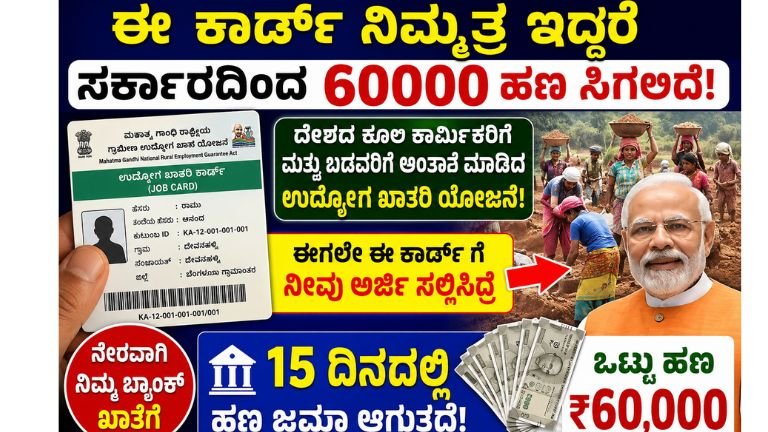
This Card Can Get You ₹60,000 from the Government! The Ultimate Guide to the NREGA Job Card Scheme
If you belong to a rural household, depend on daily wage labor, or are struggling to find a steady source of income, the government has a powerful tool designed just for you. There is a viral buzz right now about a specific government card that can help you secure up to ₹60,000 annually, with funds deposited directly into your bank account within 15 days of completing work.
We are talking about the MGNREGA Job Card (Mahatma Gandhi National Rural Employment Guarantee Act).
Often referred to as the Udyoga Khatari Yojane in Karnataka, this scheme is a lifesaver for millions of workers and low-income families across India. In this detailed guide, we will break down what this card is, how the ₹60,000 calculation works, who is eligible, and how you can apply for it today to secure your financial future.
What is the MGNREGA Job Card Scheme?
The Mahatma Gandhi National Rural Employment Guarantee Act (MGNREGA) is a monumental flagship program by the Government of India. Its primary objective is to enhance livelihood security in rural areas by providing at least 100 days of guaranteed wage employment in a financial year to every household whose adult members volunteer to do unskilled manual work.
For the poor, farmers during the off-season, and daily wage laborers, this scheme acts as a financial safety net. The Job Card is the official document issued by the local Gram Panchayat that registers you under this scheme and tracks your days of work and payments.
The Math Behind the ₹60,000: How Do You Get the Money?
You might be wondering, “Does the government just hand over ₹60,000 for free?”
The short answer is no—it is an employment guarantee, not a free cash handout. However, you can absolutely earn this amount (and sometimes more) through guaranteed labor. Here is how the math works out based on recent wage revisions:
-
Daily Wage Rates: The central and state governments revise MGNREGA daily wages annually. In states like Karnataka, Haryana, and Goa, daily wages range from roughly ₹340 to ₹370+ per day.
-
The 100-Day Guarantee: Under normal circumstances, the government guarantees 100 days of work per household. At a rate of ~₹350/day, that equals ₹35,000 a year.
-
Drought or Extra Allocation: In times of severe drought, natural calamities, or through specific state-sponsored extensions, the government often increases the guaranteed days from 100 to 150 days.
-
Asset Creation Bonuses: If multiple adult members of a single household register and work during different phases, or if you participate in specific rural development projects (like building cattle sheds, farm ponds, or asset creation), the total household earnings can easily cross ₹60,000 per year.
The 15-Day Payment Rule: By law, once you complete your allocated work under the NREGA scheme, the government is mandated to credit your wages directly into your Aadhaar-linked bank account via Direct Benefit Transfer (DBT) within 15 days. If the payment is delayed, you are legally entitled to delay compensation!
Benefits of Holding an NREGA Job Card
Owning this card opens up several doors for rural households. It is not just about the daily wages; it provides a sense of dignity and financial independence.
-
Guaranteed Unemployment Allowance: If you apply for work through your Job Card and the local administration fails to provide you with work within 15 days of your application, the government is legally required to pay you an unemployment allowance.
-
Work Close to Home: The scheme mandates that work must be provided within a 5-kilometer radius of your village. If it is further away, you are entitled to an extra 10% wage allowance to cover travel costs.
-
Safe Working Conditions: On-site facilities such as clean drinking water, shade for resting, and a first-aid box are mandatory at every NREGA worksite. If a worker brings a child under six years old, a designated person is paid to take care of the children.
-
Equal Pay for Equal Work: The scheme strictly enforces gender equality. Both men and women receive the exact same daily wage rate for manual labor.
-
Official Identity Proof: The Job Card is a government-verified document that can be used as valid ID and address proof for opening bank accounts or applying for other state welfare schemes.
What Kind of Work Do You Have to Do?
The work provided under the Udyoga Khatari Yojane focuses on improving rural infrastructure and sustainability. It is entirely unskilled manual labor, meaning you do not need any special degrees or technical skills.
Common projects include:
-
Digging canals, farm ponds (Krishi Honda), and wells for water conservation.
-
Afforestation and tree plantation drives.
-
De-silting local lakes and traditional water bodies.
-
Constructing rural roads, pathways, and drainage systems.
-
Building community assets like Anganwadi centers, toilets, and cattle sheds.
Eligibility Criteria: Who Can Apply?
To get your hands on this card and start earning, you must meet the following basic criteria:
-
Nationality: You must be a citizen of India.
-
Age: The applicant must be an adult (above 18 years of age).
-
Residency: You must reside in a rural area or village. Urban households are not eligible for this specific scheme.
-
Willingness to Labor: The applicant must be willing to undertake unskilled, manual labor.
Documents Required for the Application
Before you head out to apply, make sure you have the following documents ready to ensure a smooth, hassle-free process:
| Document Type | Details Required |
| Identity Proof | Aadhaar Card, Voter ID, or Ration Card |
| Address Proof | Ration Card, Electricity Bill, or Gram Panchayat certificate |
| Bank Account Details | Bank Passbook (Must be linked with your Aadhaar for DBT) |
| Photographs | Passport-sized photographs of all adult family members applying |
| Category Certificate | SC/ST/OBC certificate (if applicable, for statistical tracking) |
Step-by-Step Guide: How to Apply for NREGA Job Card
Getting your Job Card is completely free of cost. The government does not charge a single rupee for registration. You can apply through both offline and online methods.
Method 1: The Offline Route (Recommended & Easiest)
Since this is a rural-centric program, the offline method through your local village administration is highly efficient.
-
Visit your Gram Panchayat Office: Head over to your local Gram Panchayat office or meet your village’s Panchayat Development Officer (PDO).
-
Collect the Form: Ask for the MGNREGA Job Card Application Form (available in your local language, like Kannada in Karnataka).
-
Fill in the Details: Fill out the names, ages, genders, and Aadhaar numbers of all adult members of your household who want to work.
-
Attach Documents: Affix the passport-sized photos and attach copies of your Aadhaar Card, Ration Card, and Bank Passbook.
-
Submit and Verify: Hand over the form to the Panchayat official. They will verify your residential details and physical existence in the village.
-
Receive Your Card: Once verified, your Job Card will be generated and issued to you within 15 days of submission.
Method 2: The Online Route (Via Umang App / State Portals)
If your state offers online registration through Janasevaka, Seva Sindhu (in Karnataka), or the official Umang App, follow these steps:
-
Download the Umang App or visit the official MGNREGA portal (
nrega.nic.in). -
Register using your mobile number and search for “MGNREGA” or “Job Card”.
-
Click on ‘Apply for Job Card’.
-
Enter your personal details, upload digital copies of your documents (Aadhaar, Photos), and submit.
-
An application reference number will be generated, which you can use to track your status. The physical card will still be distributed via your local Panchayat.
How to Demand Work and Get Paid in 15 Days
Simply holding the card does not automatically start the money flow. You must actively demand work. Here is the process:
-
Submit a Written Application: Go to your Gram Panchayat and submit a written application stating that you are ready for work. You can ask for work individually or as a group.
-
Get a Dated Receipt: Ensure the Panchayat official gives you a dated receipt for your work application. This receipt is your legal proof. If they don’t give you work within 15 days from this date, your unemployment allowance kicks in!
-
Work Allocation: The Panchayat will assign you a workspace and project within 15 days.
-
Direct Bank Transfer: Once your supervisor marks your attendance (Muster Roll) and the work phase ends, the funds are calculated and pushed straight into your bank account within two weeks.
Myth vs. Reality: Clear Your Doubts
With a lot of misinformation circulating on social media regarding “free ₹60,000 government schemes,” it is vital to separate fact from fiction:
Myth: The government will automatically send ₹60,000 to anyone who signs up for this card.
Reality: You earn this money through honest, physical labor. It is a wage program, not a lottery or pension.
Myth: You have to pay a commission to local agents or leaders to get this card.
Reality: The NREGA Job Card is 100% free. Demanding money for it is illegal. If anyone asks for a bribe, report them to the higher district authorities immediately.
Click Hear to Apply link 1
The NREGA Job Card is an incredible empowerment tool for the working-class community, rural women, and economically weaker sections. If you don’t have regular employment or want to supplement your farming income, this card guarantees you employment and a steady stream of income up to ₹35,000–₹60,000 depending on your household’s total participation.
Don’t wait for opportunities to knock on your door. Grab your Aadhaar card, take a stroll down to your local Gram Panchayat office, and apply for your Udyoga Khatari Job Card today. Secure your 100 days of guaranteed work, and ensure financial stability for your family!
Did you find this article helpful? Share this guide with your friends, neighbors, and WhatsApp groups in your village so that every eligible worker can claim their rightful employment benefits!