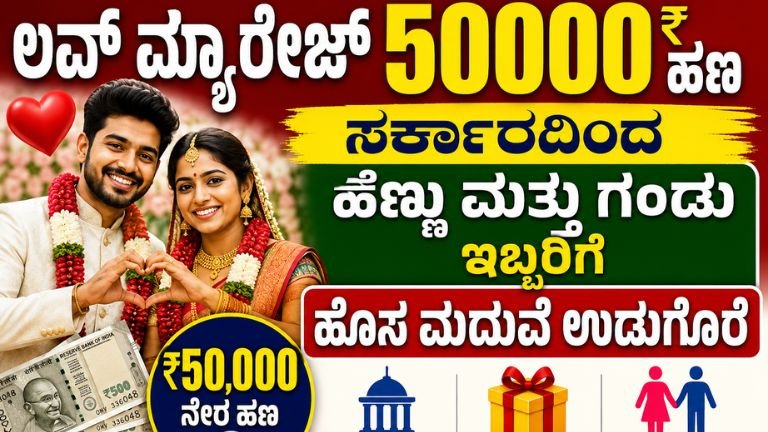
Understanding Government Marriage Financial Assistance Schemes
Marriage is a significant milestone in an individual’s life. To support couples—especially those opting for simple, low-budget ceremonies, inter-caste marriages, or belonging to economically weaker sections—the government introduces various financial aid and incentive schemes.
While there is common discussion online regarding a specific “Love Marriage INR 50,000 Scheme” for any self-selected marriage, official government platforms show that financial distributions are structurally categorized under specific social welfare programs. These target inter-caste marriages, mass marriage ceremonies, and specific community welfare incentives to promote social integration and support newlywed couples.
Breakdown of Key Government Marriage Incentive Schemes
Rather than an open-ended fund for any self-arranged marriage, the financial assistance provided by state social welfare departments follows clear, dedicated guidelines. Below are the prominent real-world frameworks where financial assistance ranging from INR 50,000 up to INR 5,50,000 is systematically distributed to eligible couples.
1. The Minority Welfare Marriage Aid Scheme
The Department of Minority Welfare frequently implements financial support measures targeting newly married couples from economically backward minority communities.
-
The Financial Incentive: Eligible couples receive a fixed direct cash assistance of INR 50,000 to help manage their initial post-marriage household setup costs.
-
Core Objective: The funds are allocated to provide basic financial security to economically vulnerable families during the wedding period, preventing high-interest informal debts.
2. Inter-Caste Marriage Incentive Schemes
To reduce deep-rooted caste-based discrimination and build a more integrated, progressive society, Social Welfare and Tribal Welfare Departments provide major financial incentives to couples opting for inter-caste marriages.
-
The Financial Incentive: In scenarios where one spouse belongs to a Scheduled Caste (SC) or Scheduled Tribe (ST) and the other belongs to a non-SC/ST community, the incentive ranges heavily from INR 2,50,000 up to INR 5,50,000.
-
Gender-Based Allocation Structure: For instance, under specific regional rules, an incentive of up to INR 3,00,000 is directly provisioned for the bride, while up to INR 2,50,000 is allocated for the groom to secure long-term household stability.
-
Disbursement Mechanics: The financial aid is rarely handed out entirely in liquid cash. Instead, it is commonly split into two systematic parts: 50% is credited directly via cash transfer, and the remaining 50% is locked into a fixed deposit under a minimum 3-year term to guarantee future financial security for the couple.
3. “Adarsha Vivaha” Mass Marriage Schemes
For couples looking to completely bypass lavish, high-cost wedding setups, governments support institutionalized mass marriage programs.
-
The Financial Incentive: Under the Adarsha Vivaha framework, the government typically credits a dedicated fixed deposit or savings allowance (often starting at INR 10,000 to INR 50,000 depending on the exact departmental sub-clause) directly in the name of the bride.
-
Organizational Support: Additionally, non-profit institutions or community bodies organizing these large-scale mass marriage functions receive separate operational subsidies to cover wedding clothing, basic jewelry items, and traditional meals for attendees.
Primary Eligibility Benchmarks for Application
To qualify for marriage-based welfare incentives, applicants must meet the clear legal, financial, and demographic parameters defined by the executing departments.
| Parameter Type | General Government Requirement Rules |
| Legal Age Limits | The bride must be at least 18 years old (up to 42 years maximum under specific reservation schemes) and the groom must be at least 21 years old (up to 45 years maximum) at the exact date of the wedding. |
| Income Thresholds | The joint annual income of both partners combined must not cross the specified threshold, which is typically capped at INR 5,00,000 per annum. |
| Caste/Community Status | For inter-caste financial incentives, one partner must hold valid, officially certified SC/ST credentials, while the other must belong to a different caste tier. |
| Marriage Validity Period | Most departments enforce a strict deadline rule where couples must apply online within 18 months from the official date listed on their marriage certificate. |
| Residency Mandatory Clause | At least one of the spouses must hold verified, permanent residency within the executing state boundaries. |
Step-by-Step Online Application Protocol
If you meet the structural criteria listed above, you can register through the dedicated state social welfare portals. Missing steps or formatting errors in your documents will pause your file during physical spot verification rounds.
Step 1: Preliminary Registration on Seva Sindhu / State Portals
-
Navigate to your state’s primary citizen services dashboard (such as the Seva Sindhu or Yuva Karnataka portal) or the specific Tribal/Social Welfare Department webpage.
-
Click on the registration tab and enter your Aadhaar Number to complete the preliminary e-KYC profile verification.
Step 2: Selecting the Specific Marriage Incentive Form
-
Log in with your newly generated credentials.
-
Locate the search bar and input “Incentive for Inter-Caste Marriage” or “Minority Marriage Aid Scheme” depending on your eligibility profile.
-
Open the digital application form.
Step 3: Entering Personal and Marriage Specifics
-
Fill out the full name, birth dates, and current employment/occupation details for both the bride and the groom exactly as displayed on their official educational records.
-
Provide the exact date of marriage registration along with the specific location details of the sub-registrar office where the marriage was legally solemnized.
-
Input the detailed bank account numbers, IFSC codes, and branch names. Ensure that a joint bank account is opened in the names of both the bride and groom, as disbursements are paid out to joint accounts to protect both partners.
Step 4: Uploading Scanned Mandatory Documentation
Carefully upload clean, unblurred, high-resolution digital copies of the following documents to avoid immediate rejection by verification officers:
-
Official Marriage Registration Certificate: Issued by the competent municipal corporation or the regional sub-registrar office.
-
Caste Certificates: Valid community credentials for both individuals, clearly showing their respective sub-castes.
-
Income Certificate: An officially verified revenue department document showing a joint family income below the INR 5 Lakh limit.
-
Age & Identity Proofs: Aadhaar Cards, PAN Cards, or Class 10 marks cards for both partners.
-
Joint Wedding Photograph: A clear photograph taken during the marriage ceremony.
-
Residential Proof: Valid voter ID, ration card, or domicile certificate confirming permanent state residency.
Step 5: Final Submission and Spot Verification Tracking
-
Review the entire application dataset using the built-in preview tool to ensure no typographical errors exist.
-
Click Submit to generate your official application acknowledgement receipt containing your unique tracking number.
-
Note that the Social Welfare Department will assign a regional officer to conduct a physical spot verification to confirm the couple’s residential status and marital details before finalizing the fund release.
Click Hear to Apply
Important Summary Checklist for Newlywed Applicants
To ensure a seamless processing cycle and secure the financial aid smoothly, keep this operational summary in mind:
-
Legal Certificate Priority: Do not delay registering your marriage at the local sub-registrar office. A religious or traditional wedding photo alone is not legally sufficient; an official Government Marriage Certificate is mandatory to unlock any financial aid.
-
Bank Mapping Status: Ensure your joint bank account is fully active and linked with your Aadhaar cards to enable direct benefit transfers (DBT) without technical failure.
-
Avoid Middlemen: All registration and tracking operations are completely free of charge on official government portals. Avoid paying third-party agents; instead, use local government citizen service centers (like Grama One or Bangalore One) for guided help.
By tracking the exact guidelines, gathering the correct certificates, and utilizing the official departmental portals early within the post-marriage window, eligible couples can secure this financial support to build a strong foundation for their new lives together.