Free Borewell Scheme 2026: Transforming Dry Lands into Green Gold – A Complete Guide for Farmers
Introduction: The Miracle of Water
For a farmer, water is not just a resource; it is life, dignity, and the future of the next generation. In many parts of Karnataka and rural India, the lack of irrigation has forced many to leave their ancestral lands in search of daily wage labor in cities. However, 2026 is witnessing a massive shift.
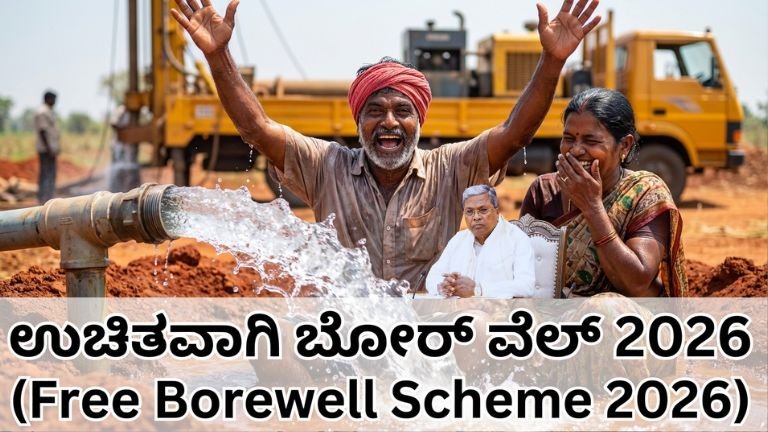
The government’s aggressive rollout of the Free Borewell Scheme (Ganga Kalyana 2026) is bringing tears of joy to thousands of families. We recently witnessed a scene in a small village where, after years of drought, a new borewell struck a massive aquifer. The farmer’s dance of joy in the gushing water reminds us why these schemes are the backbone of our economy.
If you are a farmer struggling with a dry patch of land, this is your golden opportunity. In this ultimate guide, we will break down everything you need to know to get a free borewell drilled on your land this year.
Part 1: What is the Ganga Kalyana / Free Borewell Scheme 2026?
The Free Borewell Scheme, primarily known as the Ganga Kalyana Scheme in Karnataka, is a flagship program designed to provide irrigation facilities to small and marginal farmers.
What the Scheme Provides:
-
Free Drilling: The entire cost of the borewell rig and labor is covered by the government.
-
Casing Pipes: High-quality casing pipes are provided to prevent the borewell from collapsing.
-
Submersible Pump sets: Once water is found, the government provides a high-HP pump set.
-
Electrical Infrastructure: This includes the installation of poles and transformers to provide power to the pump.
In 2026, the budget for this scheme has been doubled to ensure that even the most remote villages are covered, aiming to make every farmer “Atmanirbhar” (Self-reliant).
Part 2: Why You Should Apply Right Now
Waiting for the monsoon is no longer a viable strategy due to climate change. Here is why applying for a free borewell in 2026 is critical:
-
Triple Your Income: With a borewell, you are no longer limited to one crop. You can grow Kharif, Rabi, and even summer crops like vegetables or flowers which fetch high prices in the market.
-
Asset Appreciation: A piece of land with a functional borewell is worth five times more than a dry piece of land.
-
Government Subsidy Advantage: In 2026, the subsidy covers up to ₹3.5 Lakh to ₹5 Lakh per unit depending on the depth of the water table. This is money you don’t have to borrow from private moneylenders.
Part 3: Detailed Eligibility Criteria
To ensure the benefits reach those who need them most, the government has set specific rules for 2026:
-
Category Priority: The scheme is primarily for farmers belonging to SC/ST, Minority communities, and Backward Classes (OBC).
-
Land Holding: You must be a “Small” or “Marginal” farmer. Generally, this means owning between 2.0 to 5.0 acres of land.
-
Groundwater Zone: Your land must not be in a “Dark Zone” (an area where groundwater is officially declared as over-exploited).
-
Distance Rule: There must be a minimum distance (usually 500 feet) from any existing public or neighboring borewell to prevent groundwater depletion.
-
No Existing Borewell: You must not have an existing functional borewell on the survey number you are applying for.
Part 4: Documents Required (The Checklist)
Keep these documents ready in a folder before you visit the office or apply online:
-
Aadhaar Card: Linked with your mobile number.
-
Pahani/RTC: Latest copy (Form 16) showing you are the owner of the land.
-
Caste & Income Certificate: Issued by the Tahsildar within the last 6 months.
-
Small/Marginal Farmer Certificate: Issued by the Department of Agriculture.
-
Land Map: An official sketch showing the boundaries of your land.
-
Bank Passbook: A copy of the front page for DBT (Direct Benefit Transfer) purposes.
-
Self-Declaration: A signed form stating you have no other borewell.
Part 5: How to Apply – Step-by-Step Guide
Method 1: The Online Portal (Fastest)
-
Visit the Seva Sindhu or the official KMDC/Dr. B.R. Ambedkar Development Corporation website.
-
Look for the “Ganga Kalyana Scheme 2026” link.
-
Upload your scanned documents.
-
Pay a nominal processing fee (usually less than ₹50).
-
Save the acknowledgment number for tracking.
Method 2: Offline (Village Level)
-
Visit your local Grama Panchayat or Raitha Samparka Kendra (RSK).
-
Meet the PDO (Panchayat Development Officer) or the Agriculture Officer.
-
Fill out the physical application form and attach your photocopies.
-
Ensure you get a signed receipt after submission.
Part 6: The Selection Process
Many farmers worry about corruption or delays. In 2026, the process has become more transparent:
-
Verification: A revenue officer visits your land to check the RTC.
-
Geologist Survey: A government-appointed geologist visits to identify the exact spot where water is likely to be found. Do not drill without this certificate.
-
Approval: The District Selection Committee, headed by the MLA or District Collector, approves the list.
-
Drilling: Work orders are issued to agencies, and the rig arrives at your field.
Part 7: Managing Your Borewell for the Long Term
Getting the borewell is only half the battle. To ensure the joy lasts for decades, farmers must:
-
Rainwater Harvesting: Build a recharge pit around the borewell to ensure the water level doesn’t drop during summer.
-
Drip Irrigation: Don’t waste the water! Use drip systems (also heavily subsidized) to get the most out of every drop.
-
Crop Rotation: Switch to less water-intensive crops like millets if the water table begins to recede.
How to Apply for Free Borewell ₹5 Lakh Borewell Subsidy:
The government is ready to spend lakhs of rupees on your land because they know that when the farmer prospers, the country prospers. The sight of a farmer’s joy when water finally hits the surface is a reminder of the power of well-executed schemes.
If you meet the criteria, do not delay. Applications for the 2026 cycle are filling up fast. Visit your nearest Village Secretariat or apply online today!