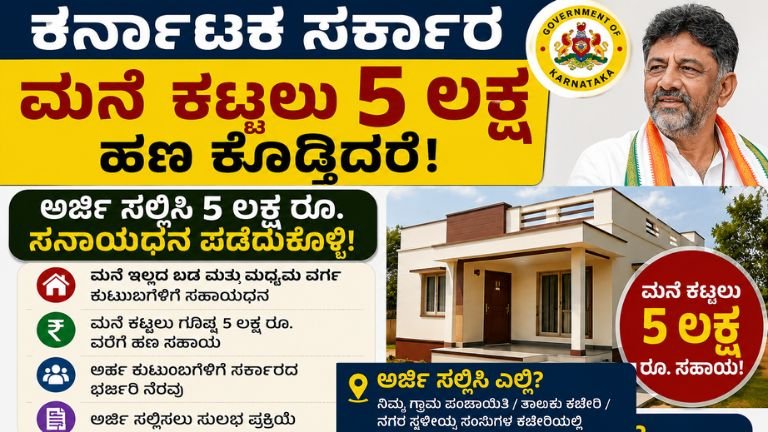
Karnataka Government’s 5 Lakh Subsidy Scheme for House Construction: An In-Depth Guide
Owning a home is a fundamental human need, providing security, dignity, and a foundation for personal growth. For many economically weaker sections (EWS) and low-income groups (LIG) in Karnataka, constructing a permanent, safe house remains a distant dream due to rising land and material costs. Recognizing this challenge, the Government of Karnataka, in collaboration with central housing initiatives, has introduced various subsidized housing schemes.
A prominent initiative widely discussed across the state offers up to ₹5 Lakhs in financial assistance/subsidy for eligible beneficiaries to construct their own homes. This comprehensive guide provides an exhaustive look into the Karnataka government’s housing subsidy schemes, eligibility criteria, application processes, required documentation, and financial breakdowns to help you navigate the system successfully.
Understanding the ₹5 Lakh Housing Assistance Scheme
The announcement and implementation of a ₹5 Lakh assistance package for house construction in Karnataka primarily operates through integrated state and central housing programs. The state government leverages existing frameworks managed by the Rajiv Gandhi Housing Corporation Limited (RGHCL) and the Directorate of Municipal Administration, alongside the federal Pradhan Mantri Awas Yojana (PMAY).
The Financial Breakdown: How the ₹5 Lakh is Structured
The total financial support of ₹5 Lakhs is generally not given as a single, upfront cash handout. Instead, it is structured as a combination of direct government subsidies and highly subsidized, low-interest institutional loans.
Typically, the financial model follows this matrix:
| Source of Funds | Type of Assistance | Estimated Amount |
| State Government Subsidy | Direct Benefit Transfer (DBT) | ₹1.50,000 to ₹2,00,000 |
| Central Government Subsidy | PMAY Component | ₹1,50,000 |
| Bank Loan / Institutional Tie-up | Subsidized Low-Interest Loan | ₹1,50,000 to ₹2,00,000 |
| Beneficiary Contribution | Personal Margin Money | Remaining Balance (if any) |
Note: The exact subsidy ratio varies slightly depending on whether the applicant belongs to the Scheduled Castes (SC), Scheduled Tribes (ST), OBC, or General Category, with SC/ST beneficiaries often receiving a higher direct subsidy component from the state.
Core Government Housing Schemes in Karnataka
To avail of this ₹5 Lakh assistance, applicants must fit into one of the specialized housing schemes run by the Karnataka government. The most prominent schemes include:
1. Basava Vasati Yojana
Managed by the RGHCL, this is one of Karnataka’s flagship rural housing schemes. It specifically targets homeless people and those living in kutcha (temporary) houses in rural areas. While the base subsidy has historically been lower, recent revisions and convergence with other rural development funds allow beneficiaries to scale up their total construction financial support toward the ₹5 Lakh mark.
2. Dr. B.R. Ambedkar Niwas Yojana
This scheme is dedicated entirely to the socio-economic upliftment of SC and ST communities in both urban and rural Karnataka. Because it focuses on historically marginalized groups, the state government provides its highest direct subsidy margins under this program, significantly reducing the loan burden on the beneficiary.
3. Devaraj Urs Housing Scheme
Designed for the benefit of Other Backward Classes (OBCs), minorities, and nomadic/semi-nomadic tribes, this scheme mirrors the structure of the Ambedkar Niwas Yojana but caters explicitly to non-SC/ST backward categories recognized by the state.
4. Vajpayee Urban Housing Scheme
For urban populations living in slums or unauthorized pockets within municipal limits, the Vajpayee Urban Housing Scheme provides financial assistance to construct pucca (permanent) houses on their own sites or through government-allotted layouts.
Eligibility Criteria
To ensure that the financial aid reaches the truly underprivileged sections of society, the Karnataka government has established strict eligibility parameters.
1. Residential Requirement
-
The applicant must be a permanent resident of Karnataka.
-
The applicant must have resided in the specific local area (village panchayat or municipality) for a minimum period stipulated by the local authorities (usually 3 to 5 years).
2. Income Thresholds
-
Rural Areas: The annual household income of the applicant from all sources must not exceed ₹1,20,000.
-
Urban Areas: The annual household income must not exceed ₹3,00,000 (aligned with EWS guidelines).
3. Property Ownership Status
-
The applicant or any member of their immediate family must not own a pucca house anywhere in India.
-
The applicant must own a vacant site or a site with a kutcha house that needs demolition and reconstruction. The site must have clear, marketable titles registered in the applicant’s name.
4. Demographic Prioritization
Priority is given to vulnerable groups, including:
-
Widows and divorcees
-
Physically challenged individuals
-
Senior citizens
-
Destitutes and victims of natural calamities
Step-by-Step Guide to the Application Process
The Karnataka government has digitized the housing application system through the Ashraya portal to maintain transparency and eliminate middlemen.
Online Application Method
-
Visit the Official Portal: Go to the Rajiv Gandhi Housing Corporation Limited (RGHCL) official website (Ashraya portal).
-
Navigate to the Application Link: Look for the active link corresponding to the specific housing scheme you qualify for (e.g., Basava Vasati Yojana or Ambedkar Niwas Yojana).
-
Fill the Application Form: Enter your personal details, income details, caste certificate numbers, and details of the site you own.
-
Upload Documents: Scan and upload clear copies of all required identification and land ownership documents.
-
Submit and Save Acknowledgement: Submit the form and print out the acknowledgment receipt containing your unique application number for future tracking.
Offline Application Method
For citizens in rural areas who lack internet access:
-
Visit the local Grama Panchayath office (for rural areas) or the Municipality/Corporation office (for urban areas).
-
Collect the physical housing scheme application form.
-
Fill out the details manually and attach physical copies of the required documents.
-
Submit the completed application packet to the designated PDO (Panchayat Development Officer) or municipal desk. Ensure you collect a signed receipt.
Required Documentation Checklist
An incomplete application is the primary reason for rejection. Ensure you have the following documents ready before applying:
-
Identity Proof: Aadhaar Card (mandatory and linked to bank account), Voter ID, or Ration Card (BPL Card is highly preferred).
-
Income Certificate: A valid income certificate issued by the Revenue Department (Tahsildar) ensuring you fall below the income ceiling.
-
Caste Certificate: If applying under SC/ST/OBC quotas, a caste certificate issued by the competent authority.
-
Land Ownership Documents:
-
Title Deeds / Sale Deed of the plot.
-
Form 9 and Form 11 (for rural properties).
-
Khata certificate and up-to-date tax paid receipts (for urban properties).
-
-
Site Photograph: A clear photograph of the applicant standing on the vacant site or next to the kutcha house to be demolished.
-
Bank Account Details: Bank passbook copy showing the IFSC code and account number (must be a single account held by the primary applicant).
Verification and Geo-Tagging Process
The allocation of the ₹5 Lakh fund involves a strict verification process to prevent fraud and ensure structural compliance.
1. Grama Sabha / Ward Committee Selection
Once applications are received, a preliminary list is generated. In rural areas, the Grama Sabha reviews the applications publicly to verify that the applicant is genuinely homeless or living in sub-standard conditions. In urban setups, a municipal ward committee handles this filtering.
2. GPS Geo-Tagging
The RGHCL tracks house construction using a mobile-app-based GPS geo-tagging system. This process occurs in four distinct stages:
[Stage 1: Vacant Site/Kutcha House] ──> [Stage 2: Foundation/Plinth Level]
                                                       │
                                                       ▼
[Stage 4: Completed House]          <── [Stage 3: Lintel/Roof Level]
Funds are disbursed into the beneficiary’s bank account via Direct Benefit Transfer (DBT) only after the successful GPS upload of each completed phase. No money is given upfront without physical progress verification on-site.
Important Rules for House Construction
Beneficiaries receiving this financial aid must adhere to specific structural guidelines laid out by the Housing Department:
-
Minimum Built-up Area: The constructed house must meet minimum square footage guidelines (typically at least 250 to 300 square feet) to ensure adequate living space.
-
Sanitation: The house blueprint must include a functional, attached toilet. No funds will be fully cleared if a toilet is omitted from the build.
-
No Sale Clause: The beneficiary cannot sell, lease, or transfer the ownership of the constructed house for a specified lock-in period (usually 15 to 20 years) from the date of completion.
Frequently Asked Questions (FAQs)
Can I apply for this scheme if I do not own land?
No. The ₹5 Lakh scheme for individual house construction requires you to own a piece of land or a site with a kutcha house. However, if you are completely landless, you can apply for the government’s separate “Site Allotment” or “Group Housing” schemes where the government provides both the land and the flat/house.
How long does it take for the subsidy amount to hit the bank account?
The funds are released progressively. Once a stage of construction (e.g., foundation) is verified and geo-tagged by the Panchayat Development Officer (PDO) or municipal engineer, it typically takes 15 to 30 working days for that specific installment to be credited via DBT.
Are single women or senior citizens given preference?
Yes. The selection criteria give additional weightage and priority to single women, widows, physically challenged individuals, and senior citizens who meet the low-income criteria.
apply Link
If your application is rejected, you will receive a reason on the Ashraya portal (e.g., document mismatch, income exceeding limits). You can rectify the errors or file an appeal with the Executive Officer (EO) of the Taluk Panchayat or the Commissioner of your local municipality.
Crucial Tips for a Successful Application
-
Ensure Aadhaar Linkage: Ensure your Aadhaar card is actively linked to your bank account and that your name matches exactly across your Aadhaar, Ration Card, and Land Revenue documents.
-
Do Not Pay Middlemen: The Karnataka government’s housing system operates transparently via online portals. Never pay bribes or processing fees to unofficial agents promising guaranteed selection.
-
Maintain Regular Progress: Once your initial structural phase is approved, initiate construction promptly. Delays in completing stages can lead to administrative hold-ups or cancellation of subsequent fund releases.