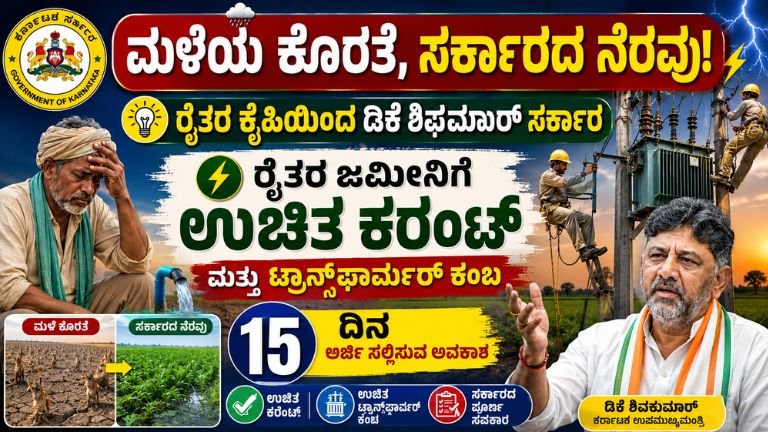
Karnataka Government’s Free Transformer & Electricity Line Scheme: Debunking Myths vs. Reality for Farmers TC
For farmers in Karnataka, water is life—and electricity is the vehicle that delivers it. With over 36 lakh irrigation pump (IP) sets running across the state, securing a reliable, affordable power connection is a top priority for rural families.
Recently, social media platforms, YouTube videos, and local messaging groups have been flooded with eye-catching headlines: “Bumper News for Karnataka Farmers: Government Announces Free Transformers and Electricity Lines for All Borewells!”
If you are a landholder or managed farm owner in Karnataka, these claims sound like a dream come true. Installing a transformer and laying lines to a newly drilled borewell can easily cost lakhs of rupees. But before you visit your local ESCOM (Electricity Supply Company) office demanding a free setup, it is crucial to separate the viral rumors from actual policy.
Here is the complete, unfiltered guide to the Karnataka Free Transformer and Electricity Line Scheme—what the law actually says, what changed, what it costs you now, and the legitimate government subsidies you can use.
Deconstructing the Viral Claim: “Free Transformers for Everyone”
The viral videos circulating online often feature clips of Chief Minister Siddaramaiah or Deputy Chief Minister D.K. Shivakumar, claiming that any farmer with a borewell or open well can get a brand-new, 100% free distribution transformer (commonly called a “TC”) and associated poles/conductors.
The Hook
The videos claim that under a “new bumper scheme,” the government has waived all infrastructure charges for agricultural connections. Some even provide step-by-step instructions on how to fill out fictitious “Free TC” forms.
The Reality Check
There is currently no active scheme in Karnataka that provides 100% free transformers and distribution lines to every individual farmer on demand.
While the state government heavily subsidizes agricultural power consumption (spending over ₹19,290 crore annually on free electricity subsidies for IP sets), the physical infrastructure required to bring that power to your specific plot is a different story.
The Historical Context: The Legacy of “Free TC” Schemes
To understand why these rumors spread so easily, we have to look back at the history of Karnataka’s power sector.
For years, the state operated under a highly subsidized model for agricultural electricity infrastructure:
-
The Regular / General Scheme: Farmers applied for a connection, paid a nominal deposit (historically around ₹24,000), and the respective ESCOM (BESCOM, HESCOM, GESCOM, MESCOM, or CESC) would bear the cost of installing the poles, drawing the transmission lines, and setting up the transformer.
-
Akrama-Sakrama & Fast-Track Schemes: To address thousands of unauthorized borewell connections, the government periodically ran “regularization” drives. Under these initiatives, unauthorized connections were legalized, and the government took on the burden of installing official transformers to stabilize the grid.
However, this system placed a massive, unsustainable financial burden on the state’s exchequer and caused severe operational delays. Farmers often waited 3 to 5 years just to get their sanctioned connections because ESCOMs lacked the immediate budget to purchase and install thousands of new transformers.
The Shift: What Changed?
In late 2023, the Government of Karnataka made a pivotal and controversial policy shift. Faced with climbing power purchase costs and a mandate to streamline the energy department’s finances, the state officially canceled the free infrastructure scheme for new agricultural IP sets.
Under the current policy:
-
The infrastructure burden has been shifted: Farmers seeking a new grid connection must now bear the cost of the poles, conductors, and the distribution transformer themselves if their land is located far from the existing low-tension (LT) grid.
-
Self-Financing Model: If you want a quick connection, you must opt for a self-financing scheme where you pay the actual estimate prepared by the ESCOM for the raw materials and installation.
How Much Does a Connection Cost Today?
Because farmers are now required to pay for the infrastructure, setting up a new grid-connected IP set is a major capital expense.
Depending on how far your borewell is from the nearest active high-tension (HT) or LT line, you could be looking at the following estimated expenses:
| Component | Estimated Cost (INR) | Details |
| 25 kVA Transformer (TC) | ₹70,000 – ₹95,000 | The step-down transformer itself. |
| Poles & Conductors | ₹15,000 – ₹25,000 per span | Required to run the physical wire from the main line to your field. |
| Labor & Installation | ₹20,000 – ₹40,000 | ESCOM-approved contractor fees for erecting poles and mounting the TC. |
| ESCOM Deposit & Fees | ₹10,000 – ₹20,000 | Standard processing and connection deposits. |
| Total Estimated Outlay | ₹1.5 Lakhs – ₹2.5 Lakhs | If major infrastructure extensions are required. |
The Takeaway: This financial reality is exactly why clickbait creators make “Free TC” videos. They exploit the financial frustration of farmers who are shocked by the high price of legal grid connections.
Legitimate Government Energy Schemes Active in 2026
While you cannot get a free traditional transformer on demand, the Karnataka government does offer highly effective, legitimate energy programs. Instead of trying to connect to a highly congested grid, the government’s primary goal in 2026 is decentralized solarization—helping farmers generate their own power.
If you want to reduce your energy expenses and secure reliable irrigation, these are the real schemes you should apply for:
1. Mukhya Mantri Saura Krishi Yojane (KUSUM-C RESCO Model)
Announced as a major focus in recent state budgets, this scheme is a massive push to solarize agricultural feeders.
-
What it is: The government is establishing 3,000 MW of solar power plants across sub-stations in Karnataka.
-
The Benefit: Instead of giving you an individual solar panel, this scheme solarizes the local grid feeder. This allows ESCOMs to supply reliable, daytime, 3-phase power to your existing agricultural pumps, eliminating the need for farmers to manage their own solar setups.
2. The Surya Raitha / PM-KUSUM Component B Scheme
If your farm is off-grid or suffers from extreme power cuts, this is your best option.
-
-
What it is: A joint initiative providing heavy subsidies for standalone solar-powered pump sets.
-
The Benefit: Farmers receive a 60% to 80% subsidy on the cost of installing a solar pump. This completely bypasses the need for costly transformers and electricity lines.
-
Bonus Income: Under certain models, if you generate excess solar power that you do not use for farming, you can feed it back into the grid and get paid by your local ESCOM.
-
3. Fast-Track Transformer Repair and Replacement
If you already have an authorized transformer and it fails or burns out, you do not have to pay for a new one.
-
The Rule: The Energy Department has established strict timelines for transformer replacement. If an agricultural TC burns out, the local ESCOM is legally mandated to repair or replace it within 72 hours (3 days) in rural areas, free of cost.
-
What to do: Immediately register a complaint via the ESCOM helpline (e.g., 1912 for BESCOM) to initiate the replacement. Do not pay any private individuals to “speed up” the process.
Step-by-Step Guide: How Farmers Can Legally Apply for a Connection
If you need a new agricultural connection and want to avoid being scammed, you must follow the official administrative process.
⚠️ Crucial Warning: Spotting Fake “Free TC” Scams
Because farmers are desperate to avoid the high cost of transformers, scammers have set up fake websites that mimic the look of official Karnataka government portals.
Never pay online processing fees on third-party websites. Legitimate government portals always end with
.karnataka.gov.inor.in.Do not share your Aadhaar OTP or bank details with anyone promising “express approval” for a free transformer.
No agent is authorized to collect cash on behalf of BESCOM, HESCOM, or other ESCOMs. All legitimate payments have official receipts.
The Verdict: Don’t Wait for “Free” — Look into Solar
The viral rumors claiming the Karnataka government is giving away free transformers and power lines are false. While the state previously absorbed these heavy infrastructure costs, the current system requires farmers to invest in their own connection setups if they are off the immediate grid map.
However, instead of spending lakhs on traditional power lines and hoping for a steady 3-phase grid supply, your smartest move is to look toward solarization. Schemes like PM-KUSUM offer incredibly high subsidies that make solar pump sets far more cost-effective, reliable, and future-proof than traditional grid connections.
For actual, verified updates on state policies, always consult your local Raitha Samparka Kendra (RSK) or visit the official website of your regional electricity supply company.
Free Electricity Connection TC
3. How to Double-Check Farmer-Specific Schemes
While Seva Sindhu hosts many welfare schemes, agricultural programs in Karnataka are highly integrated with other dedicated platforms. Use these three official resources to double-check farmer schemes:
-
FRUITS Portal (Farmer Registration & Beneficiary Information System): Almost every genuine agricultural subsidy in Karnataka requires a FRUITS ID (FID). You can check your registration and look up active benefits directly on fruits.karnataka.gov.in. If a scheme doesn’t mention FRUITS/FID, it is likely fake.
-
Mahiti Kanaja (Government Public Information Portal): Visit mahitikanaja.karnataka.gov.in. This is the state’s official open-data directory where you can look up exactly which welfare benefits, crop insurance payouts, or subsidies are actively being disbursed in your village or taluk.
-
The DBT Karnataka Mobile App: Download the official DBT-Karnataka app from the Google Play Store. Developed by the Government of Karnataka, this app lets you enter your Aadhaar to see a real-time ledger of every single rupee sent to your account from any state scheme.
⚠️ The Golden Rule of Safety: If an online post tells you to click a link to “apply now” but the website address does not end in
.gov.inor.karnataka.gov.in, close the tab immediately. It is a private blog trying to steal your personal data or generate ad revenue.