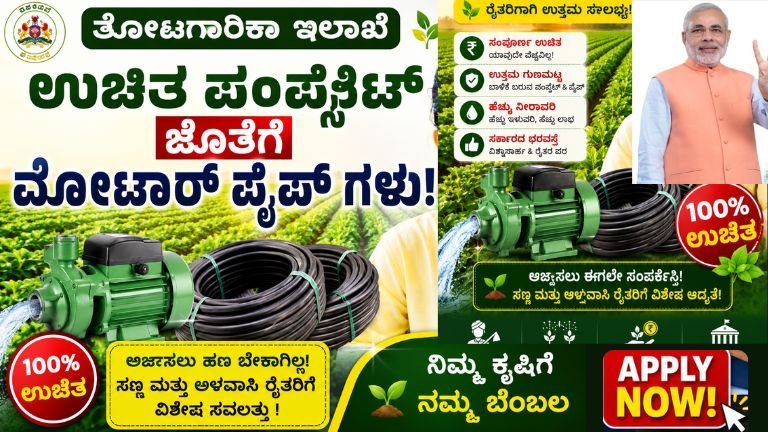
Maximizing Your Farm’s Yield: The Ultimate Guide to the Department of Horticulture’s Free Pumpset, Motor, and Pipe Schemes for Farmers subsidy
Water is the lifeblood of agriculture. For small and marginal farmers, setting up a reliable irrigation system is often the most expensive hurdle to cross. Recognizing this challenge, the Department of Horticulture, along with integrated state initiatives, has introduced heavily subsidized and free irrigation equipment programs. These schemes are designed to distribute free or heavily subsidized water pump sets, electric or solar motors, and delivery pipes to eligible farmers (Raitaru).
If you are a farmer looking to secure a water source for your plantation, fruit trees, or vegetable crops without breaking the bank, this 2,000-word comprehensive guide covers everything you need to know. We will break down how these schemes operate, the exact eligibility criteria, required documentation, and a step-by-step application blueprint to help you secure these benefits.
Understanding the Core Vision of the Scheme
The main objective of the Department of Horticulture’s equipment subsidy programs is to shift farming communities from unstable rain-fed agriculture toward controlled, precision-led micro-irrigation. High-value crops like fruits, vegetables, flowers, and plantation crops require precise watering cycles. Relying entirely on manual hauling or erratic power grids drastically lowers crop quality and market rates.
By providing free or highly subsidized (up to 50% to 90%) pump sets, high-efficiency motors, and durable PVC delivery pipes, the government aims to achieve several goals:
-
Water Conservation: Encouraging farmers to draw water from localized farm ponds, open wells, or borewells and pipe it directly to their crops.
-
Cost Reduction: Cutting down the massive capital expenditure ($₹30,000$ to $₹1,500,000$) required to purchase heavy-duty motors and hundreds of meters of pipe.
-
Sustainable Power Usage: Rapidly transitioning farmers toward solar-powered pump setups, minimizing dependence on fossil fuels or standard grid lines.
-
Doubling Farmer Income: Ensuring that dry periods do not wipe out expensive commercial horticulture crops.
Component Breakdown: What Do Farmers Actually Receive?
When a farmer qualifies for the Department of Horticulture’s irrigation assistance programs, the support isn’t limited to a standalone piece of equipment. The package is designed to build a functioning water network.
                  ┌────────────────────────────────────────┐
                  │      Horticulture Irrigation Kit       │
                  └───────────────────┬────────────────────┘
                                      │
         ┌────────────────────────────┼────────────────────────────┐
         ▼                            ▼                            ▼
┌─────────────────┐          ┌─────────────────┐          ┌─────────────────┐
│ Water Pump Set  │          │   Motor Drive   │          │ Delivery Pipes  │
│ • Diesel/Elec.  │          │ • 3 HP / 5 HP   │          │ • High-Grade PVC│
│ • Submersible   │          │ • Solar Powered │          │ • Flexible Coils│
└─────────────────┘          └─────────────────┘          └─────────────────┘
A. Submersible or Monoblock Water Pump Sets
Depending on your primary water source, the scheme provides specific pump variants:
-
Submersible Pumps: Designed for deep borewells, engineered to lift water efficiently from lower tables.
-
Open Well / Monoblock Pumps: Ideal for farmers drawing water from farm ponds (Krishi Bhagya ponds), open communal wells, or local streams.
B. Electric or Solar-Powered Motors
Power availability varies greatly across rural belts. The scheme addresses this through two primary power profiles:
-
Grid-Connected Electric Motors: Typically ranging from 3 HP to 10 HP, structured to integrate seamlessly with regular rural electricity lines.
-
Solar-Powered Motors: High-yield setups (typically 3 HP or 5 HP systems) that operate entirely off-grid. These systems run smoothly during peak daylight hours without relying on standard power lines.
C. High-Grade PVC and Flexible Delivery Pipes
A common bottleneck for farmers is buying the pipelines needed to carry water from its source to the fields. The scheme bundles a generous supply of:
-
HDPE / PVC Rigid Pipes: Built to withstand field heat and high water pressure without cracking.
-
Flexible Distribution Coils: Allowing easy redirection across rows of vegetables, orchards, or shade nets.
Scheme Allocation and Subsidy Structures
The percentage of government support varies based on specific social and economic categories to ensure fair distribution.
1. Scheduled Castes (SC) and Scheduled Tribes (ST)
-
Subsidy Scale: 100% Free of Cost (Completely funded by the state across targeted sub-plans).
-
Target Scope: Complete coverage for eligible small and marginal farmers, spanning the entire cost of the pump set, motor configuration, and a basic pipe network layout.
2. General and OBC Category Small/Marginal Farmers
-
Subsidy Scale: 50% to 90% Subsidy depending on the specific district pool.
-
Financial Framework: For modern implementations (like advanced Solar Irrigation Pumpsets), the department often provides fixed financial grants. For example, a $₹100,000$ direct grant for 3 HP solar configurations or up to $₹300,000$ for heavy-duty 5 HP solar implementations, requiring only a minimal co-pay from the farmer.
Strict Eligibility Metrics: Who Qualifies?
To ensure these valuable public resources reach genuine, hardworking farmers, the Department of Horticulture enforces strict eligibility criteria:
-
Landholding Thresholds: The applicant must be a practicing farmer owning a minimum of 1 acre of cultivable land. Preference is explicitly given to small and marginal landholders holding less than 5 acres total.
-
Horticulture Focus: The land must be actively used for, or clearing preparation for, recognized horticultural crops (e.g., vegetables, fruits, flowers, medicinal plants, or plantation crops like coconut or arecanut).
-
Water Source Availability: The farmer must possess a valid, functional water source on their property—such as a borewell, an open well, or a structured farm pond built under state rain-harvesting programs.
-
No Duplicate Benefits: The applicant must submit a declaration confirming they have not received similar pump or motor subsidies from alternative state branches (like the main Agriculture Department or the PM-KUSUM solar scheme) within the last 3 to 5 years.
Mandatory Documents Checklist
Before heading to your local office or logging into the online application portal, make sure you have clean, verified copies of these document arrays:
-
Land Ownership Records: Updated RTC (Pahani / Form 16) showing ownership and crop classification.
-
Identification Cards: Aadhaar Card linked to an active mobile number.
-
Social Category Certificate: Valid Caste Certificate issued by competent revenue authorities (crucial for SC/ST farmers to claim 100% free benefits).
-
Bank Account Proof: Clear copy of your bank passbook showing your IFSC code and account number (necessary for direct benefit transfer subsidies).
-
Farmer Registration ID: Your unique state-issued farmer identification profile (such as the FRUITS ID in Karnataka).
-
Borewell/Well Certificate: Certification or a written declaration confirming the existence of a viable water source on your property.
Step-by-Step Application Blueprint
Securing your equipment requires following a structured application process. Missing a step can delay your approval.
Maximizing the Impact of Your New Irrigation System
Receiving your free or subsidized pump and pipe kit is just the beginning. To get the most out of your new setup, combine it with efficient water management practices:
Combine with Drip Irrigation: Avoid using flood irrigation, which can waste water and cause soil erosion. Connect your new pump and pipe network directly to a drip irrigation system. This delivers water right to the roots of your plants, reducing evaporation and boosting crop yields by up to 40%.
Regular Maintenance Tips for Longevity:
-
Protect the Motor: Always install your electric or solar motor inside a secure, weather-proof pump shed to protect it from heavy rain and extreme heat.
-
Prevent Dry Running: Never run your pump when water levels are dangerously low. Running a pump dry can rapidly burn out the internal motor windings.
-
Maintain Pipe Networks: Flush your PVC pipelines periodically to clear out silt, mud, or algae blockages that can drop your water pressure.
Summary Checklist for Farmers
| Step | Action Item | Status |
| 1 | Secure your unique state Farmer ID and update your land records (Pahani). | [ ] |
| 2 | Gather your Caste Certificate (for SC/ST) to claim 100% free distribution. | [ ] |
| 3 | File your application at the local Taluk Horticulture Office or online portal. | [ ] |
| 4 | Await the official site inspection and secure your written Work Order. | [ ] |
Don’t wait until the peak of the dry season to fix your irrigation setup. Head to your local taluk Assistant Director of Horticulture office today, submit your documents, and secure a reliable water supply for your farm.