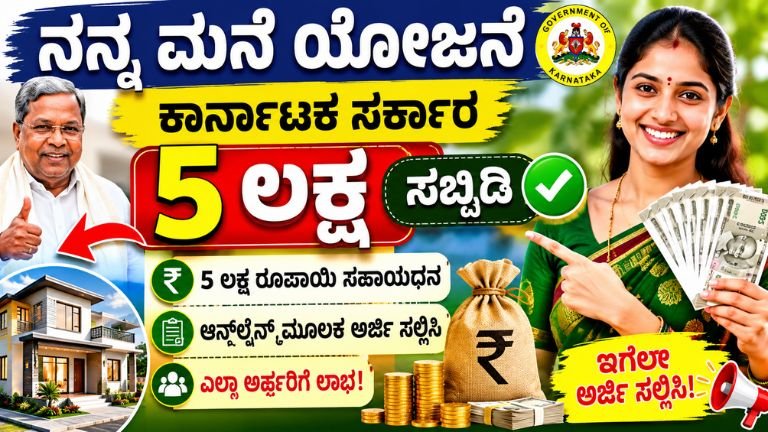
Nanna Mane Scheme Karnataka: Ultimate Guide to Eligibility, Benefits, and Application
Owning a home is a fundamental milestone, providing families with long-term stability and security. For low- and middle-income households, however, spiking land prices and rising material costs often put construction out of reach.
To bridge this gap, the Government of Karnataka operates targeted housing programs via the Rajiv Gandhi Housing Corporation Limited (RGRHCL). A central component of this push is the “Nanna Mane” (My Home) initiative, which works in tandem with state programs like the Basava Vasati Yojana and Dr. B.R. Ambedkar Niwas Yojana.
If you are looking to build a house on your own plot or move from a rented property into a permanent home, understanding how these subsidies operate is essential.
1. Demystifying the Subsidy Structure: Is it ₹5 Lakh?
There is common public perception that the state offers a flat ₹5 Lakh direct cash subsidy for individual home builders. The actual financial framework operates on a tiered structure.
The maximum direct, interest-free government subsidy for individual site builders typically ranges between ₹2 Lakh and ₹3 Lakh, depending on the specific demographic category (such as SC/ST, minority, or general BPL categories) and whether the location is rural or urban.
How the “₹5 Lakh” Value is Achieved
When people refer to a “₹5 Lakh benefit,” they are generally looking at a blended financial package rather than a single cash handout:
-
Direct Government Subsidy: A non-repayable cash contribution of ₹2,00,000 to ₹3,00,000 released in stages based on physical construction milestones.
-
Highly Subsidized Bank Loans: Institutional tie-ups engineered by RGRHCL allow beneficiaries to secure low-interest loans for the remaining balance (often up to ₹2,00,000 to ₹3,00,000) at preferential interest rates.
-
Material Assistance: In specific rural programs, the government provides bulk-purchased raw materials (like cement or steel) at highly discounted rates, raising the total financial value of the state’s support to approximately ₹5 Lakh.
2. Core Housing Programs Under RGRHCL
The Nanna Mane framework acts as an umbrella philosophy executed through distinct, structured state welfare schemes. Knowing which scheme fits your profile ensures a smooth application process.
Basava Vasati Yojana
Primarily targeting the rural poor, this scheme provides financial aid to homeless individuals who already own a plot of land or a temporary (kutcha) structure.
-
Target Audience: Economically Weaker Sections (EWS) and Below Poverty Line (BPL) households.
-
Core Benefit: Up to 85% of raw construction material value or direct financial disbursements mapped to construction stages.
Dr. B.R. Ambedkar Niwas Yojana
Designed to support historically marginalized communities in both urban and rural zones.
-
Target Audience: Scheduled Castes (SC) and Scheduled Tribes (ST).
-
Core Benefit: Offers the highest subsidy limits within the state framework (up to ₹3 Lakh in urban zones) to offset construction costs for families building on their own sites.
Vajpayee Urban Housing Scheme
Focuses entirely on municipal corporations, urban local bodies, and cities across Karnataka.
-
Target Audience: Urban poor living in rented homes or informal settlements.
-
Core Benefit: Financial assistance to construct a durable (pucca) house on a pre-owned urban site.
3. Comprehensive Eligibility Benchmarks
To ensure funds reach the families who need them most, the state enforces strict eligibility checks. Applications that fail to meet these core baselines are filtered out automatically.
+---------------------+---------------------------------------------------------+
| Criterion           | Requirement Details                                     |
+---------------------+---------------------------------------------------------+
| Residency           | Must be a permanent resident of Karnataka.              |
+---------------------+---------------------------------------------------------+
| Property Ownership  | The applicant must NOT own any other permanent (pucca)  |
|                     | house anywhere in India.                                |
+---------------------+---------------------------------------------------------+
| Land Asset          | Must own a vacant site or a temporary kutcha structure  |
|                     | with valid title deeds clear of legal disputes.         |
+---------------------+---------------------------------------------------------+
| Income Cap (Rural)  | Annual household income must not exceed ₹32,000         |
|                     | (historically used for basic rural BPL listings).       |
+---------------------+---------------------------------------------------------+
| Income Cap (Urban)  | Varies by category; generally capped at ₹3,00,000       |
|                     | per annum for urban EWS housing tiers.                  |
+---------------------+---------------------------------------------------------+
Important Condition: The land site must be fully clear of legal encumbrances, and the title deeds must be registered under the applicant’s name or an immediate family member’s name (preferring the matriarch of the household).
4. Documentation Checklist
Gathering documentation early prevents processing delays. Applications require clear scanned copies of government-issued proofs.
-
Identity & Citizenship: Aadhaar Card and Voter ID Card.
-
Economic Status: Valid BPL (Below Poverty Line) Card or EWS Certificate issued by the Revenue Department.
-
Income Verification: Official Income Certificate issued by the competent authority (e.g., Tahsildar).
-
Social Category: Caste Certificate (essential for SC/ST quotas under the Ambedkar Niwas Yojana).
-
Land Ownership Proof: Title deeds, Patta/Podi documents, recent Tax Paid Receipts, and a clear Encumbrance Certificate (EC).
-
Financial Details: Bank Passbook with a clearly visible Account Number and IFSC code (must be linked to Aadhaar for Direct Benefit Transfer).
5. Step-by-Step Online Application Process
The application flow is routed digitally via the Ashraya portal to maintain transparency and track construction progress.
6. How the Fund Release and Geo-Tagging System Works
The state does not release the entire subsidy amount as an upfront lump sum. To prevent misuse of funds and ensure construction matches building codes, disbursements are tied to verified physical progress.
The Verification Process
Local geo-technical officials use a dedicated mobile application to track progress:
-
Foundation Stage: The first financial installment is triggered once the local nodal officer visits your plot, confirms ownership, and uploads a geo-tagged photograph of the cleared ground and dug trenches.
-
Plinth Level: The second installment releases when the brickwork foundation reaches the plinth level.
-
Lintel & Roof Level: The third installment drops when walls are raised to the lintel level and roof shuttering begins.
-
Completion: The final retention amount transfers once plastering, door installation, and basic plumbing are complete, verified by a final geo-tagged photo of the completed home.
All payments move via Direct Benefit Transfer (DBT) directly into the bank account linked to the beneficiary’s Aadhaar card.
7. Troubleshooting and Verification Procedures
How to Check Application Status Online
If you have already applied and want to check your status, you do not need to visit local government offices:
-
Go to the Ashraya Portal.
-
Click on the “Beneficiary Information” link on the main menu.
-
Select your District and enter your unique Application Reference Number.
-
The system will display the current status of your approval, showing whether it is pending at the Gram Panchayat level, awaiting geo-tag verification, or if a fund release is scheduled.
Common Reasons for Application Rejection
-
Mismatched Aadhaar Data: Minor spelling variations between your land documents, income certificate, and Aadhaar card can halt processing.
-
Prior Ownership Identification: If cross-referencing reveals property tax payments under your name for another permanent structure, the application is automatically flagged.
-
Income Exceeding the Threshold: Submitting income certificates that display values above the designated regional caps will lead to immediate disqualification.
apply Link
Can I apply if I live in a rented house but do not own a plot of land?
Pure landless applicants cannot use the individual construction subsidy scheme directly. However, you can apply for the Chief Minister’s Multi-Storey Housing Scheme, where the government provides both the land site and flat allotment in a multi-story complex at a highly subsidized rate.
How long does it take for the subsidy amount to clear?
The verification and approval cycle typically spans 3 to 6 months. Once approved, individual installment clearances rely on how quickly you complete construction stages and trigger the official geo-tagging inspections.
Is it possible to modify an existing house using this scheme?
No. These specific programs are designed for building a new home from the ground up on a vacant plot, or replacing an existing, unsafe temporary (kutcha) structure. They do not cover standard home renovations, expansions, or painting.