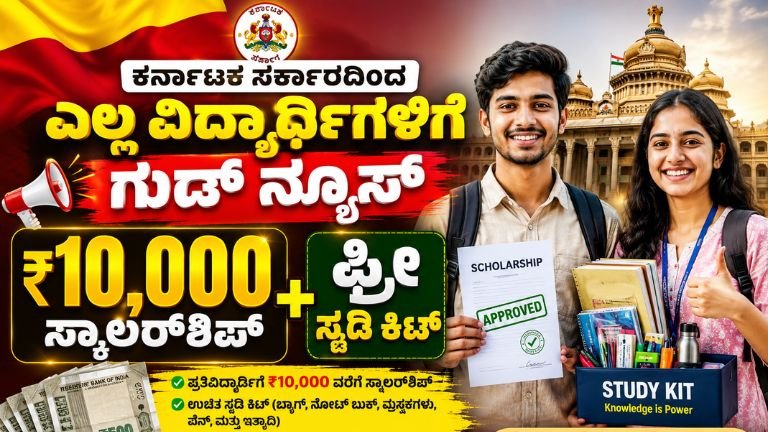
Navigating the Truth: Karnataka State Government’s ₹10,000 Financial Aid and Learning Kit Initiatives DK SHIVKUMAR
Social media platforms, local message groups, and viral videos are frequently filled with striking announcements declaring massive, universal handouts for the student community. A highly circulated claim states that the Government of Karnataka is directly distributing a flat ₹10,000 cash scholarship along with a free “study kit” to all students across the state.
For students navigating the rising costs of higher education, such updates bring immense hope. However, when processing public welfare news, it is necessary to separate casual social media summaries from actual state policy.
The Government of Karnataka operates some of the most robust, deeply funded, and structured student welfare departments in India. Yet, there is no single, blanket universal scheme that hands over a flat ₹10,000 and a physical study kit to every student automatically. Instead, what actually exists is a highly organized, target-specific network of distinct financial allowances, welfare board educational programs, and merit incentives. These are distributed through specialized portals based on strict eligibility criteria, academic tracking, family income thresholds, and community categories.
This guide breaks down the actual mechanics of Karnataka’s major state student support programs. It details how the “₹10,000 allowance” operates under official policies, the reality behind free learning kits, and a complete step-by-step roadmap for authentic verification and secure applications.
Part 1: The Anatomy of Karnataka’s Student Aid Schemes
The viral phrase “₹10,000 scholarship along with a study kit” actually stitches together two entirely different administrative programs handled by completely separate ministries within the state administration:
-
The Post-Matric Fee Concession and Educational Allowance System: Administered digitally through the State Scholarship Portal (SSP), which awards tiered financial amounts (frequently matching or exceeding ₹10,000) for student maintenance and educational costs.
-
The Institutional or Labor Board Supply System: Free distribution of physical books, basic learning components, specialized professional tools, or computing devices to specific student brackets.
By understanding how these components operate independently, you can easily evaluate where you fit within the state’s formal criteria and maximize your actual financial aid.
Part 2: Demystifying the “₹10,000 Scholarship” — Where Does the Number Come From?
When the state government or regional news outlets reference an educational grant or stipend hitting the ₹10,000 threshold, they are almost always referring to specific sub-schemes within the centralized state structures.
The primary avenues where a Karnataka student receives a lump-sum financial credit of approximately ₹10,000 include:
1. The SSP Post-Matric Educational Allowance & Maintenance Fees
The State Scholarship Portal (SSP) serves as the unified engine for distributing higher education aid. Instead of applying to ten different offices, students submit their details to the SSP, which routes the data to departments like Social Welfare, Tribal Welfare, Backward Classes Welfare, and Minority Welfare.
For students enrolled in post-metric courses—such as Pre-University Courses (PUC), Industrial Training Institutes (ITI), polytechnic diplomas, graduation degrees (BA, BSc, BCom, BBA), and professional paths (BE, BTech, MBBS)—the state provides more than just a direct tuition waiver. It also calculates a Maintenance Allowance / Educational Expense Support.
-
The Allocation Range: Depending on whether a student is a day scholar or a hosteller, and based on their specific grouping (Group A, B, C, or D courses), this yearly maintenance allowance ranges from ₹2,500 to ₹13,500.
-
The ₹10,000 Sweet Spot: Technical, vocational, and professional undergraduate degree students under Category-1, 2A, 3A, 3B, SC, and ST classifications frequently see their direct maintenance allowances or institutional course fee components hit the exact ₹10,000 per annum mark.
2. The Directorate of Minorities (DOM) Merit Incentives
For students belonging to recognized minority communities (Muslim, Christian, Sikh, Jain, Buddhist, and Parsi), the state operates an explicitly defined, fixed financial incentive program based entirely on academic performance:
-
SSLC (Class 10) Toppers: Students who clear their board examinations with 85% marks or above receive a one-time direct cash incentive of ₹10,000.
-
2nd PUC (Class 12) Toppers: Students achieving the same high distinction at the pre-university level receive a one-time cash incentive of ₹20,000.
3. Private-Public Hybrids: The Vidyadhan & Corporate State-Linked Grants
Often confused with direct government programs, highly integrated regional public-private programs like the Vidyadhan Scholarship work closely with state education boards. For students who pass their SSLC from the Karnataka Board with a score of 90% or higher (or 9 CGPA) and whose family income falls below ₹2 Lakhs, these programs award a clear, structured ₹10,000 annual scholarship for the duration of their 11th and 12th standard (PUC) studies.
Part 3: The Reality of the Free “Study Kit”
When rumors point to a free “study kit” paired with a cash payout, they are generally taking a highly localized or department-specific physical distribution program and generalizing it to the public. The state government administers physical aid through distinct, targeted pathways:
1. The School Education & Literacy Department Initiatives
At the school level (Class 1 to Class 10), the state does not distribute cash packets. Instead, it provides concrete physical support directly through government and government-aided schools:
-
The Standard School Kit: Free textbooks, notebooks, school bags, stitched uniforms, shoes, and socks are issued to students at the beginning of each academic term.
-
This is a universal supply system for state-run schools, but it does not come with a separate ₹10,000 cash handout.
2. The Karnataka Labor Board (Karmika Card) Educational Toolkits
The most expansive, high-value “Study Kit” program in Karnataka is managed by the Karnataka Building and Other Construction Workers Welfare Board (KBOCWWB).
If a student’s parent or legal guardian is a registered construction worker holding a valid, active Labor Card (Karmika Card), the student is eligible for an exceptional combination of high-value tools and direct monetary scholarship benefits:
-
The Professional Tool/Study Kit: Students pursuing technical paths like ITI, polytechnic diplomas, or engineering degrees receive specialized technical kits, drawing boards, reference materials, or fully equipped bags tailored to their trade.
-
The Digital Learning Expansion: In recent academic cycles, this board has actively distributed free laptops or learning tablets to the children of registered laborers pursuing higher professional education, ensuring they are equipped for digital coursework.
-
The Cash Component Parallel: Concurrently, the children of Labor Card holders receive direct academic financial assistance ranging from ₹5,000 up to ₹30,000 depending on the course. This is the likely source of the viral rumor joining a “₹10,000-tier scholarship” with a physical “study kit.”
Part 4: Comprehensive Eligibility Mapping
To ensure you can determine exactly what you are entitled to, review this rigorous breakdown of eligibility criteria across the primary state programs that deliver these benefits:
| Department / Scheme | Core Targeted Beneficiaries | Family Annual Income Ceiling | Academic Prerequisites |
| Social Welfare Department (SC Schemes) | Students belonging to Scheduled Castes. | Up to ₹2.5 Lakhs for full fee/allowance structure; up to ₹10 Lakhs for partial fee waivers in technical lines. | Enrollment in a recognized post-matric institution with minimum baseline passing marks. |
| Tribal Welfare Department (ST Schemes) | Students belonging to Scheduled Tribes. | Up to ₹2.5 Lakhs (Extended allowances for specific engineering/medical categories). | Valid admission via regular or counseling streams; state domicile. |
| Backward Classes Welfare (BCWD) | Category-1, 2A, 3A, 3B, and specific OBC groups. |
₹2.5 Lakhs for Category-1;
₹1.0 Lakh for 2A, 3A, and 3B classifications. |
Minimum 50% or higher in the previous year’s qualifying board or semester exam. |
| Directorate of Minorities (DOM) | Muslim, Christian, Jain, Buddhist, Sikh, Parsi students. | Up to ₹2.0 Lakhs for general post-matric; up to ₹2.5 Lakhs for Merit-cum-Means. | Minimum 50% marks in the preceding exam for regular renewals; 85%+ for one-time toppers’ cash. |
| Karmika Welfare Board (Labor Card) | Children of registered building/construction laborers. | No standard income cap, but requires a verified, active Labor Registration ID. | Maintained enrollment in state-recognized institutions (Regular courses). |
Part 5: Step-by-Step Guide to Securely Apply for Your Benefits
If you meet the eligibility criteria for the state’s post-matric scholarships or specific labor board programs, do not use unofficial web links found on social media. Instead, use the official state workflows to secure your funds via Direct Benefit Transfer (DBT).
Phase 1: Essential Document Gathering
Before initiating an online application, compile these verified documents. The state data system is heavily automated; any mismatch in text, names, or registry numbers will result in automatic rejection during the e-attestation phase.
-
Aadhaar Card Verification: Ensure that your name spelling on your Aadhaar card perfectly matches your SSLC marks card.
-
The Kutumba ID: Karnataka uses the Kutumba family ID system. If your family does not have a Kutumba ID, you must generate one via the state’s family portal, as it links your household data automatically.
-
Current Year Income and Caste Certificates: Must feature a valid, verifiable RD Number issued by the Revenue Department (Nadakacheri). Ensure the certificate has not expired.
-
Academic Marksheets: Your SSLC Registration Number, PUC registration credentials, or previous semester marks cards.
-
College Bonafide Certificate & Official Fee Receipts: Must explicitly state your course, current year/semester, and itemized fee breakdown.
-
Hostel Certificate (If Applicable): If you are staying in an officially registered state hostel or a recognized private facility, secure your hostel registration number to claim your higher maintenance allowance.
-
Aadhaar-Seeded Bank Passbook: Your bank account must be actively linked to your Aadhaar number for NPCI mapping.
Phase 2: Navigating the State Scholarship Portal (SSP)
Follow this precise workflow to complete your application on the official state portal:
[Step 1: Account Creation via Kutumba]
       │
       ▼
[Step 2: Profile Setup & Department Selection]
       │
       ▼
[Step 3: Document Upload & RD Integration]
       │
       ▼
[Step 4: Submission to College E-Attestation Officer]
       │
       ▼
[Step 5: Final Verification & DBT Processing]
Detailed Procedural Walkthrough:
Step 1: Account Creation & Authentication
-
Open your browser and navigate exclusively to the official SSP Post-Matric URL:
ssp.postmatric.karnataka.gov.in. -
Click on “Create New Account”.
-
The portal will request your Kutumba ID. Enter it to display your family structure. Select your name from the household listing.
-
Provide your Aadhaar details and complete the mobile OTP authentication.
Step 2: System Login and Profile Enrichment
-
Log in using your newly generated User ID and Password.
-
Navigate to the student dashboard and fill in your basic personal information, parent/guardian occupation details, and permanent address.
Step 3: Integrating Academic and Certificate Data
-
Enter your SSLC / Tenth Standard Registration Number. The system will communicate with the secondary education board database to pull your basic details automatically.
-
Input your Income and Caste Certificate RD Numbers. Click “Fetch Data”. The SSP portal will directly communicate with the Nadakacheri servers to pull your family income and category details. You do not need to manually upload scanned copies if the RD integration succeeds.
-
Enter your college admission details, including your university registration number or college admission code.
Step 4: Activating Extra Allowance Fields (Hostel/Disability)
-
If you are a hosteller eligible for the higher maintenance bracket (which pushes the scholarship towards the ₹10,000 threshold), click the Hostel Details tab. Input your hostel code or warden-verified certificate tracking ID.
-
If applicable, provide your verified disability certificate details to unlock specific additional state allowances.
Step 5: E-Attestation Protocol and Finalization
-
After reviewing your complete application profile, hit Submit.
-
Print out the generated acknowledgment form.
-
Take this form along with your physical fee receipts and bonafide certificate to your college’s designated E-Attestation Officer (a staff member appointed by your college to verify student data on the government portal).
-
Once the college officer clicks “Verify” on their portal, your application moves directly to the state department level for final payment approval.
Phase 3: Applying for the Labor Card Study Kit and Educational Benefits
If your eligibility is tied specifically to the Karnataka Labor Welfare programs, you must take a parallel path through the labor portals:
-
Visit the Karnataka Seva Sindhu Portal or the official KBOCWWB Portal.
-
Select “Application for Educational Assistance / Toolkit Distribution for Children of Construction Workers”.
-
Log in using your credentials and enter your parent’s unique Labor Registration Number (Karmika Card Number).
-
Input the student’s academic details, current course enrollment, and institution code.
-
Upload a digital copy of the parent’s active labor identity booklet alongside the student’s current bonafide admission letter.
-
Submit the application. The system will route the file to the local District Labor Officer. Once verified, the student is notified to collect their physical study toolkit/device from the regional labor office, and the financial allocation is processed via DBT.
Part 6: How to Securely Track Your Application and Payment Status
Once your application is submitted, you can track its progress directly through the portal to ensure there are no processing stalls.
1. Verification Checklist for the Student Dashboard
Log in regularly to ssp.postmatric.karnataka.gov.in and access the “Track Student Status” tab. Select the relevant academic year to review your clearance pipeline:
-
College Verification Status: Indicates whether your college E-Attestation officer has verified your admission and fee records.
-
Department Verification Status: Shows whether the Social Welfare, BCWD, or Minority Directorate has reviewed your caste, income, and eligibility criteria.
-
Push to DBT Status: Displays when the file has cleared checking and is sent to the financial network for payment.
2. Validating Your Bank Account Linkage (Aadhaar Seeding)
Because the state government processes all scholarship funds exclusively via Direct Benefit Transfer (DBT), if your bank account is not correctly linked to your Aadhaar card via the National Payments Corporation of India (NPCI) mapper, your payment will fail, even if your application is fully approved.
-
Visit the official UIDAI website or use the Karnataka DBT Mobile App (available on the Google Play Store).
-
Log in using your Aadhaar and OTP to access the “Check Aadhaar/Bank Seeding Status” tool.
-
Ensure the system displays an “Active” status next to a valid bank account. If it shows unlinked or inactive, visit your bank branch immediately and submit an “Aadhaar Seeding and Mandate Form” to clear your payment path.
Part 7: Guarding Against Online Fraud and Misinformation
Because student welfare schemes generate massive online traffic, malicious actors frequently create fake portals, clone official websites, or distribute deceptive links to harvest personal data. Protect your personal information by following these guidelines:
-
Analyze the Website Address (URL): Official Karnataka government websites will always end with the suffix
.gov.inor.nic.in(such askarnataka.gov.in). Never enter your personal information or Aadhaar numbers on websites ending in.com,.org,.xyz, or.net. -
Zero Processing Fees: The Government of Karnataka never charges processing fees, application charges, or registration costs for any student scholarship or learning kit program. If a portal or agent demands a payment of ₹100, ₹500, or any other amount to “fast-track” your ₹10,000 scholarship, it is a scam.
-
Protect Your OTPs and Credentials: State officers will never call, text, or WhatsApp you requesting your account passwords, Aadhaar OTPs, or bank verification pins. Keep your login credentials private.
apply Link
Clarifying the Facts: A Final Summary
To keep your application process clear and straightforward, keep these central facts in mind:
-
No General Blanket Payout: The state does not operate a single, generic program handing ₹10,000 cash and a study kit to every student universally.
-
Targeted Scholarships: The ₹10,000 figure corresponds to specific, structured annual allowances for technical, professional, or high-merit students processed through the official SSP or Minority Welfare frameworks based on caste, income, and grades.
-
Targeted Study Kits: Free school supplies are provided directly through state-run schools, while specialized toolkits, tablets, or laptops are reserved for the children of registered construction workers via the Labor Welfare Board.
-
Official Paths Only: All legitimate financial transfers are processed securely via Direct Benefit Transfer (DBT) into Aadhaar-linked accounts following institutional verification.
By using the official government portals (ssp.postmatric.karnataka.gov.in), double-checking your family’s Kutumba status, and ensuring your income certificates are fully updated, you can confidently apply for and secure the genuine state benefits you are entitled to for your academic journey.